How to Read a Commercial Solar Proposal (Without an
Learn how to read a commercial solar proposal: system size, production estimates, degradation and pricing line items, plus red flags to catch before you sign.
Dan Katzman
Teamsun
A commercial solar proposal comes down to four numbers you can check yourself: system size in kW DC, first-year production in kWh, the degradation rate, and the price per watt DC. Divide production by size and price by size, then compare every bid on those same terms. For Connecticut, Massachusetts and Rhode Island property owners, that is how you read a solar proposal without an engineering degree.
Key takeaways
- Size is not output: kW is the panel rating at test conditions. Annual kWh is what pays your bills, and it depends on shade, tilt and losses.
- Specific yield is the fairness test: divide yearly kWh by kW DC. Bids on the same roof should land close together, and a gap of several percent needs an explanation in writing.
- Degradation compounds: a 0.5% versus 0.8% yearly assumption changes lifetime output by roughly 3% on a 25-year model.
- Price per watt DC beats total price: national commercial pricing averaged about $1.77 per watt DC in Q2 2026, so use it as a reference point, not a target.
- Walk-away rule: no equipment model numbers, no stated modeling assumptions, or pressure to sign within days means you should not sign that proposal.
Solar proposal at a glance
| Proposal line | What it means | What to check | Red flag |
|---|---|---|---|
| System size (kW DC and AC) | Panel rating and inverter rating | Panel count times panel watts equals kW DC | Only one kW number, with no DC or AC label |
| Annual production (kWh) | Modeled first-year output | kWh divided by kW DC; sun data source; shading study | No assumptions listed |
| Degradation rate | Yearly drop in output | Rate used in the model versus the panel warranty | Zero degradation or an unstated rate |
| Price per watt DC | Total cost divided by kW DC times 1,000 | Compare to the roughly $1.77 national Q2 2026 commercial average | Large gap with no line-item reason |
| Incentives and tax treatment | Federal credit, depreciation, state programs | Which credit path is assumed, and who claims it | Incentives baked into the price with no detail |
| Financing terms | Cash, loan, PPA or lease | PPA rate, escalator, term, buyout | Savings shown only for year one |
| Installer credentials | License and who does the work | State license lookup; in-house crew or subcontractors | Cannot name the crew or license number |
1. What does system size (kW) tell you about output?
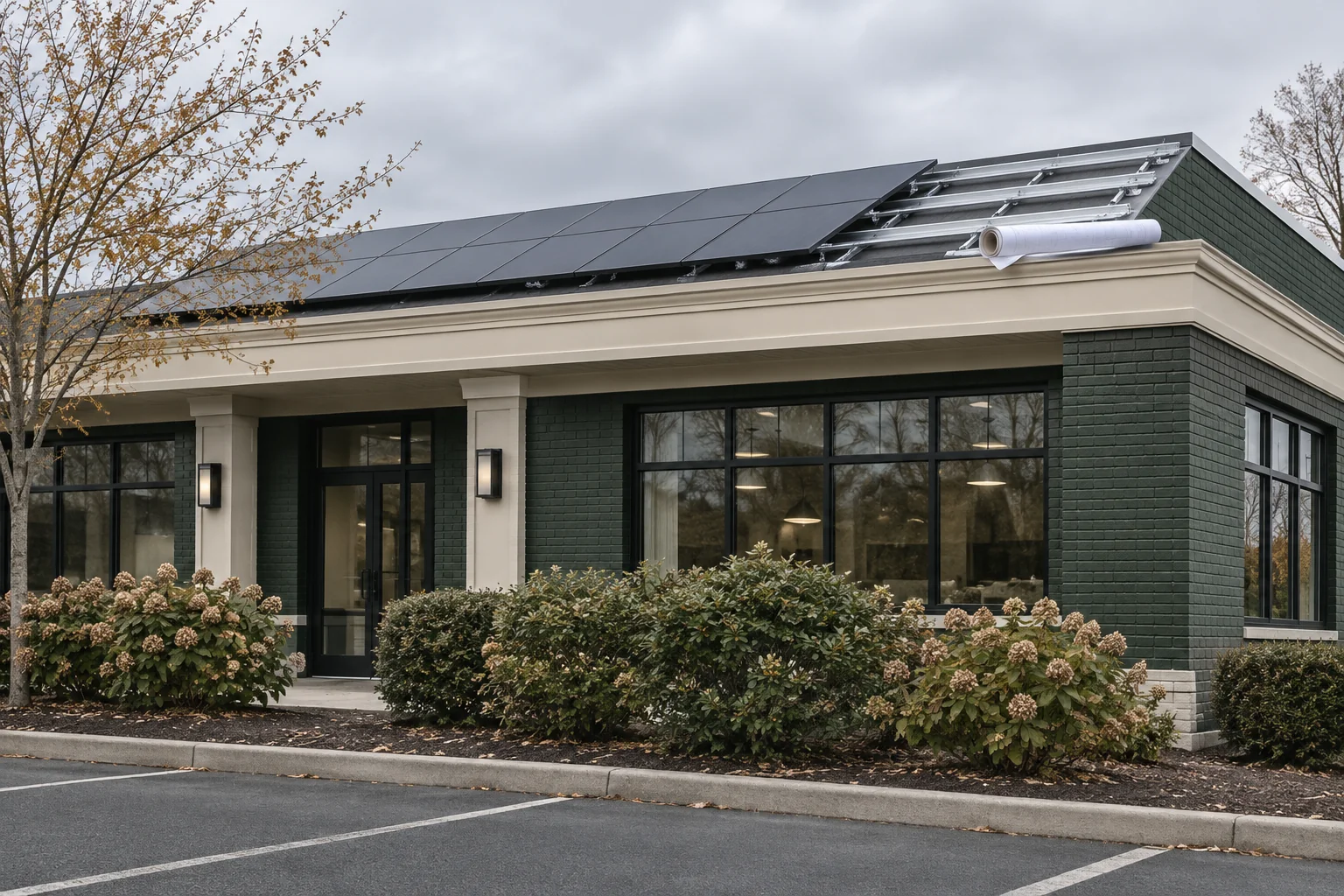
System size in kW tells you the peak power the panels can produce under standard test conditions, not the energy you will use. Multiply panel count by panel wattage to get kW DC. Output in kWh depends on sun, shading, tilt and losses, so size alone says little about savings.
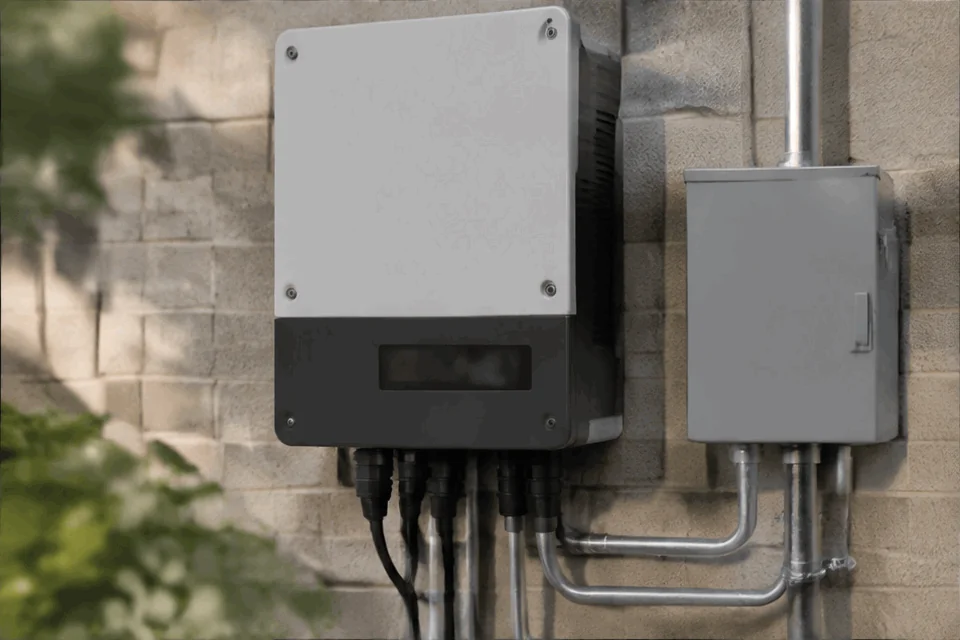
Most proposals list two size numbers. kW DC is the total panel rating. kW AC is what the inverters can send to your building and the grid. The DC number is usually larger, because panels rarely hit their peak rating and inverters are sized with that in mind.
A quick check: a bid for 200 panels rated at 500 watts each should say 100 kW DC. If the math does not work, ask why. On a roof, we also check that the layout drawing shows the same panel count as the equipment list. Mismatches happen when a design changes after a site visit and the paperwork does not.
Why roof space caps the number
On small and mid-size commercial buildings, the roof usually sets the size before your electric bill does. Setbacks from edges, rooftop units, skylights, drains and parapet shadows all take area. Ask for a roof layout drawing with every obstruction marked. If it is missing, the size is a guess.
If you are still working out what size fits your building, our guide on how many solar panels a small business needs walks through the load side of that question.
2. How do you read the production estimate?
A production estimate is the proposal's forecast of annual kWh, built from a computer model of sunlight, shading, roof tilt and system losses. Divide it by system kW DC to get specific yield. Compare that figure across bids. A gap of several percent usually traces to different modeling assumptions, not better equipment.
Specific yield is just kWh per kW DC per year. It strips out size so you can compare a 90 kW bid with a 110 kW bid on the same roof. Because the estimate is doing more work in your financial case than the price, a 4% difference in first-year yield moves the payback more than a 4% difference in capital cost. It compounds across twenty-five years.
What drives the number up or down
- Sun data source: the proposal should name the irradiance dataset it used. "Industry standard" is not a name.
- Shading analysis: trees, neighboring buildings and rooftop equipment. Ask whether it was measured on site or pulled from satellite images.
- Tilt and direction: a flat-roof array tilted low packs more panels but yields slightly less per panel than a steeper tilt.
- System losses: wiring, inverter conversion, dirt, snow and downtime. A bid that assumes almost no loss is the one most likely to disappoint.
- Degradation: covered in the next section, but it also shifts the year-one-to-year-twenty-five path.
A worked example (hypothetical numbers)
Suppose two bids for the same flat roof in Connecticut. These figures are illustrative, not real quotes.
| Item | Bid A | Bid B |
|---|---|---|
| System size | 100 kW DC | 100 kW DC |
| Total price | $185,000 ($1.85 per watt) | $170,000 ($1.70 per watt) |
| Year-one production | 118,000 kWh | 108,000 kWh |
| Specific yield | 1,180 kWh per kW | 1,080 kWh per kW |
| Price per first-year kWh | about $1.57 | about $1.57 |
Bid B looks $15,000 cheaper. Per kWh of first-year output, the two are nearly identical. The real question becomes why Bid B models 8.5% less energy from the same roof. Maybe it counted a shading problem that Bid A ignored. Maybe it assumed heavier losses. Ask both installers for the modeling report and settle it before you pick on price.
The reverse also happens. A bid with a high yield and no shading study is a promise you cannot check. Teamsun's rule on a roof: if the number looks better than the neighbor's bid, the model should show why.
3. Which degradation assumptions should you check?
Degradation is the slow drop in panel output each year. The Jordan and Kurtz analytical review of field data found a median of about 0.5% per year and a mean of 0.8%. Your proposal should state its assumed rate, and that rate should not be more optimistic than the panel warranty allows.
The mean is higher than the median because a tail of poor performers pulls it up. In that review, 78% of reported rates were below 1% a year. For a 25-year cash flow, the rate you choose matters more than most owners expect.
What compounding does over 25 years
Take the 118,000 kWh system from Bid A, and run it two ways. Both assume year one at full output and a steady annual drop after that. These are modeling examples, not predictions for your roof.
| Assumed rate | Output in year 25 | Lifetime output (25 years) |
|---|---|---|
| 0.5% per year | about 88.7% of year one | about 2.78 million kWh |
| 0.8% per year | about 82.5% of year one | about 2.68 million kWh |
The gap is about 96,000 kWh, or roughly 3.4% of lifetime energy. That does not sound dramatic, but it equals nearly a full year of production. A proposal that assumes zero degradation overstates every year after the first.
What to ask about degradation
- Which rate does the model use? Pass: a stated number, tied to the panel's performance warranty. Fail: no number, or a rate of zero.
- Does the warranty guarantee a floor? Pass: the datasheet gives a minimum output at year 25 or 30. Fail: only a product warranty, with no performance guarantee.
- Does year one include an initial drop? Some panels lose output in the first months. A careful model includes it.
Once a system is running, you can check real output against the model. Our guide to reading your solar monitoring app data shows what to look for.
4. What should the pricing line items include?
A commercial solar proposal should break the price into equipment, racking, electrical work, labor, permitting, interconnection and any roof or structural work, then show a total in dollars per watt DC. National commercial pricing averaged about $1.77 per watt DC in Q2 2026, so use that as a reference point only.
That national figure rose about 5.6% year over year even as module prices fell, because electrical and other hardware costs climbed. Your Connecticut, Massachusetts or Rhode Island project may land above or below it. Roof condition, electrical service upgrades and utility requirements move the number. What matters is whether the proposal explains where its price comes from.
The lines to look for
- Panels: manufacturer, model number and wattage. "Tier-1 panels" with no model is not a specification.
- Inverters: model, count, and whether microinverters, string inverters or power optimizers are used.
- Racking and mounting: ballasted or attached, and whether a structural review is included.
- Electrical: conduit, disconnects, meter and any switchgear or service upgrade.
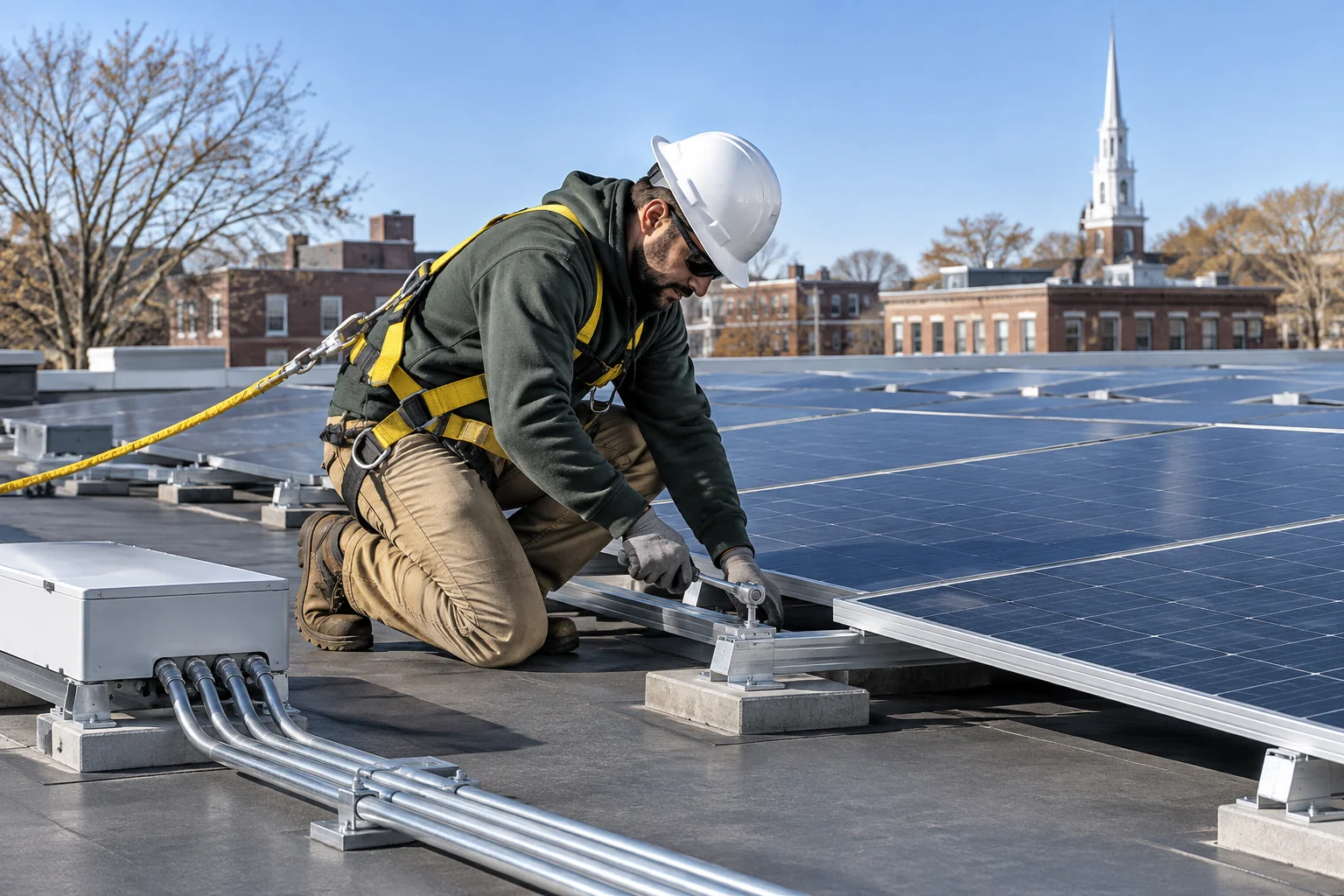
- Labor: who installs. Our crews are in-house W-2 employees, and the proposal should tell you whether your installer's are.
- Permits and interconnection: who files, who pays, and what happens if the utility requires a study.
- Monitoring and warranty: what you can see, and how long workmanship coverage lasts.
How to compute price per watt yourself
Take the total price before incentives and divide by kW DC times 1,000. A $185,000 bid for 100 kW DC is $1.85 per watt. Do the same math on every bid, and use DC every time. If one bid quotes per AC watt, the number is not comparable until you convert it.
Incentives and tax treatment
Federal commercial solar credits now run mainly through Section 48E, and which version applies depends on when construction began or begins. The proposal should say which path it assumes and who claims the credit. Do not rely on a savings number until your accountant confirms it.
Depreciation is a separate benefit for taxable owners. See our explainer on commercial solar depreciation under MACRS for how it stacks with the credit.
Roof work hiding in the fine print
If your roof is near the end of its life, a solar proposal should say so. Panels outlast many roofing membranes, and removing and reinstalling an array later costs real money. Look for a roof condition note, and ask whether any roofing work is in the price or excluded.
5. Which red flags mean you should walk away?
Walk away when a proposal hides equipment models, gives production with no stated assumptions, skips a shading analysis, assumes steep utility rate increases without saying so, or pressures you to sign within days. Any one of these blocks a fair comparison. Two or more means the installer is selling, not engineering.
Here is the checklist we would run on any bid, ours included. Each line shows what a good answer looks like and what means stop.
| Check | Good answer | Walk away if |
|---|---|---|
| Equipment | Panel and inverter model numbers listed | Only brand names or "Tier-1" language |
| Production model | Sun data source, shading study, loss assumptions stated | One kWh number with nothing behind it |
| Degradation | Rate stated and matches the warranty | Zero, or never mentioned |
| Utility rate growth | Escalation rate stated, with a flat-rate case shown | Savings only work with a high, unstated rate increase |
| Price | Line items and a price per watt DC | One lump sum |
| Roof | Condition noted, structural review included or priced | Roof never mentioned on an older building |
| Contractor | License number you can look up; crew type stated | Cannot give a license number |
| Timing | Time to review and compare | Price expires in days |
On licensing, Connecticut's online License Lookup is maintained by the State and is considered a primary source of verification. Search with only one or two pieces of information, such as the company name or license number. Do this before you sign, not after.
What to do when a check fails
Do not discard the bid right away. Send the installer a written question about the failed line and give them a few days. A good installer will send a modeling report, a revised layout or an itemized price. If the answer is vague or the pressure rises, you have your answer.
6. How do financing terms change the proposal?
Financing changes which numbers matter. With cash or a loan, you own the system and claim the incentives. With a PPA or lease, a third party owns it. For PPAs, check the starting rate per kWh, the annual escalator, the contract term and the buyout terms.
Government guidance for businesses says to take time to review and compare proposals, which may include options to buy or lease panels, a power purchase agreement, and financing. NYSERDA's contractor guidance for New York businesses makes that point, and it applies equally to a CT, MA or RI owner.
Questions that expose weak financing terms
- Is the PPA rate fixed or escalating? A starting price below your utility rate can cross above it in later years.
- What is the buyout price, and when can you use it? Pass: a schedule in the contract. Fail: "we will quote it later."
- What happens if you sell the building? The agreement should say whether it transfers to the buyer.
- Who maintains the system and fixes the roof if it leaks? Get the answer in writing.
A consumer guide from New York's utility regulator lists the terms an agreement should include: installation location, schedule, price, contract term, end date, late fees and renewal provisions. It is written for residential customers, but the same checklist is smart for a business lease or PPA.
For the full picture on each option, read our breakdown of commercial solar financing for 25kW to 500kW systems.
7. How do you compare bids side by side?
Convert every bid to the same four numbers: cost per watt DC, first-year kWh per kW, assumed degradation, and year-one bill savings. Put them in one table, then check equipment models, warranties and who does the install. The cheapest bid wins only if the other rows match.

The US EPA suggests that when you evaluate proposals, it helps to summarize key variables side by side and to allow time between steps for review by authorities. That is good advice for any solar proposal, and the table below is a simple way to do it.
| Row | Bid 1 | Bid 2 | Bid 3 |
|---|---|---|---|
| kW DC / kW AC | |||
| Price per watt DC | |||
| kWh per kW (specific yield) | |||
| Degradation rate used | |||
| Panel and inverter models | |||
| Warranty (product, performance, workmanship) | |||
| Installer: in-house or subcontracted | |||
| Timeline to power-on | |||
| Financing terms |
A simple decision rule
If two bids match on equipment and yield, pick the lower price per watt. If their yields differ by more than a few percent, make each installer defend the model before you look at price. If a bid is lowest but lacks model numbers, treat it as incomplete, not cheap.
One thing is not settled for any bid: the future. Utility rates, tariffs and federal incentive deadlines can all move after you sign, so ask each installer what happens to the price if equipment costs change before ordering.
Where our view as an installer differs
A proposal is a design on paper. We think the most useful question is what each line looks like on your roof. A shading number is a tree you can walk to. A conduit run is a path across your roof membrane. A line labeled "electrical" is a service panel we need to open before we price it.
Our commercial work covers 25kW to 500kW rooftops and ground mounts, with full permitting and utility interconnection support. We use our own W-2 crews, not subcontractors, so the person who walks your roof is the person who answers for the install. Our average install timeline is 47 days, though a larger commercial project depends on permitting and utility review.
If you want to see how a roof fits the picture, our solar services overview explains what we design and install across Connecticut, Massachusetts and Rhode Island.
FAQ: reading a commercial solar proposal
What is a good specific yield for a commercial solar proposal?
There is no single good number, because yield depends on location, tilt and shade. A better test is consistency. Bids for the same roof should have specific yields within a few percent of each other. If one is far higher, ask for the modeling report and the shading study behind it.
Should a solar proposal include degradation?
Yes. A proposal that assumes no degradation overstates every year after the first. It should state the annual rate used, and that rate should be consistent with the panel's performance warranty. A field-data median of about 0.5% per year is a common reference point.
How do I know if a solar installer is licensed in Connecticut?
Ask for the company's license number, then check it in the State of Connecticut's online License Lookup. Search with one or two pieces of information. If the installer cannot provide a number, or the lookup shows nothing, do not sign until you get a clear explanation in writing.
How long should I have to review a solar proposal?
Long enough to compare at least two other bids and check the numbers with your accountant. A fair installer will give you days or weeks, not hours. A price that expires in a few days, with no reason given, is a pressure tactic and a red flag.
Can I use these steps to compare residential bids too?
Yes. System size, specific yield, degradation, price per watt and installer credentials work the same on a home. The differences are in tax treatment and financing, which vary between homes and businesses. A commercial owner also needs to check depreciation and roof condition more closely.
Get a second set of eyes on your solar proposal
If you already hold a bid and want it checked line by line, send it to us. We will tell you what the numbers mean on your roof, whatever the installer. To start fresh, request a free quote for your building, or talk to a designer about your roof and load. You can also call 203-903-4091 to walk through a proposal by phone.
Recommended Resources
Written by
Dan Katzman
Teamsun
Teamsun writes practical solar guidance to help property owners compare equipment, project scope, costs, and long-term service before making a decision.
Keep going.
Can I Add Solar Panels Without Replacing My Whole Roof?
Can I add solar panels without replacing my whole roof? Learn what inspectors check â shingle age, decking, flashing â to avoid costly mistakes.
Dan Katzman
Teamsun
Commercial Solar ROI Payback Period
Commercial solar ROI payback depends on system size, utility rates and incentives. Learn how to estimate break-even in CT, MA and RI before you sign.
Dan Katzman
Teamsun
How to Choose a Solar Panel Brand: 3 Checks That Matter
Choose a solar panel brand by checking efficiency, warranty terms and manufacturer track record. A plain how-to for CT, MA and RI homeowners.
Dan Katzman
Teamsun