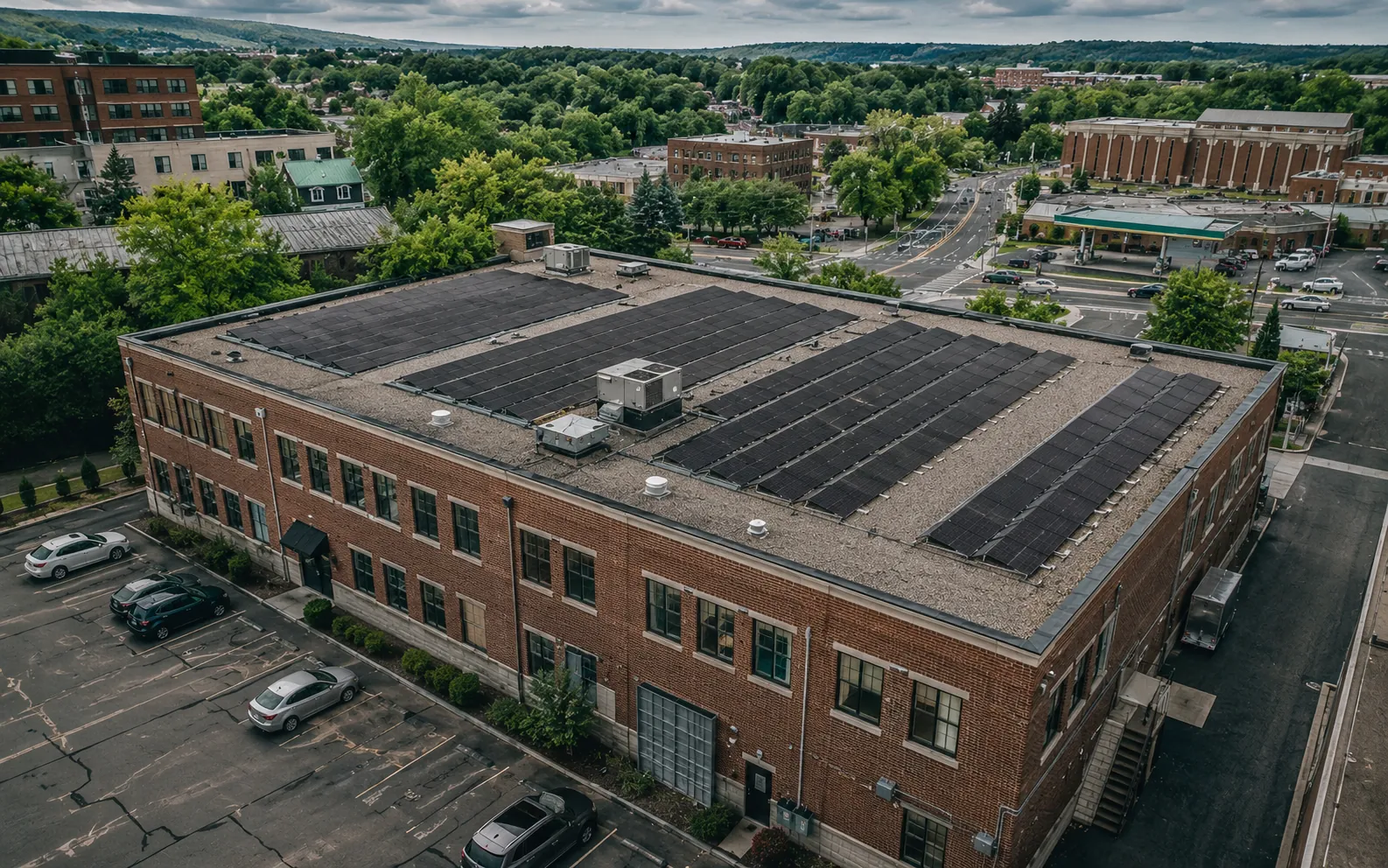
Commercial solar installation creates an electricity-generating asset for a business or property. A successful project depends on more than available roof space: electricity consumption, utility tariffs, ownership rights, building condition, interconnection, financing, and operating responsibilities all influence its value.
Teamsun offers commercial solar projects in Connecticut, Massachusetts, and Rhode Island. Begin with a feasibility discussion that identifies the decision-makers, property constraints, and business objective before selecting a system size.
Establish who controls the project
Identify the building owner, electricity-account holder, facility manager, and party authorized to sign a long-term agreement. In a leased building, the tenant that pays the electricity bill may not control the roof. A project can make physical sense while its benefits and obligations are divided among parties that have not agreed on terms.
Create a written responsibility map. Who provides roof records? Who approves construction access? Who receives electricity benefits? Who handles a future roof repair or tenant departure? Addressing these questions early prevents a favorable energy estimate from becoming an impractical proposal.
Study electricity use, not just the annual total
Twelve months of bills establish a baseline. Interval data, where available, shows when the building uses power. Two facilities with similar annual consumption can have different daytime loads and demand-charge exposure.
A warehouse with steady daytime activity should not be modeled using the same operating assumptions as a building with irregular evening peaks. Separate energy savings from demand-charge savings, and ask which tariff components the forecast actually reduces.
Define the technical scope
A feasibility review should cover roof or site condition, structural suitability, electrical infrastructure, proposed equipment, utility constraints, and the installation’s effect on building operations. If the roof may need replacement, compare coordinating that work now with removing and reinstalling equipment later.
The project team also needs a procurement scope that makes competing bids comparable. MassCEC’s commercial guidance emphasizes defined project requirements and evaluation criteria before selecting a provider. MassCEC procurement guidance
Request the expected annual energy, key modeling assumptions, preliminary design, exclusions, and responsibilities for permitting and interconnection. An early layout is not a substitute for final engineering or utility approval.
Compare financing on consistent assumptions
Ownership, loans, leases, and commercial PPAs assign capital costs and operating responsibilities differently. Compare the same production model, utility forecast, contract period, and maintenance assumptions across options.
A business tax benefit is not interchangeable with a homeowner credit, and an advertised maximum is not a project-specific entitlement. Have the appropriate tax adviser review the entity, ownership, timing, and applicable requirements before counting a benefit in the investment decision.
Include roof work, engineering, electrical upgrades, operating costs, and contractual escalation where relevant. State whether the result is simple payback, annual cash flow, or a discounted investment measure; these answer different financial questions.
Plan for the operating years
Commissioning and handover should leave the owner with equipment records, approved drawings, utility documentation, monitoring access, and a clear service route. Establish who reviews production, responds to alerts, and authorizes corrective work.
A facility manager needs a usable operating plan, not just an installation photograph. Ask how system performance will be compared with expectations and which records will support a future repair or ownership change.
How commercial solar affects a building’s electricity use
A commercial photovoltaic system generates electricity from available sunlight and uses inverter equipment to supply compatible AC power. The building can use some of that generation while it is produced, with imports or exports handled under the approved connection and tariff. The balance depends on the operating schedule as well as the array’s output.
Consider two hypothetical buildings with the same annual electricity use. One has steady daytime operations throughout the week; the other has concentrated evening use and long periods of low daytime demand. Their annual totals are similar, but their direct use of solar and export exposure can differ. That difference should appear in the feasibility model before the project is sized.
A business also needs to distinguish energy from demand. Energy measures accumulated consumption in kWh, while tariff-defined demand is a power measure in kW. A solar system can reduce energy purchases without reducing the billing demand by the same proportion. The Department of Energy’s rate guidance explains why those bill components need separate analysis.
Set decision criteria before requesting bids
Write a short project brief that ranks the business’s objectives. It may prioritize operating-cost reduction, a specified investment return, building improvements, resilience, or environmental reporting. Different priorities can justify different designs or ownership arrangements. A proposal cannot be judged fairly if the decision-makers disagree about the result they want.
Define the investment horizon and any planned change in property use. A building scheduled for major renovation, lease expiration, or sale needs a different risk discussion from a long-term owner-occupied facility. Identify internal constraints such as capital availability, procurement rules, construction windows, and requirements for legal or engineering review.
Turn those priorities into comparison criteria. For example, request consistent treatment of roof work, utility upgrades, maintenance, financing, and performance assumptions. A bidder should not win by excluding a necessary cost that another bidder included. A defined scope also helps a provider identify a genuine constraint rather than trying to fit the project to an arbitrary capacity target.
Roof, ground-mounted, and site-layout considerations
A commercial roof review should consider condition, remaining service plans, structural suitability, drainage, access, rooftop equipment, and the proposed mounting approach. A large uninterrupted area in an aerial image may still contain restrictions that reduce usable space. The solar layout should respect the building’s operation and maintenance needs rather than consume every visually available surface.
A ground-mounted option introduces a different set of site questions. Land use, grading, drainage, access, vegetation, electrical routing, and applicable local approvals can influence feasibility. The apparent simplicity of unused land does not establish that it is suitable or less expensive than a roof installation.
Ask the designer to explain why the recommended location serves the business’s objectives. The comparison should include the complete site work and the effects on future property use. A preliminary concept is useful for screening options, but final engineering and approvals are needed before it becomes a construction commitment.
Interconnection can shape the project
The utility reviews the proposed connection, equipment, capacity, and operating arrangement under its applicable process. A project may require studies, agreement conditions, metering changes, or utility work. These requirements can affect schedule and cost independently of the solar contractor’s installation speed.
Ask the proposal to separate known interconnection requirements from allowances or unresolved risks. If a utility review is pending, identify which design assumptions depend on its result. A financial model that ignores a possible connection constraint can overstate the value of an otherwise attractive layout.
Keep compensation approval separate from electrical approval. A system may need both permission for grid operation and qualification under a particular incentive or export arrangement. Establish who submits each application, who signs, what documents are required, and how status is communicated to the owner. One approval should not be represented as evidence that every other process is complete.
Evaluate commercial storage as a defined use case
Storage can be considered for selected backup loads, demand management, time-based operation, or eligible program participation. Each objective needs a supported operating strategy. A battery chosen only from annual energy consumption may be poorly matched to short, high-demand events or a critical process with particular starting requirements.
For demand management, analyze interval data and the tariff’s billing rules. Identify the duration and timing of the peaks the battery would need to address. If the battery discharges for one purpose and is unavailable for a later peak, the financial model should reflect that constraint. The same stored energy cannot be assumed to serve incompatible tasks at the same time.
For resilience, define which business functions must continue and what interruption they can tolerate. A general solar-plus-battery description is not a continuity plan for critical operations. The proposed design, controls, commissioning, and operating procedures need review appropriate to the consequences of failure.
Compare ownership, leases, and PPAs
Owning a system puts the investment and associated responsibilities with the purchasing entity under the relevant agreements. Financing changes cash timing and introduces borrowing terms. Third-party ownership can reduce the host’s initial equipment investment while creating long-term contractual obligations for use or electricity purchases.
A commercial PPA should be evaluated using its actual price schedule, production assumptions, term, maintenance provisions, site rights, transfer conditions, and end-of-term options. The building owner, electricity purchaser, and system owner may be different parties. Each needs clarity about roof work, access, insurance, and changes in occupancy.
Tax and accounting treatment require entity-specific advice. Do not move a homeowner incentive assumption into a commercial spreadsheet or treat an advertised maximum as an entitlement. Ask the financial analysis to show the project before uncertain benefits, then identify each benefit’s basis, recipient, timing, and conditions separately.
Build a financial model a decision-maker can inspect
The model should connect the proposed design to generation, on-site use, exports, avoided tariff charges, operating costs, financing, and applicable program revenue. Its time horizon should match the investment question. Simple payback is useful for one narrow question, while discounted cash flow and other measures address different aspects of a long-term project.
Include a conservative case. Test lower production, different electricity-price growth, service costs, and unresolved utility or roof expenses. The purpose is not to make the project appear unattractive; it is to identify which assumptions materially affect the decision and which risks the contract can address.
Distinguish a forecast from a contractual guarantee. If a proposal includes a performance commitment, read how performance is measured, which exclusions apply, and what remedy is available. A promised remedy has value only when its scope and responsible party are clear. Do not infer a guarantee from a modeled annual energy figure.
Plan construction around business operations
Identify the people who control site access, safety coordination, deliveries, work areas, and electrical shutdown approval. A facility may have tenant requirements, restricted hours, sensitive equipment, or seasonal operating peaks. Those constraints should be disclosed before scheduling rather than treated as surprises during installation.
The construction plan should explain how roofing, electrical, and utility work interact. Ask which activities could interrupt operations and what notice will be given. A fixed installation window may remain dependent on permits, equipment, weather, or utility readiness, so distinguish contractual commitments from preliminary targets.
Keep changes documented. If site conditions require revised equipment, routing, or layout, the owner should see the effect on price, production, approvals, and schedule. A substitution that looks minor on a parts list can affect support, design, or financial assumptions and deserves a clear review process.
Handover and performance management
A commercial handover should leave the facility team with final drawings, equipment information, warranties, operating documentation, monitoring access, and required approvals. Identify who can authorize repairs and who receives alerts. The project should not depend on a single employee’s personal login or an undocumented relationship with the installation crew.
Define the performance review method. Compare actual operation with a reasonable weather- and availability-aware expectation, and distinguish a reporting gap from lost generation. A month below a typical-year estimate is not automatically a contract breach, while repeated unexplained downtime should not be ignored because the annual total still looks acceptable.
Frequently asked questions
What if the building has several meters or tenants?
The project must identify the account or accounts affected and the applicable billing arrangement. Do not assume electricity generated on one roof can automatically offset every tenant’s bill. Property rights, utility rules, metering, and contracts need to support the proposed allocation.
Can the project be expanded later?
Future expansion depends on site space, equipment compatibility, electrical capacity, utility review, and program treatment. Ask which limits would remain after the first phase. A staged plan should describe the conditions for later work rather than rely on an unspecified future approval.
Can a commercial battery be included?
Potentially. Its value depends on loads, tariff structure, backup objectives, and the proposed controls. Evaluate storage as a defined use case rather than an automatic addition.
Does a large roof justify a large array?
Not by itself. Usable roof area, consumption, export compensation, electrical constraints, and financing can limit the practical project.
What should a consultation include?
Bring bills, available interval data, building ownership or lease information, roof history, and the business’s investment criteria.
Request a commercial solar feasibility discussion with Teamsun to identify the information needed for a decision-ready proposal.