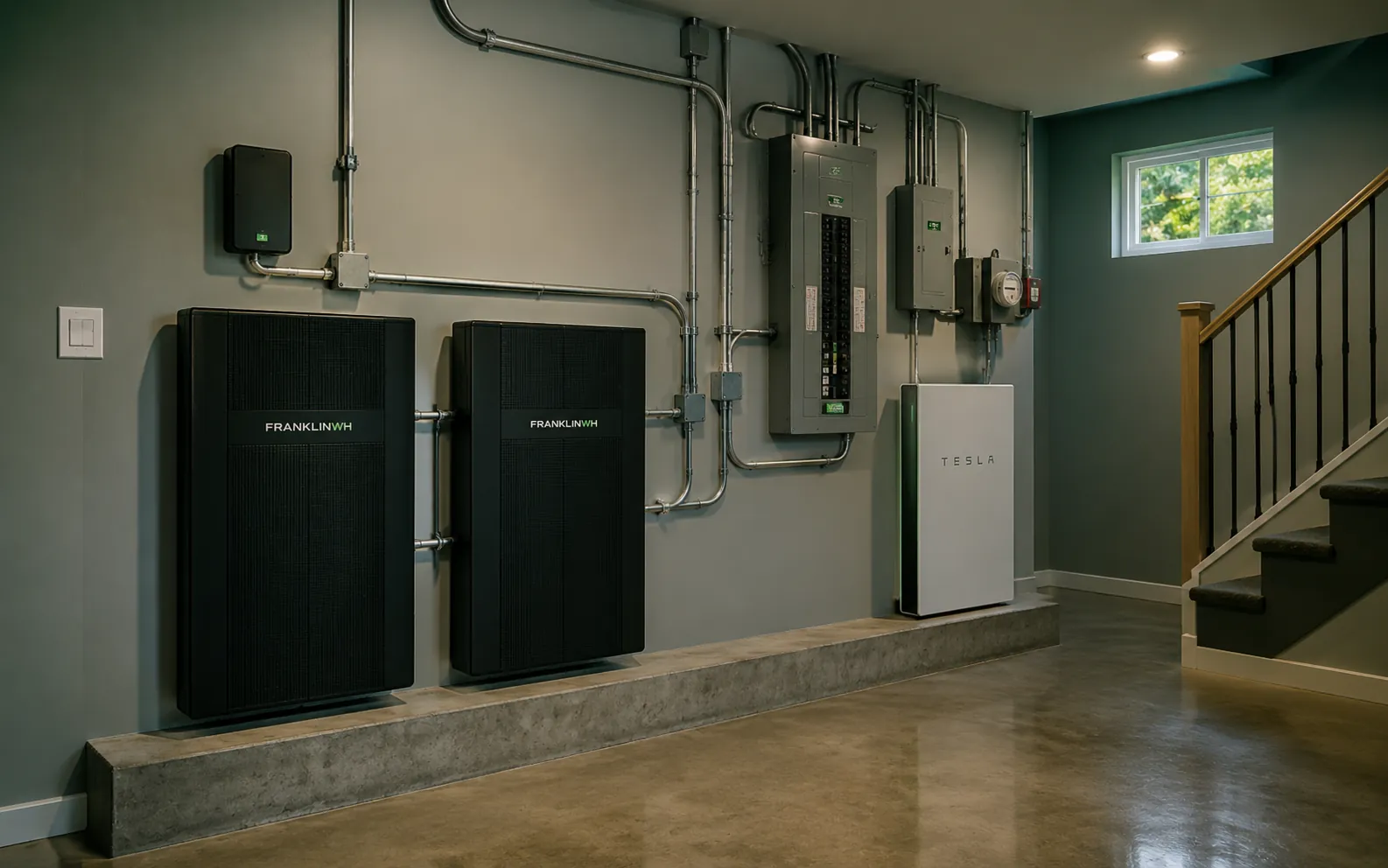
Home battery storage holds electrical energy for later use. A battery system can support selected household loads during an outage, shift when electricity is used, or participate in an eligible utility program. Its actual capabilities depend on the battery, inverter, controls, electrical design, and operating permissions.
Teamsun offers battery-storage assessments for homes in Connecticut, Massachusetts, and Rhode Island. Start with the loads and operating goals, then compare equipment capable of meeting them.
Capacity and power answer different questions
Battery energy capacity, commonly expressed in kilowatt-hours, describes an energy quantity. Power, expressed in kilowatts, describes how quickly energy can be delivered. DOE distinguishes these two measures when explaining storage systems. DOE solar and storage basics
A proposal therefore needs more than a large capacity number. Ask what power is available continuously, how motor starting is handled, and which circuits can operate simultaneously. Also ask whether the quoted capacity is nameplate, usable, or already adjusted for a particular operating reserve.
For a deliberately simplified example, 8 kWh available at the household load boundary could support a constant 1 kW load for eight hours. A constant 2 kW load would use that energy in four hours. Real operation involves changing loads and system limits; this arithmetic is a planning example, not a runtime promise.
Whole-home connection is not unlimited backup
A system connected to a broad portion of the house may still require certain loads to be turned off or managed. Cooking, heating, pumps, and EV charging can create demands that exceed the available output or use stored energy quickly.
Create a priority list rather than a wish list. Separate essential loads from conveniences and identify which equipment must start during an outage. Ask what happens if demand exceeds the design limit and whether the system sheds loads automatically or relies on the homeowner.
Plan for the next morning
Outage planning should include more than the first few hours. Ask how the system responds when storage runs low, whether solar can recharge it while disconnected from the utility, and what enables restart. A sunny day does not by itself prove that an installation can restart after a shutdown.
Also discuss a full battery during strong solar production. The equipment needs a supported way to manage available generation. These operating conditions belong in the system design, not in assumptions based on a battery’s advertised capacity.
Compare costs and commitments separately
Request the complete installation scope: equipment, electrical work, controls, permitting, utility review, commissioning, and monitoring. If a proposal includes an incentive, identify the program, application requirements, payment recipient, and operating obligations.
Backup value and bill savings are different objectives. A household may reasonably want resilience even where the tariff provides limited financial benefit from shifting electricity. Ask for separate explanations of each benefit so a savings estimate does not disguise the cost of backup.
How a home battery charges and discharges
A home battery stores energy through an electrochemical process and later supplies electrical energy through its supported conversion equipment. Charging and discharging involve losses, so the energy delivered later is less than the energy required to store it. This does not make storage ineffective; it means the benefit must justify the equipment cost and the losses involved in moving energy through time.
The controller determines when the battery should charge or discharge within the permitted settings. It may consider solar generation, household consumption, a backup reserve, a supported utility schedule, or a grid-program signal. The available modes depend on the equipment and approvals. A battery’s physical capacity alone does not identify which of these strategies a particular installation can use.
A household example helps separate the decisions. A household may want to store afternoon solar for the evening while preserving part of the battery for outages. If the day produces little surplus, the battery may not reach the desired charge from solar alone. Whether it can charge from the grid, and whether that is economically useful, requires the actual operating permissions and tariff.
The components around the battery matter
The battery enclosure is only one part of a functioning system. Conversion equipment manages the electrical relationship between the battery and the home. Controls coordinate operation, measurements inform those controls, and protection addresses the installation’s electrical requirements. A backup configuration also needs a supported way to separate the backed-up circuits from the utility during an outage.
Some products integrate several functions into one unit, while other designs use separate components. Neither packaging approach removes the need to understand the complete configuration. Ask the proposal to name the equipment that supplies each required function and explain what is included in the installed price.
The battery-management system supervises conditions within the battery according to the manufacturer’s design. That is different from a homeowner’s energy-management app, which may display operating information or allow selected settings. A convenient app does not replace the protective and control functions of the equipment, and it should not be used as a reason to modify settings outside the supported owner controls.
Compare everyday operation with outage operation
When the utility is available, the home can exchange electricity with the grid under its tariff and approved configuration. During an outage, a backup installation must operate within a separate set of limits. The available battery energy, output, connected loads, solar behavior, and restart conditions become especially important.
Consider a home that normally operates several high-demand appliances because the utility supplies any shortfall. In an outage, the same appliance combination may exceed the backup system’s capability. Connecting those circuits to backup does not establish that all of them can operate simultaneously. The design may rely on automated load management, specific circuit selection, or household operating choices.
Ask for an explanation of what changes automatically when the utility fails and what the household must do. The answer should identify the actual supported loads, any transition limitations, and the service route if the system does not behave as expected. Do not infer a guaranteed interruption-free supply for sensitive equipment from a generic home-backup description.
Reading a battery specification sheet
A useful comparison identifies the measurement behind each number. Energy capacity may be stated as nominal or usable. Output may include different continuous and short-duration capabilities. An efficiency figure may cover the battery alone or a wider conversion path. Warranty conditions may address time, energy throughput, retained capacity, operating conditions, or a combination.
Those distinctions matter when comparing products. A larger energy rating does not prove stronger starting capability. A favorable efficiency figure measured at one boundary cannot be compared directly with a figure measured at another. A warranty’s capacity-retention threshold is not a promise that every battery will follow that exact degradation path.
Ask the installer to summarize the specifications relevant to your use case in one consistent table. Include the actual configured system, not just the maximum rating somewhere in the manufacturer’s portfolio. If additional modules are proposed, establish whether they increase stored energy, output power, or both in that particular arrangement.
Build a realistic backup-load plan
Write down the household functions that matter most during an outage, then identify the appliances behind them. Refrigeration, lighting, communication, water supply, and heating controls can be priorities, but each home is different. Medical or other critical needs warrant a plan proportionate to the consequences of interruption and should not depend on a generic online runtime estimate.
Separate continuous use from occasional use. A refrigerator cycles; a pump may start briefly but require significant starting capability; an oven may draw heavily for a limited period. Estimating every device as though it runs constantly can overstate energy needs, while ignoring simultaneous starts can understate power needs. A qualified assessment should address both errors.
The load plan is also a behavior plan. If the design assumes EV charging waits until the utility returns, everyone who uses the charger should understand that condition. Clear household instructions can be more useful than a large capacity number that nobody knows how to manage during an extended interruption.
Evaluate storage economics in the right order
Begin with the gross installed cost and the desired capability. Then examine the applicable tariff and any confirmed program opportunity. Storage can move electricity from one time to another, but the financial value of that shift depends on the costs and credits at those times, the energy lost through cycling, and the cost of the equipment itself.
For a hypothetical comparison, assume a household could otherwise export a quantity of solar energy for a credit. Storing that energy gives up the export credit and may later avoid some purchased electricity. The relevant benefit is the difference after the storage losses and other applicable costs, not the entire retail value of the later discharge. Actual tariffs may calculate those transactions differently, so this is a reasoning framework rather than a local savings formula.
Program payments add another layer. A performance forecast should identify the payment recipient, required participation, measurement basis, and assumed contribution. If future payments have been assigned in exchange for an upfront discount, they should not also appear as future homeowner income in the same model.
Installation location and ownership considerations
A suitable battery location depends on the equipment instructions, applicable requirements, access, environmental conditions, and the property’s electrical arrangement. A garage wall that looks convenient is not automatically approved for every product. Ask the designer to explain location constraints and any protective or site work included in the scope.
Keep service access in mind. Equipment should remain accessible under the installation’s requirements, and the homeowner should understand any restrictions on storage or later changes around it. Do not treat the installation area as an ordinary shelf space simply because the enclosure appears finished and weather resistant.
If a home already has leased solar or a PPA, establish the equipment owner’s role before integration. If the battery itself is third-party owned or participates through an aggregator, identify who can change settings, who receives payments, and who arranges service. These arrangements should be clear before the owner relies on a particular operating strategy.
Maintenance, alerts, and long-term records
Homeowners should know what normal operation looks like in the approved monitoring interface and which alerts require contact. A change in reserve, an outage event, or a program dispatch can alter the displayed charge without indicating a fault. Conversely, repeatedly dismissing warnings can delay needed service. Use the exact product’s owner guidance and the installer’s handover instructions.
Keep a record of the equipment, approved configuration, warranty documents, commissioning, and any service changes. When a component is replaced, update those records. A later capacity expansion or home sale is easier to assess when the actual configuration is documented rather than reconstructed from an old quote.
Ask how future support will be handled if the installer or a communications provider changes. The answer should distinguish equipment warranty remedies from monitoring services and installation workmanship. No article can establish that all future support will be free, so the written terms matter.
Frequently asked questions
Is a battery the same as a generator?
Both can contribute to an outage plan, but they have different energy sources, operating constraints, maintenance needs, and integration requirements. Compare the household functions and duration you need before choosing equipment. A proposed combined system requires documentation for the exact supported arrangement; one device must not be assumed to connect safely with another merely because both provide power.
Will a battery work throughout a long winter outage?
That depends on consumption, available stored energy, supported solar recharge, weather, and any other approved resources. Evaluate a conservative scenario with little or no solar contribution as well as a stated recharge scenario. An annual-average solar estimate is not a forecast for a particular winter storm.
Can I change the reserve whenever I want?
Owner-accessible settings depend on the equipment and participation agreement. Ask which changes are permitted and how they affect backup, bill management, or program performance. Keep the original design assumptions available so a setting change is an informed choice.
Must I have solar panels?
Some battery installations can operate without solar, subject to their design and utility rules. That does not mean every incentive or operating mode is available to a standalone battery.
Can I add capacity later?
Possibly, but expansion depends on the exact generation of equipment and supported configuration. Request the expansion constraints in writing before treating future additions as guaranteed.
Does a battery eliminate the utility bill?
No such outcome should be assumed. Energy use, solar production, tariff charges, operating settings, and finance costs all remain relevant.
Request a home battery consultation with Teamsun and bring a list of desired backup circuits. If panels are already installed, a battery retrofit assessment can establish what equipment may be retained.