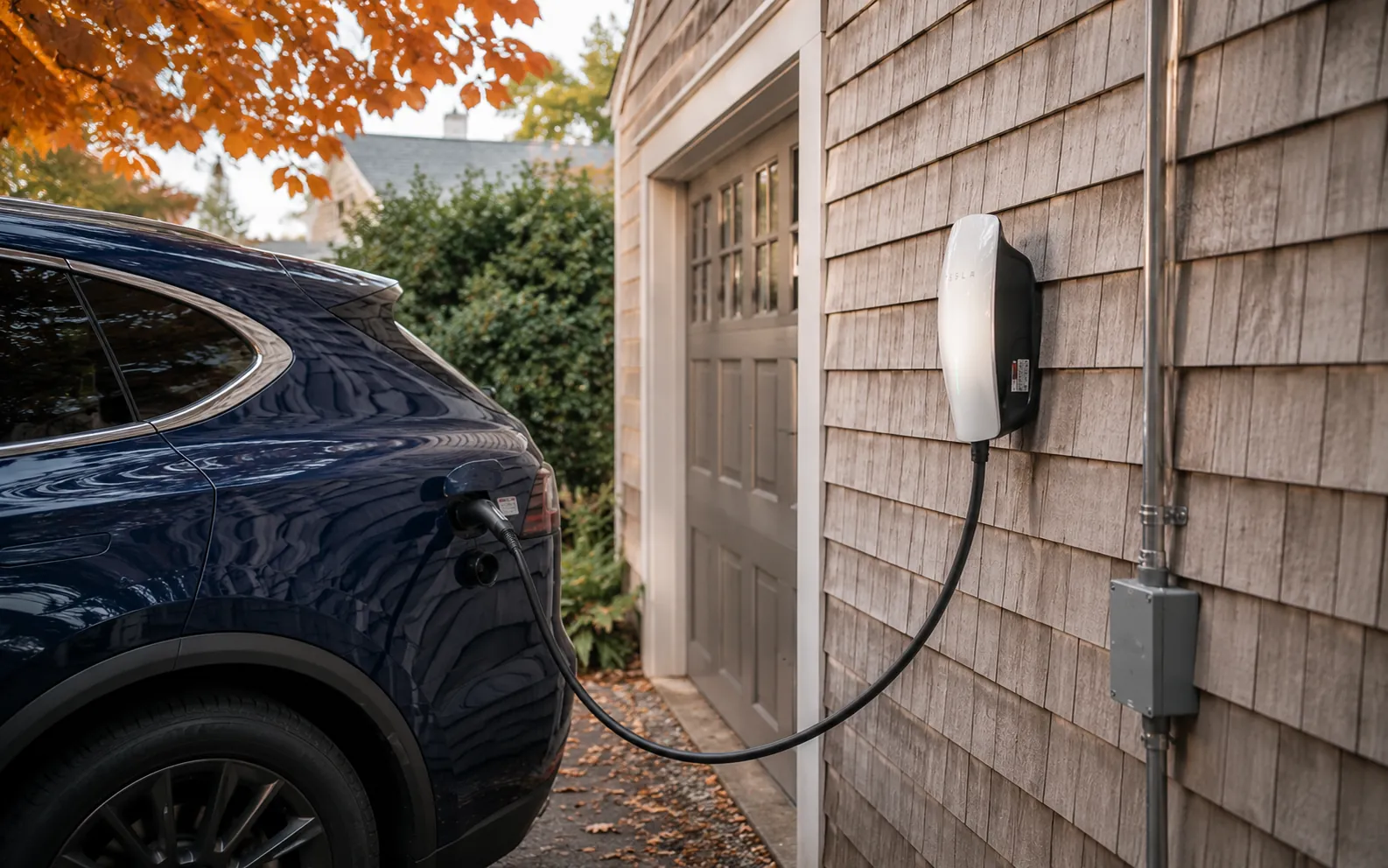
Home EV charger installation adds a supported charging connection where you park. The project includes more than choosing a wall-mounted unit: vehicle compatibility, the charging routine, electrical capacity, equipment location, permitting, and the connection method all affect the result.
Teamsun offers home EV charging work in Connecticut, Massachusetts, and Rhode Island, including assessment of electrical upgrades and solar integration. The appropriate installation depends on the property and the vehicle rather than a universal charger size.
The US Department of Energy’s home-charging guide explains residential charging options and the need to assess the home’s electrical installation.
Size the charging plan around your driving
Start with how far you normally drive, how long the vehicle is parked at home, and when you need it ready. A household with long overnight parking may have different needs from one that regularly arrives late and leaves early.
The vehicle also limits the AC charging power it can accept. Buying a higher-rated charging unit does not automatically make every vehicle charge faster. Ask for a proposed charging rate that considers both the vehicle and the site’s electrical capacity.
Keep the distinction between power and energy clear. Charging power affects how quickly energy is supplied; the vehicle’s energy need depends on use. A simple hypothetical 6 kW charging session lasting two hours delivers 12 kWh at the stated measurement boundary, before any additional losses outside that boundary. It does not establish driving range for a particular vehicle.
Have the electrical capacity assessed
A spare breaker position does not by itself prove that the service can support another load. The electrician needs to assess the existing installation and applicable load requirements.
Ask whether the proposal requires a panel or service upgrade, a suitable load-management system, or a different charging rate. Compare those options against planned household electrification. An EV project may be the right time to consider a future heat pump or battery, but that does not justify unnecessary equipment replacement.
Decide how and where the equipment connects
Hardwired and receptacle-connected charging have different equipment and installation requirements. The proposed unit, location, circuit, and any receptacle must form an approved installation. Avoid treating an existing outlet’s appearance as evidence that it is suitable for continuous EV charging.
The route from the electrical equipment to the parking space can affect cost. Ask about trenching, wall finishes, weather exposure, cable management, impact protection, and access for future service. These details help make two quotes comparable.
Electrical installation belongs to qualified professionals. Do not use a glossary explanation as a wiring or breaker-selection guide.
Solar charging requires a clear operating goal
An EV can increase household electricity consumption, which may affect future solar sizing. It can also create an opportunity to use more solar electricity during the day if the vehicle is available to charge.
A proposal should explain whether “solar charging” means charging during likely solar hours, using measured surplus through compatible controls, or simply offsetting annual vehicle consumption with additional generation. Those are different arrangements. A home battery and an EV charger also need coordinated power limits if both are expected to operate during an outage.
What EV charging equipment actually does
Electric vehicle supply equipment, often shortened to EVSE, provides a controlled connection between the property’s electrical supply and the vehicle. For ordinary AC home charging, the vehicle’s onboard charger performs the conversion needed by its battery. The wall-mounted equipment, cable, connector, vehicle, and electrical installation must work together as a supported system.
This distinction explains why the largest number on an EVSE advertisement does not determine every vehicle’s charging speed. The vehicle may accept less AC power, the installation may be configured at a lower supported rate, or the car’s operating conditions may change the rate. A useful proposal identifies the expected charging arrangement for the actual vehicle rather than promising a universal speed.
Charging is also an energy-planning question. The amount needed after a typical day of driving may be much less than the vehicle’s full battery capacity. Designing around routine replenishment and available parking time can produce a different decision from assuming the battery must be charged from empty every night.
Level 1 and Level 2 charging serve different needs
Level 1 uses ordinary household-voltage AC charging through a suitable supported arrangement. Level 2 uses a higher-voltage AC supply and can provide a higher charging rate where the vehicle and installation support it. DC fast charging is a different category and should not be assumed to be part of a residential Level 2 installation service.
A driver with modest daily use and a long overnight parking window may have different requirements from a household sharing one parking space or returning late after a long trip. The useful comparison includes time available, daily energy need, vehicle limits, and installation cost. Faster capability can be valuable, but it should answer an actual use case.
The Alternative Fuels Data Center explains residential charging options. Its guidance supports assessing the home’s electrical capacity rather than assuming every existing outlet is suitable. A qualified professional should evaluate the circuit and equipment under their applicable requirements.
Estimate the daily energy need
Use the vehicle’s own information and your driving pattern to estimate energy demand. As an illustrative planning exercise, assume a driver needs 18 kWh returned to the vehicle after an ordinary day. At an average 6 kW measured at the same energy boundary, the idealized charging time is three hours. At 3 kW, it is six hours.
Those numbers are arithmetic examples, not a claim about a particular vehicle or charger. Actual charging includes conditions and losses that depend on the measurement boundary, vehicle behavior, temperature, and settings. Do not divide a battery’s full rated capacity by the EVSE’s maximum advertised output and treat the result as a guaranteed session time.
Also consider the unusual days. A longer commute, a second trip, or two vehicles needing charge may change the desired flexibility. Distinguish occasional inconvenience from a regular limitation before paying for a larger electrical scope. A design should make clear which routine need it meets and which exceptional situations may require a different charging plan.
A load assessment is more than counting empty breaker spaces
The electrical panel’s physical space and the service’s ability to support additional load are different questions. A qualified electrician reviews the installation and applicable calculation requirements, along with the proposed charging equipment. Existing appliance use and planned electrification can affect the available options.
If additional capacity appears necessary, compare supported approaches. These might involve an appropriate charging rate, an approved energy-management arrangement, or an electrical upgrade. The correct choice depends on the equipment, site, and applicable requirements; a generic article cannot select a breaker, conductor, or service rating for the home.
Ask the estimate to state why a proposed upgrade is needed and what capability it provides. If a future heat pump or second EV is part of the rationale, identify that assumption explicitly. The owner should be able to distinguish necessary work for today’s charger from optional preparation for a later project.
Choose the location with everyday use in mind
The best parking-side location is not always the shortest electrical route. Consider where the vehicle’s charging port sits, how the cable will be managed, and whether another vehicle may use the space. A cable stretched across a walkway or driveway can create a practical problem even when the charger itself is conveniently mounted.
Outdoor locations require equipment and installation suitable for the conditions. Ask about exposure, physical protection, cable handling, and service access. A product’s enclosure rating or marketing image should not be treated as permission to install it anywhere without following its instructions and local requirements.
For shared driveways, rented property, or multifamily settings, establish permission and responsibility before installation. Questions about who pays for electricity, who can use the equipment, and what happens when an occupant moves are part of the project. A single-family homeowner model should not be applied automatically to a shared parking arrangement.
Hardwired and receptacle-connected arrangements
A hardwired installation connects the equipment through its approved electrical arrangement without relying on an ordinary user-plugged receptacle. A receptacle-connected unit uses a compatible outlet and plug under the relevant equipment and installation requirements. Each approach has practical implications for location, service, portability, and permitted equipment.
Do not assume that a receptacle with a familiar shape is suitable because it previously powered another appliance. The existing circuit, outlet condition, installation requirements, and continuous charging use need assessment. Extension cords and improvised adapters should not be treated as substitutes for a properly designed charging installation.
Ask how the selected arrangement affects future replacement or a vehicle change. A portable unit can still require a substantial fixed electrical installation. Conversely, a hardwired unit can be serviceable without the homeowner performing electrical work. Compare the supported complete arrangements rather than reducing the choice to convenience at the plug.
Smart charging and electricity costs
A smart charger may offer scheduling, usage records, remote controls, or integration with another energy-management system. The available functions depend on the exact product and supported communications. Decide which features solve a problem for the household before paying for a capability that may not be used.
A charging schedule can matter where the actual tariff varies by time. Under a flat rate, shifting the same energy to another hour does not automatically produce an energy-price saving. Other benefits, such as using available solar or participating in an eligible program, require their own conditions and controls.
Review subscriptions, internet requirements, account access, and behavior when communications are unavailable. A homeowner should know whether the equipment retains a local schedule, changes to a fallback mode, or loses a particular feature. Avoid assuming a cloud-connected product will provide every advertised function indefinitely without ongoing requirements.
How an EV fits with solar and a home battery
An EV increases the home’s energy demand, but the timing of charging determines how much solar can serve it directly. A car parked away from home during sunny hours may rely on evening grid imports even when the solar array produces substantial annual energy. Annual offset and direct solar charging describe different outcomes.
If a compatible control system follows measured solar surplus, ask how it handles clouds, other household loads, minimum charging limits, and the vehicle’s needs. The system should not leave the driver without required charge simply because the day’s solar production was lower than expected unless that is an informed operating choice.
During an outage, EV charging can consume a home battery’s energy quickly. Include it in the backup-load discussion rather than assuming the charger remains an unrestricted convenience. Bidirectional vehicle functions are also equipment- and vehicle-specific; an ordinary Level 2 installation does not automatically provide home backup or utility export.
Commissioning and ownership questions
At handover, confirm that the installation is complete under the applicable approvals and that the equipment is configured for the supported charging rate. Ask for an operating demonstration using the intended vehicle where practical, owner account access, equipment records, and the service contact.
Frequently asked questions
Will changing vehicles require a new charger?
Not necessarily, but connector compatibility, supported adapters, vehicle AC limits, and desired features need review. Check the exact manufacturer’s guidance instead of assuming every vehicle and connector combination is interchangeable.
Can two cars share one home charging installation?
Potentially, through an arrangement designed for the site and equipment. Compare parking schedules, energy needs, supported load sharing, and electrical capacity. Two connectors do not establish that both can operate at their maximum advertised rates simultaneously.
What if my internet connection stops working?
The effect depends on the product and configuration. Ask which charging functions continue locally and which depend on communications. Keep that answer with the handover information so an app outage is not automatically mistaken for an electrical failure.
Is the fastest available charger always the best choice?
No. Compare the charging window and actual driving need with vehicle limits, installation cost, and electrical requirements.
Can I use an adapter with any vehicle?
Use only a supported vehicle-and-equipment combination. Confirm the connector, adapter approval where applicable, and manufacturer instructions for the exact products.
Will a rebate cover the installation?
Do not assume eligibility or a payment amount. Confirm the current utility or state program, equipment requirements, application timing, and reimbursement terms before committing to a purchase.
Discuss EV charging with Teamsun, including your vehicle, parking location, electricity use, and future plans. Request a written scope that includes the electrical assessment, approvals, installation, and final operating checks.