How to Choose a Solar Panel Brand: 3 Checks That Matter
Choose a solar panel brand by checking efficiency, warranty terms and manufacturer track record. A plain how-to for CT, MA and RI homeowners.
Dan Katzman
Teamsun
To choose a solar panel brand, ignore the biggest number on the spec sheet and run three checks instead: real efficiency for your roof, the full warranty terms, and the manufacturer's track record. A panel that wins on one line of a datasheet but fails the other two is a poor buy for a Connecticut, Massachusetts or Rhode Island roof that has to perform for decades.
We are Teamsun, a privately owned installer serving homeowners across Connecticut, Massachusetts and Rhode Island. Every quote we write uses Tier 1 panels, inverters and batteries, installed by W-2 employees rather than subcontractors. Here is how we would judge a panel brand if we were sitting at your kitchen table with three quotes in front of us.
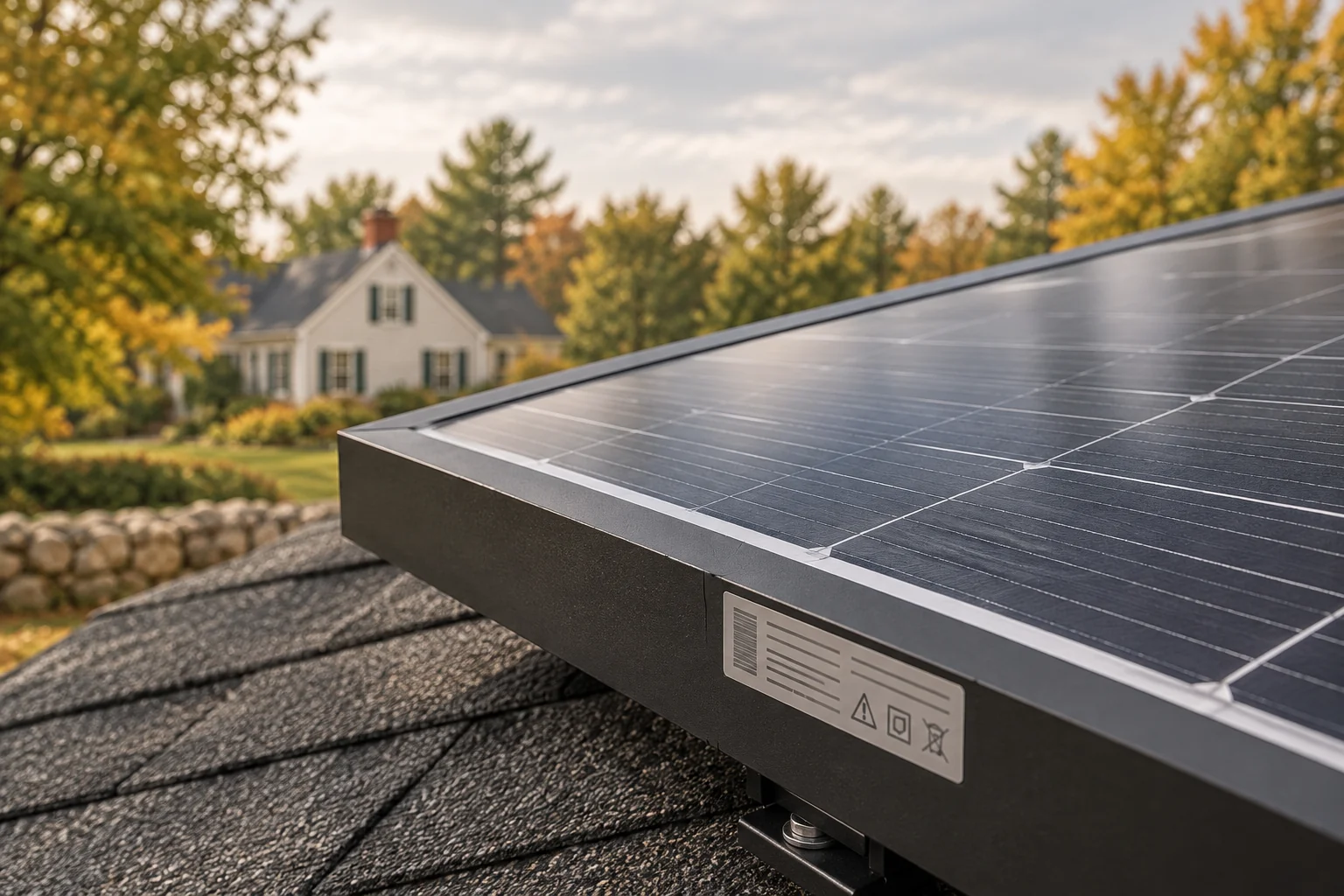
1. Know why spec sheets alone mislead you
A spec sheet is a lab report. Every number on it is measured under standard test conditions, which means a controlled light level and a controlled cell temperature. Your roof in Hartford, Worcester or Providence has snow, shade from the neighbor's maple, and July heat. The sheet tells you what a panel can do, not what yours will do.
Spec sheets also hide the real decision. Most quotes list a line such as "24 panels, 420 W" and a total price. The brand and model may sit in a footnote or not appear at all. Two quotes that look identical on price can specify panels from very different manufacturers.
The third trap is that every sheet looks impressive. Wattage, efficiency, temperature coefficient, tolerance: when five datasheets are spread on a table, the differences between reputable brands are small, and the differences that matter (who pays when a panel fails in year 14) are not on the sheet at all.
So the job is not to become an engineer. It is to find the few lines that change what you pay and what you get, then ask the installer for the rest in writing.
2. Ask the installer which panel tier they quote
"Tier 1" is an industry shorthand, mostly about a manufacturer's financial standing and ability to finance large projects. It is not a performance grade, and some installers use it loosely. So do not accept the label alone. Ask for the brand, the exact model number and what the installer means by Tier 1.
Put these questions to every installer, and ask for the answers on the quote itself:
- Which manufacturer and exact model are the panels? A vague "premium panels" line is a red flag.
- Which inverter and battery brands are included? The panel is only one piece of the system.
- Is the equipment the same on every option in the quote? Some proposals quietly swap brands between the cheap and expensive versions.
- What is included in the price? Penn State Extension advises homebuyers to confirm that the quote covers all panels, racking, hardware, wires and inverters.
- Who will be on my roof? Employees or subcontractors, and who answers the phone after install.
That last question matters for accountability. Connecticut's Attorney General has warned that many solar companies contract out marketing and installation to third parties, so you may be asked to sign with a company different from the one you met. Read the contract name and compare it to the person at your door.
You can also check licensing yourself. The state's solar buyer's guide notes that you can verify the license or registration of electricians and home improvement contractors through the Department of Consumer Protection. Do it before you sign, not after.
3. Check efficiency the right way
When does panel efficiency actually matter?
Panel efficiency matters most when your roof space is limited. Higher-efficiency panels fit more watts into the same area, so a small or heavily broken-up roof may need them to reach your target system size. On a large, open roof, a slightly less efficient panel can produce the same energy for less money.
Think of efficiency as a tool for solving a space problem, not a quality score. If your installer can fit the system you need on the roof you have, a few points of extra efficiency are a luxury, and you should not pay a large premium for them.
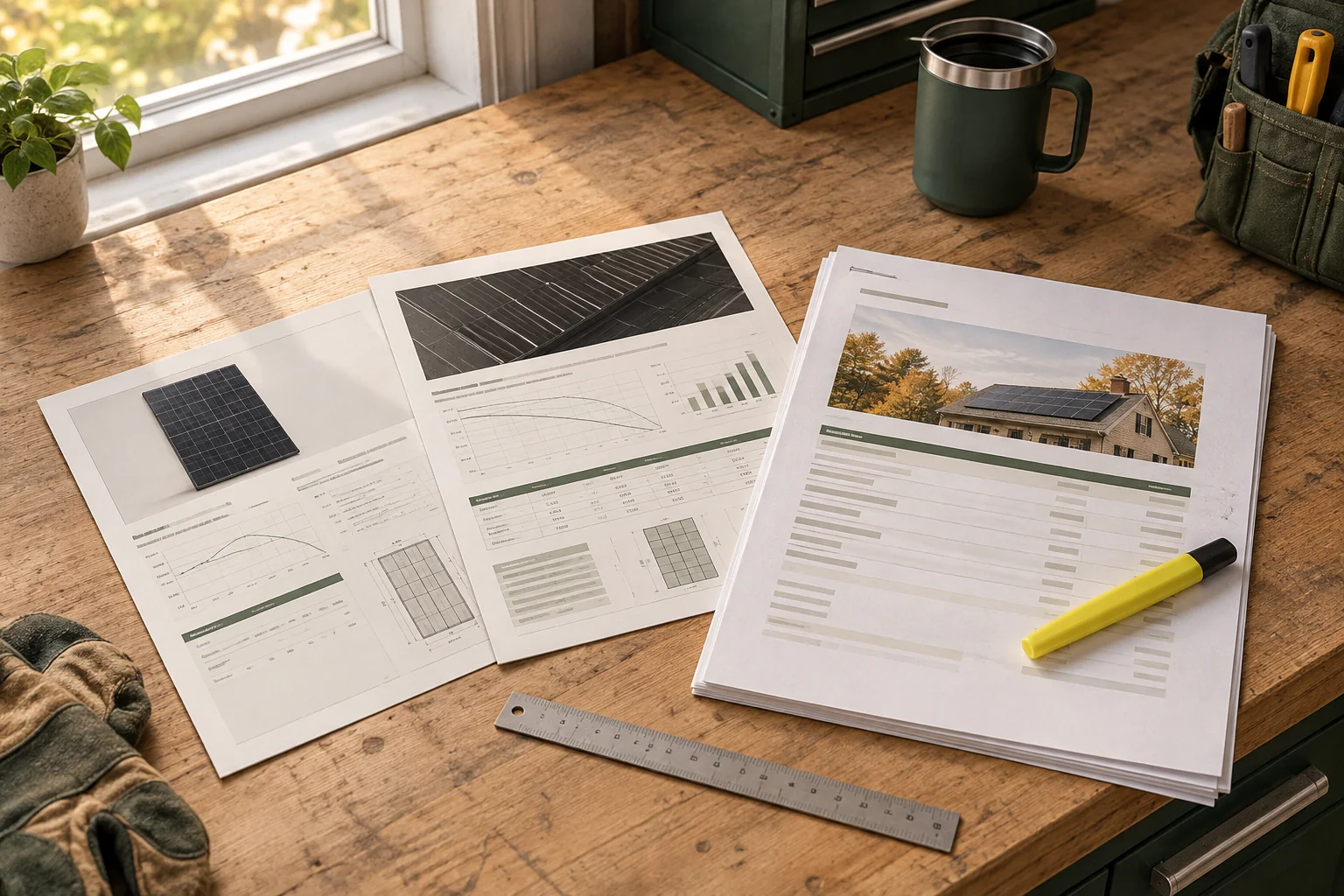
What to compare instead of the efficiency percentage
Divide the quoted price by the system size in watts, so you are comparing cost per watt. Here is a hypothetical example using the "24 panels, 420 W" line from earlier, which is 24 × 420 = 10,080 W. If one quote for that system were $25,000, it would be $25,000 ÷ 10,080 ≈ $2.48 per watt.
If a second quote for the same size were $40,000, it would be $40,000 ÷ 10,080 ≈ $3.97 per watt, so ask what the extra buys. Then ask for the estimated first-year production in kilowatt-hours. Those two numbers let you compare quotes even when the panels differ.
Look at three more lines on each datasheet:
- Temperature coefficient. It shows how much output drops as panels heat up. Lower loss is better for hot summer afternoons.
- Annual degradation rate. This is the share of output a panel loses each year. Field data shows a median loss of about 0.5% per year (a figure drawn from a published review of roughly 2,000 measured degradation rates, not from a manufacturer), so a datasheet claiming much worse is worth a question. Our degradation rate explainer shows how to turn that number into kilowatt-hours.
- Power tolerance. A panel rated "0 to +5 W" will not come in under its label. A "plus or minus" tolerance can.
Also ask whether the installer's production estimate accounts for your shade, roof pitch and direction. A brand with a great datasheet on a poorly modeled roof still underdelivers.
4. Read the warranty terms, not the headline year
What does a 25-year solar panel warranty actually cover?
A 25-year panel warranty usually bundles two promises: a product warranty against physical defects, and a performance warranty guaranteeing minimum output at year 25. These are different documents with different terms. Labor, shipping and removal costs are often not covered, so the headline year tells you very little on its own.
The U.S. Department of Energy notes that component warranties on panels, inverter and racking are typically 25 years, with a production guarantee that output will not fall by more than a modest amount over that period. That is why we treat 25 years as the reference point when we read a brand's paperwork. A brand offering far less deserves a question.
Now read the fine print. These are the lines that decide whether the warranty is worth anything:
- Guaranteed output at year 25. Many performance warranties promise at least 80% to 85% of rated power at the 25-year mark; the DOE source only says output should fall by a modest amount, so confirm the exact percentage in each warranty. Higher is better.
- Labor and shipping. Does the manufacturer pay to remove a failed panel, ship a replacement and reinstall it? Or only send the part?
- Who files the claim. You, the installer, or the manufacturer. If your installer closes, can you still claim?
- Transferability. If you sell your home, does the warranty move to the buyer?
Do not forget the rest of the system. String inverters generally have shorter lives than panels, and Rhode Island's Office of Energy Resources notes that warranties average around 10 years on that equipment. On the battery side, 10 years is the standard warranty we see. Our guide to product, performance and workmanship coverage breaks down how each layer works and who backs it.
5. Judge the manufacturer's track record
Why does the company behind the warranty matter?
A warranty is only as good as the company that issued it. If a manufacturer exits the market in year eight, a 25-year promise becomes paper. Track record is the check that tells you whether the brand is likely to be around, and likely to pay, when you file a claim.
You do not need insider data. Ask or look up these items:
- Years selling into the U.S. market. A long record of shipments beats a new brand with a bold marketing campaign.
- Whether the brand has a U.S. service and claims process. Ask for the claims steps in writing.
- How the installer has handled claims. Ask how many warranty claims they have processed on that brand, and what happened.
- Whether the brand is financially stable. This is the real meaning behind the Tier 1 label, so ask how the installer checked.
How do you look up a brand's Tier 1 status?
Tier 1 refers to a bankability rating, which is a view of whether lenders would finance projects using that maker's panels. The BloombergNEF bankability list is the usual public reference. Check whether the brand appears on the current list, and ask the installer to show you.
Public buyer guides say crystalline panels give higher efficiency in less area, while thin film blends into roofing, so efficiency ranges differ by panel type. Compare the exact models on your quotes rather than relying on the type alone.
The installer's own record matters just as much as the panel maker's. If a company installs a brand today but disappears in five years, the best manufacturer warranty in the world is hard to use. Look for an installer with a long local history, its own employees and a service team.
For a wider vetting process, see how the industry thinks about transparency in the SEIA Solar Business Code, which sets out expectations for how member companies deal with customers. Membership in a trade group is a signal, not a guarantee, so still check licenses and references.
If you already own a system and your installer is gone, the panel brand is less of a problem than the service gap. We service and repair systems from other installers, and our repair-for-any-brand guide covers what to expect.
New England conditions and the datasheet lines that matter
Snow load, shading and cold affect which lines to read. Check the datasheet's snow and wind load ratings against your roof. Shade from trees makes a modeled production estimate more important than efficiency. Cold weather generally helps output, so the temperature coefficient matters most for summer heat. The Shrewsbury municipal solar guide suggests asking whether a system can withstand hail and your area's wind risk.
6. Compare quotes side by side with a simple scorecard
Once you have three written proposals (Rhode Island's Office of Energy Resources recommends contacting at least three solar installers and getting written proposals), put them in one table. Fill in each row from the quote, not from memory or a sales call.
| Check | What to write down | A good answer looks like |
|---|---|---|
| Panel brand and model | Manufacturer, exact model number | Named on the quote, same on every option |
| Tier claim | What the installer means by Tier 1 | A clear explanation tied to the manufacturer's finances |
| Cost per watt | Total price divided by system watts | Close to the other quotes, or a clear reason for the gap |
| First-year production | Estimated kWh | Modeled for your shade and roof direction |
| Degradation rate | Percent per year | In line with typical field results |
| Product warranty | Years, labor and shipping covered? | Around the 25-year reference, with labor terms stated |
| Performance warranty | Guaranteed output at year 25 | Stated as a percentage in writing |
| Inverter and battery | Brands and warranty years | Named brands, terms in the contract |
| Who installs | Employees or subcontractors | Employees, with a license you can verify |
Price still counts. Typical residential systems cost $25,000 to $40,000 before incentives in our market, and our installation cost breakdown shows what drives the range. Once panels are equal on the checks above, a lower price is a real advantage. A lower price that comes from an unnamed brand or a thin warranty is not.
If two quotes still look close, ask each installer one extra question: "If this panel fails in year 12, what do I do and who pays for labor?" The clearer the answer, the better the company.
Teamsun's Tier 1 standard in your comparison
Tier 1 panels, inverters and batteries are on every quote we write. That gives you a fixed reference point when you compare us to other installers: the equipment tier does not change with the size of the job. We use 25 years as the panel warranty reference, and our standard battery warranty is 10 years.
On batteries, we install FranklinWH, Tesla Powerwall and Enphase IQ, and we retrofit batteries onto solar systems we did not install, any brand and any age. If you are already shopping for storage, our guide on solar, battery and EV charger services shows the options in one place.
Equipment is only half of what we put in writing. Our installs are done by W-2 employees, not subcontractors. We have powered 9,000+ homes across New England, with an average of 47 days from contract to a live system, and 95% customer satisfaction from third-party post-install surveys. We are licensed beyond our core states too, in ME, NH, VT and FL.
The customer who compares well is the one who asks the questions in this guide. Bring your other quotes. We will go through the brand, model, warranty and cost per watt line by line, and tell you plainly where ours is stronger or weaker.
Ready to compare? Request a free quote with named equipment and warranty terms, or talk to a designer about the quotes you already have. You can also call us at 203-903-4091.
Recommended Resources
Written by
Dan Katzman
Teamsun
Teamsun writes practical solar guidance to help property owners compare equipment, project scope, costs, and long-term service before making a decision.
Keep going.
Can I Add Solar Panels Without Replacing My Whole Roof?
Can I add solar panels without replacing my whole roof? Learn what inspectors check â shingle age, decking, flashing â to avoid costly mistakes.
Dan Katzman
Teamsun
How to Read a Commercial Solar Proposal (Without an
Learn how to read a commercial solar proposal: system size, production estimates, degradation and pricing line items, plus red flags to catch before you sign.
Dan Katzman
Teamsun
Solar Panel Hail Damage: How Panels Hold Up and What to Do
Solar panel hail damage explained for CT, MA and RI homeowners: how panels are tested, signs to check from the ground, safety steps, insurance and repairs.
Dan Katzman
Teamsun