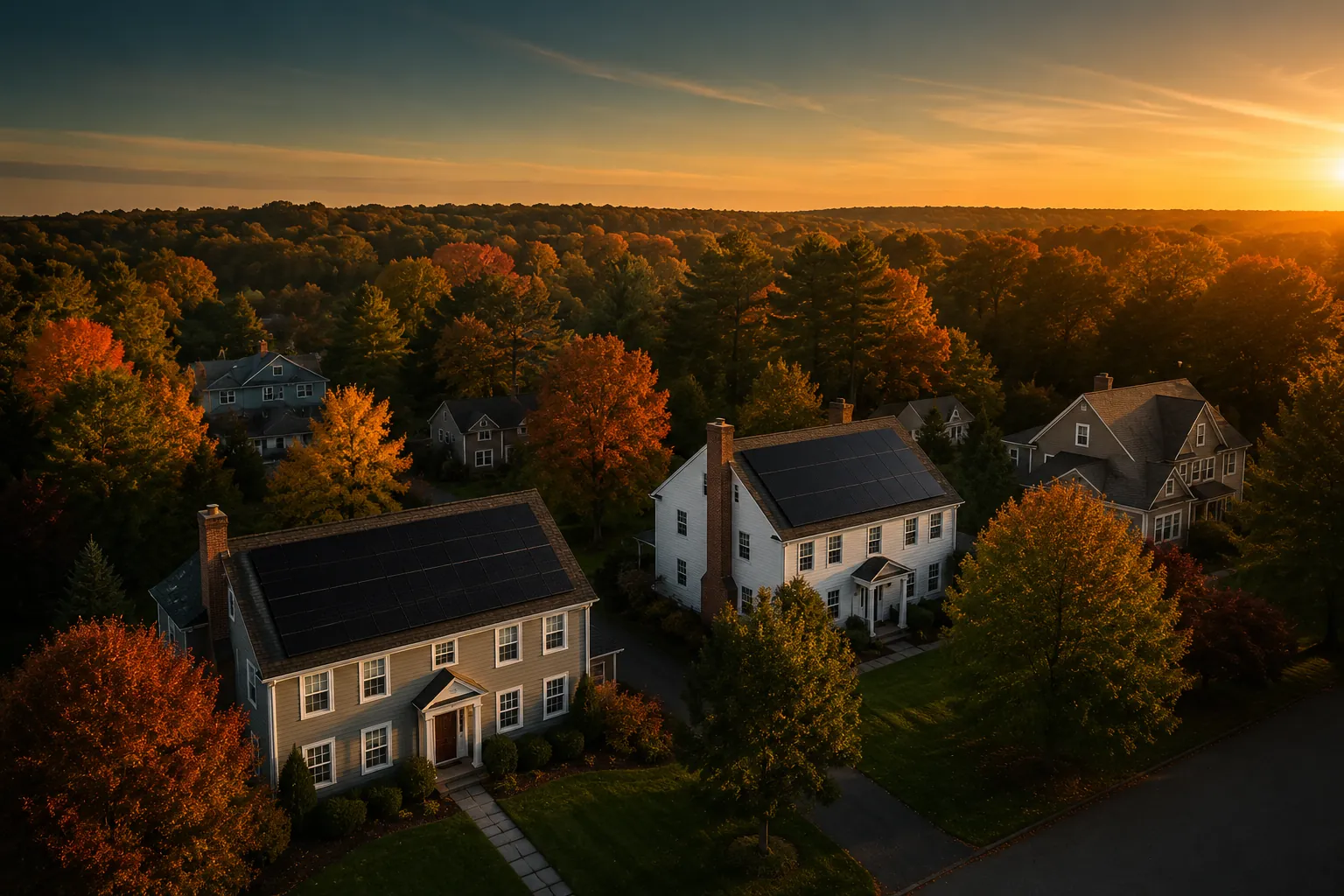
Solar Installer in Waltham, MA: 2026 Quote Guide
Compare Waltham solar installers using SMART 3.0, Eversource interconnection, City permits, roof scope, taxes, and verifiable quote evidence.
Dan Katzman
Founder, Teamsun
A solar installer in Waltham, MA should build the proposal around your Eversource meter, Waltham Community Electricity supply status, roof, electrical service, City permit path, and current 2026 incentive rules. Compare at least three written quotes on the same system and scope. The strongest proposal is not the one with the largest lifetime-savings graphic; it is the one that makes every approval, cost, assumption, and responsible party auditable.
Teamsun sells and installs residential solar, so we have a commercial interest if you request a quote. This guide does not claim unverified Teamsun projects, Waltham crews, licenses, permit history, prices, timelines, warranties, reviews, or customer results. Ask Teamsun and every competing bidder to document those facts before you sign.
The short version: Eversource is the electric distribution utility in Waltham. Waltham Community Electricity can supply the generation portion of the bill, but it does not approve solar. A permit-ready project may involve Waltham Fire Prevention, Building, and Wires, plus conditional zoning, conservation, or demolition review. SMART 3.0, net metering, state taxes, and the former federal credit must appear as separate quote rows.
Teamsun’s residential solar installation service explains the broader project scope. This page stays focused on one decision: how a Waltham homeowner can compare address-specific proposals before choosing a contractor.
What makes a Waltham solar installation quote complete?
A complete Waltham quote connects five records: the electric bill, the property, the roof and electrical design, City approvals, and the contract economics. If one is missing, the price may change after signing or the projected value may rest on the wrong utility, tariff, or usable roof area.
Use this local gate review before comparing dollars per watt:
| Waltham project gate | Evidence to request | Purchase implication |
|---|---|---|
| Electric account | Current Eversource bill, rate class, meter number, annual usage, and named supplier | Establishes the distribution utility, supply baseline, and benefiting account |
| Utility screen | Dated Eversource hosting-capacity result and proposed interconnection path | Flags possible grid review; it does not grant approval |
| Property authority | Owner name, legal use, unit count, roof rights, meters, and open permits | Shows who may contract and which account or accounts may benefit |
| Roof and fire layout | Measured roof planes, array coverage, access paths, setbacks, shade, attachments, and structural basis | Determines the usable array area and permit-ready scope |
| Electrical scope | Main service, panel, meter, disconnects, grounding, routing, and any upgrade allowance | Prevents electrical work from appearing later as an undefined change order |
| City approvals | Fire plan review, Building permit, Wires permit, inspections, and any conditional land-use review | Assigns filing, corrections, fees, and closeout to named parties |
| Program treatment | SMART 3.0 category, net-metering formula, ownership, qualification, and downside cases | Keeps production payments separate from bill credits |
| Contract economics | Gross cash price, financing price, exact equipment, exclusions, taxes, warranties, and service | Makes three proposals comparable without relying on a sales summary |
Waltham creates a useful proof test because its departments publish distinct requirements. The Fire Prevention Bureau’s 2026 solar checklist asks for exact measurements of roof planes, panels, and setbacks; array and roof-plane percentages; access paths; conduit treatment; shutoff details; labels; and field inspection (Waltham solar and energy-storage checklist). The Building Department enforces construction and zoning requirements, while the Wires Department handles electrical permits and inspections.
That means “permits included” is not enough. A useful quote names the filer and expected deliverable for each department. It says who pays current fees, answers plan-review comments, revises the array, schedules inspections, corrects failed work, and provides closed permits.
The City also lets owners search permit records by address. Its guide explains that building permits generally begin with P, Wires permits with W, and Fire Prevention permits with F (Waltham issued-permit search instructions). Use the search to inspect your property’s open work and to verify comparable installer claims without treating a permit record as proof of production, savings, or customer satisfaction.
This page is deliberately different from our Massachusetts solar installer comparison. The statewide guide owns provider credentials and program comparison across utility territories. This Waltham guide owns the Eversource/Waltham Community Electricity distinction, the three-department City review, Waltham roof-access rules, and parcel-level land-use questions.
Is Eversource the electric utility in Waltham?
Yes. Eversource is the electric distribution utility for Waltham, while Waltham Community Electricity is a municipal aggregation program that can supply electricity. Eversource continues delivery, billing, grid maintenance, outage response, metering, and solar interconnection even when the City program is listed as the supplier.
The City’s current Community Electricity page describes the program as a competitively selected supply option and states that Eversource continues to deliver electricity, maintain the grid, repair outages, and send the bill (Waltham Community Electricity). The City’s aggregation materials further explain that participating changes the supplier and supply cost, while Eversource continues managing delivery and existing solar net-metering benefits (Waltham municipal aggregation plan).
Give every bidder the same account packet:
- every page of a recent Eversource bill;
- at least 12 consecutive months of kWh usage;
- the supply product and supplier shown on the bill;
- the rate class, service address, account, and meter identifiers;
- all meters involved at a multi-unit or mixed-use property;
- any existing solar, battery, generator, transfer switch, or service work; and
- planned loads such as an EV, heat pump, addition, accessory unit, or new occupants.
Then require the quote to separate the bill inputs:
| Bill input | Correct source | What not to assume |
|---|---|---|
| Distribution utility | Eversource bill and territory record | Waltham Community Electricity is not the utility |
| Generation supplier | Supplier line on current bill | The City program’s prior or advertised rate is not permanent |
| Delivery rates | Current Eversource rate class and tariff | A supply price is not the full avoided electric rate |
| Fixed and excluded charges | Current bill and tariff | Annual energy offset does not guarantee a zero bill |
| Export credit | Applicable net-metering rules and current Eversource tariff | Every exported kWh is not necessarily equal to the retail total |
| Production payment | SMART 3.0 qualification and meter | SMART is not a price discount from the installer |
Do not copy a rate from an old Waltham aggregation notice into a 20-year savings model. The City’s program materials explicitly warn that future savings cannot be guaranteed because Eversource Basic Service changes. A proposal should identify the current supplier, then show a zero-rate-escalation case and let the supply assumption change independently from delivery charges.
Four terms should never be collapsed into “Waltham rebates”:
- Waltham Community Electricity is an electricity-supply choice.
- Net metering is an Eversource bill-credit mechanism governed by Massachusetts rules and tariffs.
- SMART 3.0 is a qualification-based solar production incentive.
- Interconnection is the utility’s technical and contractual process for connecting generation.
If a salesperson cannot explain those differences in plain English, the economics are not ready to compare.
Teamsun crews reach Waltham from the same dispatch area that covers Newton and Cambridge, so the permitting, utility, and inspection routine described here is the one our field team already runs locally.
How should SMART 3.0 and net metering appear in a 2026 Waltham quote?
SMART 3.0 and net metering should appear as separate cash-flow rows. SMART pays for metered generation from an eligible, qualified system. Net metering converts eligible excess generation into dollar credits on the Eversource bill. Neither is an automatic rebate subtracted from the installer’s gross contract price.
As of August 10, 2026, the Massachusetts Department of Energy Resources lists these Program Year 2026 SMART 3.0 flat rates for small systems:
| SMART 3.0 category | 2026 flat incentive rate | What the proposal must prove |
|---|---|---|
| Qualifying STGU at or below 25 kW AC | $0.03 per metered kWh | AC capacity, eligibility, available capacity, application, metering, ownership, and final qualification |
| Qualifying low-income STGU at or below 25 kW AC | $0.06 per metered kWh | All of the above plus low-income category eligibility |
DOER says Program Year 2026 has 600 MW AC of available capacity for units subject to the capacity cap. It also records approval of the revised SMART 3.0 tariff in May 2026 and company-specific tariffs in July 2026, after which final statements of qualification began issuing (SMART 3.0 Program Details). A published rate is not a reservation for a particular address.
Require the installer to disclose:
- module DC capacity and inverter AC capacity;
- SMART category and the official rate source used;
- who owns the system, incentive rights, and renewable attributes;
- who applies and who corrects an incomplete application;
- whether program capacity has been secured or is merely assumed;
- what metering and reporting equipment is included;
- the production model and degradation assumption;
- the payment term used in the financial model; and
- what happens contractually if the project does not receive the assumed treatment.
Net metering needs a separate Eversource model
The Massachusetts DPU’s net-metering guide, updated July 13, 2026, says net-metering credits appear as dollars, not banked kWh. The value depends on the facility class and capacity, rate class, current utility tariff, on-site load, parcel and meter configuration, and other eligibility facts (Massachusetts net-metering guide).
The guide says the cap-exempt threshold increased from 10 kW to 25 kW and describes a path for certain eligible Class I facilities above 25 kW that serve on-site load and meet interconnection and other conditions. That does not mean every proposal under 25 kW receives an identical credit or every larger system qualifies. Capacity is evaluated in AC for net-metering purposes, and configuration matters.
Some current bill components are never included in net-metering credits. DPU lists fixed customer charges, system-benefit charges, demand charges, the energy-efficiency reconciliation factor, and the net-metering recovery surcharge among the exclusions. The agency also warns that an older credit example should not be used to predict future value because utility rates change.
Make the bidder complete this table:
| Economic quantity | Required quote disclosure |
|---|---|
| Annual on-site use | Load-shape method and benefiting Eversource meter |
| Annual exports | Production interval assumptions and export volume |
| Net-metering value | Facility class, AC capacity, rate class, current tariff components, and exclusions |
| WCE or other supply | Supplier and rate shown separately from delivery |
| SMART production | Metered generation, category, rate, term, recipient, and qualification status |
| Annual production | Weather source, shade, orientation, equipment losses, soiling, downtime, and degradation |
| Downside cases | Zero rate escalation, lower production, lower export value, and delayed incentive start |
A multi-family, condominium, trust-owned, or multi-meter property needs more review. Massachusetts’ single-parcel and facility rules can affect how capacity behind a retail meter and interconnection point is treated. Roof authority also does not prove that one owner can direct benefits to a particular account. Require written property authorization and an account-specific net-metering explanation before signing.
The cleanest proposal lets you delete SMART, change the supply rate, reduce production, or modify the export value without changing the gross system price. That is how you test whether the purchase still works when one assumption changes.
What does Eversource interconnection require for a Waltham home?
Eversource interconnection is a separate approval from Waltham permits. Massachusetts says a distributed-generation owner must obtain a written Interconnection Service Agreement and then Authorization to Connect before operating in parallel with the grid. A passed City inspection does not replace either document.
The DPU maintains standardized interconnection tariffs and posts the current utility process (Massachusetts utility interconnection guidance). The page records DPU approval of updated interconnection tariffs on April 27, 2026. The proposal should cite the version used for its application pathway rather than rely on a salesperson’s memory from a prior project.
Eversource’s Massachusetts hosting-capacity map lets a bidder search an address and review circuit-level estimates. Eversource defines hosting capacity as the amount of new distributed energy resources that may be added without adversely affecting reliability or requiring significant upgrades (Eversource Massachusetts hosting-capacity map). The map is a screening tool, not an approval, price, or promise that conditions will remain unchanged.
Ask for a dated interconnection sheet:
| Interconnection question | Evidence | Limitation |
|---|---|---|
| Which distribution utility applies? | Eversource bill and service address | Supplier choice does not change the utility |
| What capacity is proposed? | DC modules and AC inverter output | Do not use the larger number without labeling units |
| What does the hosting screen show? | Dated address/circuit map record | Estimated headroom is not Authorization to Connect |
| Which application path is assumed? | Current Eversource tariff/process reference | Utility review can change the path |
| Are studies or upgrades included? | Written allowance or exclusion | “Standard interconnection included” is too vague |
| Who answers utility corrections? | Named party and contact in the contract | The homeowner should not discover this after signing |
| What is the operating milestone? | Eversource Authorization to Connect | Installation or City inspection alone is not permission |
A responsible milestone plan generally covers preliminary screening, application submission, technical corrections, Interconnection Service Agreement, City permits and inspections, required meter or protection work, Authorization to Connect, and final document delivery. The sequence can overlap, and Eversource or the City can require changes. The installer should state dependencies rather than guarantee a universal completion date.
Electrical scope can change the application. Service amperage, main panel condition, meter position, overhead or underground service, line-side or load-side connection, disconnects, grounding, conduit route, inverter selection, battery equipment, and existing generation all matter. Waltham’s Wires Department electrical application asks for service and meter details and a utility authorization number, which is a useful clue that the local and utility records must match.
Do not accept “panel upgrade if needed” as a blank allowance. Ask for the site-survey finding, trigger, included equipment, utility work, trenching or restoration, permit responsibilities, and unit price. If the exact need cannot be known before utility review, the contract should cap or define the contingency and give you a right to reconsider a material change.
Commercial project review
Commercial economics turn on tariff, tax position, and roof term.
Teamsun reviews interval data, demand charges, and building constraints, then models the structures worth pursuing for your entity before design work begins.
Which Waltham permits and inspections can solar require?
A typical grid-connected Waltham rooftop project should be planned around Fire Prevention plan review and final inspection, a Building permit and inspection, and a Wires electrical permit and inspection. Additional zoning, conservation, or historical review is conditional. The installer should confirm the current path with each authority for the specific address and scope.
Waltham Fire Prevention reviews the solar layout
The Fire Prevention Bureau’s current hub links the solar plan-review application, final solar inspection, energy-storage permit, solar FAQ, fee schedule, and payment process. It says plans cannot be emailed at this time and warns that incomplete submissions will be rejected (Waltham Fire Prevention permits and downloads).
The 2026 solar checklist is more specific than a generic fire-code citation. It currently calls for:
- one set of stamped plans;
- prepaid plan review, listed as $50 residential and $100 commercial;
- a completed Fire Prevention plan-review application;
- exact measurements for all roof planes, panels, and setbacks;
- roof-plane and solar-array percentages;
- three-foot access paths on separate roof planes from gutter to ridge;
- conduit that does not cross those access paths;
- ridge-path treatment based on array coverage;
- accessible and labeled solar shutoffs; and
- a field inspection, with modifications possible if the installation does not meet applicable requirements.
These details can reduce usable roof area. A sales layout that fills every attractive roof plane but omits access paths is not a Waltham-ready production estimate. Require the permit layout and annual production model to use the same panel count and equipment.
The Fire plan-review application says solar plans must be paid in advance and include exact roof, panel, and setback measurements (Waltham solar plan-review application). Confirm submission method and fees immediately before filing because City forms and instructions can change.
Building reviews construction and zoning compliance
Waltham’s Building Department enforces City and state rules for construction, alteration, repair, and demolition. Its current page says property owners must sign permit applications and that applications submitted after July 1, 2025 must comply with the Tenth Edition Massachusetts Building Code. It currently lists residential permit fees as $12 per $1,000 of estimated construction cost with a $50 minimum (Waltham Building Department).
Do not infer that a Fire-approved layout is structurally approved. The proposal should identify the structural basis for the roof, attachment and flashing details, applicable code, responsible designer, and any engineer or plan stamp the Building Department requires. Ask who resolves a mismatch between the remote layout, field measurements, structural findings, and permit plan.
If reroofing is part of the project, treat it as separate scope. The City’s Building page allows roofing permits through specified submission methods, but the solar contractor should still coordinate permit timing, deck repairs, underlayment, attachments, roof warranty, inspection, and solar mobilization. Use our solar and roofing contractor guide to compare responsibility across both trades.
Wires permits and inspects the electrical work
The Wires Department says electrical permits require the Commonwealth application, a valid Massachusetts electrical license, and an active certificate of liability insurance. It also says only a person holding a Massachusetts electrical license can pull the permit; homeowners cannot pull their own electrical permit (Waltham Wires Department).
That creates a concrete verification question: who is the license holder pulling the W permit, what business employs or contracts that person, and who is responsible for inspection corrections? Massachusetts’ electrical board states that PV system components, including associated racking and modules, fall within licensed electrical work, while a general contractor may contract for PV if it uses licensed electricians for the electrical scope (Massachusetts electrical-board solar policy).
Ask for one responsibility matrix:
| Approval or task | Named party | Record delivered to owner |
|---|---|---|
| Fire solar plan review | Stamped/approved plan and project number | |
| Building permit | Issued permit and approved plan | |
| Wires permit | Permit tied to named licensed electrician/business | |
| Fire final inspection | Passed/closed result | |
| Building final inspection | Passed/closed result | |
| Wires final inspection | Passed/closed result | |
| Eversource interconnection | ISA, correspondence, meter record, Authorization to Connect | |
| SMART 3.0 | Application, qualification, metering, and payment records |
Midway through quote review, stop and test the actual plan. If you want Teamsun to complete this matrix for your address, send the Eversource bill and Waltham property details through the contact form. Compare the response against at least two other written proposals.
When do Waltham zoning, conservation, or historical rules matter?
Routine roof-mounted solar is listed as an allowed use in most Waltham zoning districts, but the current Table of Uses is not a universal approval for every parcel or design. Ground-mounted equipment, added structures, dimensional conditions, wetlands work, or demolition can trigger more review. Confirm the property zone and current interpretation before treating a sales layout as permit-ready.
Waltham’s zoning Article X says solar systems must follow the Table of Uses and Article IV dimensional requirements. It treats ground-mounted solar setbacks like an accessory building and provides special-permit and decommissioning rules for certain larger ground systems (Waltham Zoning Ordinance Article X). The current Table of Uses lists roof-mounted solar as allowed in the City’s residential districts and several other districts, with different treatment in some categories (Waltham Zoning Ordinance Article III).
Do not use that summary to self-approve a parcel. Waltham’s Planning FAQ tells applicants to identify the zone and obtain a Building Department determination before pursuing variance or special-permit relief. Ask Building to confirm the operative ordinance, district, use, height, equipment location, and any nonconforming-property issue.
Use this conditional screen:
| Project condition | Authority to ask | Why it can change scope |
|---|---|---|
| Standard roof array | Building and Fire Prevention | Use, height, structure, layout, setbacks, and access |
| Ground-mounted array | Building/Planning and possibly special-permit authority | Accessory setbacks, use table, size, screening, and land disturbance |
| New battery enclosure or equipment structure | Building, Fire Prevention, and Wires | Construction, location, electrical, fire, access, and listing requirements |
| Trench, pad, grading, tree work, or clearing near wetlands or waterways | Conservation Commission | State Wetlands Protection Act review may apply |
| Demolition or substantial destruction of an older building | Building and Historical Commission | Waltham’s demolition-delay ordinance may apply |
| Condominium or shared property | Association, legal counsel, insurer, utility, and City | Roof authority, access, meter benefits, maintenance, and permits differ |
Conservation review is about site disturbance, not solar by label
The Waltham Conservation Commission says work within 100 feet of wetlands, ponds, or intermittent streams, or 200 feet from rivers and perennial streams, is likely to need review. “Alteration” includes tree cutting and grading (Waltham Conservation Permit FAQ).
A normal rooftop array with no jurisdictional ground work may not trigger this path. A ground mount, battery pad, trench, access improvement, clearing, or service work might. If the parcel is near a resource area, obtain a determination before promising that tree removal or trenching is included. The City describes Request for Determination and Notice of Intent paths with different documentation and closeout requirements.
Historical review should not be overstated
Waltham has a Historical Commission and a demolition-delay ordinance. The ordinance addresses demolition or total/substantial destruction and buildings that are at least 75 years old; it is not evidence that every rooftop solar project on an older home needs historical approval (Waltham delayed-demolition ordinance).
If the project includes major roof reconstruction, demolition, an addition, or work to a documented historic asset, ask Building and the Historical Commission whether review applies. Do not let an installer use “historic home” as a vague cost allowance, and do not let one dismiss the issue without checking the actual scope. Record the City’s answer in the contract file.
Which roof, electrical, and property constraints change a Waltham proposal?
Usable roof area, not gross roof area, controls the final system. Waltham’s fire-access rules, shade, roof condition, structural findings, vents and obstructions, ownership, and electrical route can reduce capacity or add scope. The quote should turn each constraint into a measured fact or a clearly priced contingency.
Roof evidence to request
Ask for:
- roof covering type, approximate age, installation record, and warranty;
- number of layers and visible condition, confirmed during site work where accessible;
- leak, ice-dam, repair, chimney, skylight, and ventilation history;
- framing and deck observations, spans, and the structural approval basis;
- exact roof-plane measurements and usable area after Waltham access paths and setbacks;
- shade by roof plane and the source of the shade model;
- attachment, flashing, sealant, and waterproofing details;
- conduit, inverter, disconnect, and roof-access routing;
- responsibility for roof leaks and workmanship claims; and
- a priced removal-and-reinstallation process for future roofing.
An old roof is not automatically disqualified. The purchase question is whether its remaining service life and condition justify placing equipment above it. If a near-term reroof is likely, coordinating roof and solar work may avoid paying later to remove and reinstall the array. The solar and roof contracts should identify which party owns deck repairs, flashing, penetrations, warranty interfaces, and leak investigation.
Do not rely on an anonymous “no structural work” notation from another Waltham permit. Each house, roof plane, attachment system, array, and code review differs. Ask the bidder to state what structural evidence the City will receive for your project.
Electrical evidence to request
Photograph the meter, service entrance, main panel label, main breaker, available spaces, grounding, and proposed equipment route. Then ask the installer to document:
- existing and proposed service amperage and voltage;
- overhead or underground service;
- meter count and which account receives solar;
- connection method and equipment ratings;
- whether a panel, meter socket, service, transformer, or disconnect change is assumed;
- battery or generator integration and operating modes;
- trenching, wall repair, paving, landscaping, and paint restoration;
- utility authorization number and interconnection records; and
- the licensed electrical person and business pulling the Wires permit.
For a battery, require separate information about energy capacity in kWh, output power in kW, supported circuits, transfer equipment, outage behavior, equipment location, ventilation or thermal controls, listings, fire plan, and warranty. Waltham Fire Prevention publishes a separate energy-storage permit path; battery capacity is not proved by the number of solar panels.
Ownership and meter constraints
A single-family owner with one meter usually has a cleaner authority path than a condominium unit or multi-family property. For shared property, identify:
- who owns the roof and exterior surfaces;
- who can authorize penetrations and equipment;
- which meter and legal customer will host the system;
- how costs, production, credits, and SMART payments are allocated;
- access for construction, emergencies, service, and future roofing;
- insurance and indemnity requirements;
- responsibility if a unit is sold; and
- who controls monitoring and warranty claims.
Do not sign first and ask the association later. Property approval, Eversource eligibility, SMART ownership, City permits, and tax treatment are separate questions.
Waltham projects
Get a proposal built around Waltham conditions.
Teamsun handles the permit filings, Massachusetts program paperwork, and utility interconnection for projects in this area, and quotes against your actual bill rather than a regional average.
How should you compare Waltham solar costs and financing?
Compare the gross cash price and included scope before incentives or financing. No web average can price an address-specific Waltham roof, fire layout, electrical service, interconnection finding, or contract. Market pages are useful for question discovery, but they are not a substitute for a site survey and current written proposal.
Complete one worksheet for each bidder:
| Comparable quote field | Bidder A | Bidder B | Bidder C |
|---|---|---|---|
| Gross cash price before incentives | |||
| Financed amount and total of payments | |||
| DC module capacity | |||
| AC inverter capacity | |||
| Gross cash dollars per DC watt | |||
| Exact modules, inverter, racking, and monitoring | |||
| Permit-ready panel count after Fire access | |||
| Structural and roof scope | |||
| Building, Fire, and Wires permits/inspections | |||
| Eversource application, studies, and upgrades | |||
| SMART category and status | |||
| Net-metering and WCE supply assumptions | |||
| Electrical upgrades and restoration | |||
| Warranties and service responsibilities | |||
| Exclusions, allowances, and change-order rates |
Calculate gross cash dollars per DC watt as:
Gross cash price ÷ module DC nameplate watts
Use it as a normalization tool, not a verdict. A lower figure may exclude a service upgrade, roof work, engineer, Fire revisions, utility study, labor for warranty service, or removal/reinstallation. A higher figure may include useful scope—or may simply cost more. Inspect the rows.
For a loan, require cash price, financed principal, dealer or origination fee, APR, term, payment schedule, total of payments, security interest, prepayment rules, and any assumed re-amortization. Compare the same ownership model. A lease or power-purchase agreement shifts ownership and may change SMART, tax, transfer, maintenance, and buyout rights; it should not be compared to cash ownership by monthly payment alone.
Run at least four cases:
- disclosed base production and current program assumptions;
- zero electricity-rate escalation;
- lower production with the same project price;
- actual financing cash flow without an assumed federal homeowner credit.
Massachusetts consumer guidance tells buyers to understand who owns the system, total cost, rate or payment changes, responsibilities, projected savings assumptions, warranties, maintenance, transfer terms, and consequences of sale (Massachusetts solar consumer FAQ). A “solar payment lower than your bill” claim is incomplete unless the model shows remaining utility charges, escalation, term, ownership, and total paid.
Which tax assumptions are current for a 2026 Waltham installation?
A 2026 Waltham homeowner proposal should not subtract the former 30% federal Residential Clean Energy Credit. It should present Massachusetts income-tax, sales-tax, and property-tax treatment separately, with eligibility conditions and taxpayer review. These provisions are not Teamsun, Eversource, City, or SMART rebates.
| Tax item | Current official framework as of August 10, 2026 | Quote treatment |
|---|---|---|
| Federal homeowner credit | IRS says it is unavailable for property placed in service after December 31, 2025 | Do not subtract it from a system completed in 2026 |
| Massachusetts personal income-tax credit | Smaller of 15% of eligible net expenditure or $1,000 for a qualifying principal residence | Show separately; confirm taxpayer and cost eligibility |
| Massachusetts sales/use tax | DOR lists qualifying equipment directly related to solar supplying a principal residence as exempt | Ask which contract line items qualify and how treated |
| Massachusetts property tax | State law provides a 20-year exemption framework for qualifying systems, subject to statutory conditions and proof | Confirm documents and filing with Waltham Assessors |
The IRS currently says the federal homeowner credit covered qualifying property installed through December 31, 2025 and is not available for property placed in service after that date (IRS Residential Clean Energy Credit). The IRS also states that paying before the deadline does not preserve the credit when original installation is completed afterward (IRS accelerated-credit termination FAQ).
Massachusetts DOR describes the residential solar and wind energy credit as the smaller of 15% of net expenditure or $1,000. It applies to qualifying owners or tenants and a principal Massachusetts residence, has defined cost rules, and can be carried forward subject to its limits (Massachusetts residential property tax credits). The underlying regulation defines net expenditure and excludes leases and various nonqualifying costs (830 CMR 62.6.1).
DOR’s sales-and-use-tax guide, updated May 7, 2026, lists equipment directly related to solar systems used as primary or auxiliary power for a taxpayer’s principal Massachusetts residence among exempt items (Massachusetts sales and use tax guide). Do not infer that every roof, electrical, battery, repair, or financing line is exempt. Ask the contractor to document treatment and consult a qualified tax adviser for the owner’s facts.
For property tax, Massachusetts Division of Local Services explains that qualifying solar systems can receive a 20-year exemption and that the owner bears the burden of proving eligibility. The current framework includes size and production-to-load conditions and exceptions; it is not a blanket promise for every system (Massachusetts DLS solar abatement guidance). Contact the Waltham Assessor’s Office before filing to ask which application, installation date, utility authorization, DOER qualification, ownership, and load documents it expects.
Retain the signed contract, paid invoices, permits, final plans, equipment specifications, SMART records, Eversource Interconnection Service Agreement and Authorization to Connect, tax forms, and assessor correspondence. Tax law and administrative practice can change. This guide is not tax advice.
How do you verify a Waltham solar installer before signing?
Verify the exact legal entities that sell, contract, build, perform electrical work, finance, warrant, and service the system. A familiar brand or marketplace profile does not prove who will pull Waltham’s Building, Fire, and Wires permits or answer a future roof leak.
Massachusetts says contractors that solicit, bid on, or perform covered work on an existing owner-occupied one-to-four-unit residence generally must hold Home Improvement Contractor registration, and the entity signing the homeowner contract must be registered (Massachusetts HIC contractor requirements). The homeowner guidance specifically says solar panels are not within the general energy-conservation-device exception and recommends checking registration history, insurance, and recent references (Massachusetts HIC homeowner resources).
HIC registration is not an electrical license. Waltham requires a Massachusetts electrical license holder to pull the Wires permit. Depending on structural and construction scope, other registrations, licenses, or professional stamps may apply. Use our guide to verifying a solar installer’s license to map the seller, contractor, electrician, engineer, roofer, and warranty provider.
Score each company zero for missing, one for partial, and two for complete evidence:
| Waltham installer criterion | Two-point evidence |
|---|---|
| Legal parties | Every seller, contractor, electrical business/licensee, engineer, roofer, financier, warrantor, and service entity named |
| State verification | Current HIC status/history, applicable construction credential, electrical license/business, and insurance verified |
| Local permit plan | Fire, Building, Wires, corrections, inspections, and closeout assigned |
| Address utility plan | Eversource bill, hosting screen, application path, ISA, upgrades, and Authorization to Connect assigned |
| Program accuracy | Current SMART and net-metering sources, separate calculations, eligibility and downside cases |
| Roof/electrical design | Measured Fire-compliant layout, structural basis, attachments, service scope, routing, and restoration |
| Complete price | Gross cash price, financing, exact equipment, allowances, exclusions, substitutions, and change-order rates |
| Contract protection | Scope, payments, cancellation, material changes, approval failure, schedule basis, and document delivery |
| Warranty map | Product, workmanship, roof, labor, shipping, access, transfer, exclusions, and remedy by provider |
| Post-install service | Intake, monitoring, diagnosis, Waltham coverage, escalation, response terms, and installer-failure contingency |
Massachusetts homeowner guidance recommends interviewing at least three contractors, obtaining detailed written estimates, checking HIC status and complaint history, requesting insurance, and asking for the three most recent references. Ask for references with customer permission and comparable scope: Eversource, Waltham, similar roof and electrical conditions, current permitting, and the same ownership model.
A project elsewhere in Massachusetts can show general experience but does not prove current Waltham Fire layout knowledge. A Waltham permit proves a filing occurred, not that the customer was satisfied or the system achieved a sales estimate. Verify both process and outcome without asking an installer to disclose another homeowner’s private records.
Teamsun should receive no automatic points. Ask Teamsun to document current Waltham service availability, Massachusetts credentials, legal entities, workforce and subcontractor roles, relevant permit and Eversource records, similar project references, equipment, warranties, and post-install service. That first-party evidence has not been verified for this article.
Put us through the same test
Ask Teamsun every question on this list.
Licensing, crew structure, warranty terms, and service history should be answerable in writing by any company you shortlist — including this one.
Which red flags should stop a Waltham solar purchase?
Pause when a claim cannot be traced to the bill, property, official program, utility record, City requirement, design, or contract. A polished proposal is not a permit or interconnection decision.
Investigate these statements:
- “Waltham Community Electricity approves solar.” It is a supply program; Eversource handles distribution and interconnection.
- “Your supply rate is the solar credit.” Net-metering value follows the applicable tariff and excludes some charges.
- “SMART is a rebate off our price.” SMART 3.0 is a qualification-based payment for metered generation.
- “The hosting map says the system is approved.” It is a preliminary screen, not an ISA or Authorization to Connect.
- “We only need one City permit.” Waltham publishes separate Fire, Building, and Wires responsibilities for solar work.
- “The roof fits this panel count.” Ask whether the design includes Waltham’s measured access paths, setbacks, and array percentages.
- “The homeowner can pull the electrical permit.” Waltham says the Wires permit must be pulled by a Massachusetts electrical license holder.
- “Zoning never applies to rooftop solar.” Roof systems are broadly allowed, but district, height, property, structures, and unusual scope still need a current determination.
- “Every old Waltham home needs historical approval.” The demolition-delay rule concerns demolition/substantial destruction; check actual scope instead of using a blanket claim.
- “The 30% federal credit is included.” IRS guidance says the homeowner credit is unavailable for a system placed in service after 2025.
- “A 25-year warranty covers everything.” Map product, labor, roof, shipping, access, transfer, exclusions, and remedy to providers.
- “Permit and utility approval will take exactly this many days.” Require a documented basis and contractual remedy or treat it as a projection.
Payment terms are another control. Tie payments to objective milestones. Keep meaningful value outstanding until required City inspections, Eversource authorization, commissioning, monitoring access, punch-list work, and final document delivery. Massachusetts consumer guidance says written contracts are required for covered home-improvement jobs over $1,000 and describes deposit and permit protections; verify the current rules for your contract rather than accepting an informal side agreement (Massachusetts HIC program guide).
Require written approval for material equipment substitutions. A different panel size, racking system, inverter, or battery can affect Waltham access paths, array coverage, structural loading, production, electrical routing, Fire plans, and Eversource documents. The contract should state the production and price remedy.
Review our guide to comparing solar warranties before signing. A module manufacturer’s product warranty does not automatically pay an installer to diagnose the problem, remove panels, repair the roof, ship a replacement, or reinstall equipment.
What should you send before requesting a Waltham solar proposal?
Send every bidder the same address packet. Consistent inputs make prices more comparable and reveal whether a company performs Waltham-specific diligence.
Include:
- every page of a recent Eversource bill;
- 12 to 24 months of usage if available;
- current Waltham Community Electricity, Eversource Basic Service, or competitive-supplier status;
- exact service address, account holder, rate class, and all meters;
- property ownership, legal use, unit count, roof authority, and association documents if relevant;
- roof age, covering, layers, leak and repair history, warranty, and available plans;
- photos of roof planes, attic or framing access, meter, main panel, service equipment, and proposed equipment locations;
- known zoning, wetland, historical, easement, tree, or open-permit issues;
- existing solar, battery, generator, transfer switch, or electrical work;
- planned EVs, heat pumps, additions, occupants, or other load changes; and
- cash, loan, lease, resilience, moving, and construction priorities.
Request one response format:
- gross cash price, financed price, total payments, DC size, and AC size;
- exact equipment, substitutions, and monitoring;
- measured roof layout complying with current Waltham Fire rules;
- shade/loss inputs and year-one production;
- structural basis, roof work, attachments, leak responsibility, and future removal/reinstallation;
- service and panel findings, utility screen, and upgrade assumptions;
- Fire, Building, Wires, conditional approvals, inspections, and closeout;
- SMART and net-metering models in separate tables;
- legal entities, registrations, licenses, insurance, and subcontractors;
- warranties, post-install service, and installer-failure process;
- exclusions, allowances, change-order triggers, and unit prices; and
- milestone records through Eversource Authorization to Connect.
A remote quote can label facts pending site survey, structural review, Fire/Building/Wires review, Eversource review, and ownership verification. It should not use a broad change-order clause as a substitute for investigating the roof and service before signing.
Waltham solar installation FAQ
Who is the electric utility in Waltham, Massachusetts?
Eversource is the distribution utility. It manages delivery, billing, meters, outages, grid maintenance, and solar interconnection. Waltham Community Electricity may supply the generation portion, but participating does not replace Eversource.
Does Waltham Community Electricity change solar net metering?
The City program changes the supply option shown on the Eversource bill. The City’s aggregation materials say existing solar net-metering benefits remain with Eversource. A new project still needs an account-specific model under current DPU and Eversource tariffs.
What does SMART 3.0 pay for a small Waltham system in 2026?
DOER currently lists $0.03 per metered kWh for qualifying systems at or below 25 kW AC and $0.06 per kWh for qualifying low-income systems. Program capacity, eligibility, ownership, metering, application timing, and final qualification matter.
Are SMART 3.0 and net metering the same benefit?
No. SMART is a production incentive for qualifying metered generation. Net metering is a bill-credit mechanism for eligible excess electricity. They need separate applications, assumptions, and quote rows.
Does a hosting-capacity map guarantee Eversource approval?
No. The map estimates grid capacity and can help screen an address. Formal Eversource review, an Interconnection Service Agreement, and Authorization to Connect determine whether and how the system may operate.
Which Waltham departments review rooftop solar?
A proposal should address Fire Prevention plan review and final inspection, the Building permit and inspection, and the Wires electrical permit and inspection. Zoning, Conservation Commission, or Historical Commission review can apply to particular properties or added scope.
What does Waltham Fire Prevention require on a solar plan?
Its 2026 checklist calls for exact roof-plane, panel, and setback dimensions; roof-plane and array percentages; access paths; conduit treatment; shutoff and label details; payment and application records; and a field inspection. Confirm the current checklist when filing.
Can a Waltham homeowner pull the electrical permit?
No. Waltham’s Wires Department states that only a person holding a Massachusetts electrical license may pull the electrical permit and that homeowner electrical permits are not allowed.
Does rooftop solar need a Waltham zoning special permit?
The current zoning table broadly lists roof-mounted solar as allowed in residential districts, but property zone, height, equipment, structures, and nonconforming conditions still need City confirmation. Ground systems have different rules and may require a special permit depending on scale and district.
Does a historic Waltham home always need Historical Commission approval for solar?
Not based on age alone. Waltham’s demolition-delay ordinance addresses demolition or substantial destruction of qualifying older buildings. If solar is bundled with major structural or demolition work, ask Building and the Historical Commission about the actual scope.
Can wetlands rules affect a solar project in Waltham?
They can affect ground mounts, battery pads, trenching, grading, clearing, and tree work near regulated resource areas. Waltham says work within 100 feet of wetlands or 200 feet of rivers and perennial streams is likely to require Conservation Commission review.
Should I replace my roof before installing solar?
Replace or repair first when the roof’s condition and remaining life make future removal and reinstallation likely. Ask for an inspection, structural basis, permit-ready array, attachment details, roof warranty allocation, and a priced future removal/reinstallation process.
Is the federal 30% homeowner solar credit available for a Waltham installation completed in 2026?
No under current IRS guidance. The Residential Clean Energy Credit is not available for property placed in service after December 31, 2025. Massachusetts has separate tax provisions with different eligibility rules.
How long does Waltham solar installation take?
There is no defensible universal duration. Roof work, Fire/Building/Wires corrections, conditional land-use review, Eversource studies or upgrades, inspections, meter work, and SMART qualification can change the sequence. Ask for milestone ranges supported by comparable records and written dependencies.
How many Waltham solar quotes should I get?
Get at least three detailed written proposals using the same bill, roof, property, equipment, and financing inputs. Massachusetts homeowner guidance also recommends interviewing at least three contractors. More quotes do not help if their system size, scope, or ownership model differs without explanation.
Sources and methodology
This guide was researched on August 10, 2026. Primary sources include the City of Waltham, Massachusetts DOER, DPU, DOR, contractor and electrical regulators, Eversource, the IRS, and current Massachusetts administrative guidance. Installer, marketplace, cost, directory, and homeowner-forum pages were reviewed to understand search format, questions, objections, and content gaps; they were not used to establish utility territory, permits, incentive rates, tax eligibility, prices, savings, timelines, or Teamsun claims.
Time-sensitive facts include SMART 3.0 capacity and rates, net-metering rules, Eversource tariffs and hosting data, Waltham forms and fees, code editions, tax rules, and municipal interpretations. Recheck them immediately before publication, application, and contract signing.
The decision hierarchy used here is:
- current Eversource bill, property records, and ownership documents;
- current Eversource address screen and formal interconnection response;
- current DOER and DPU program documents;
- current Waltham Fire, Building, Wires, zoning, conservation, and historical determinations;
- permit-ready structural, roof, fire-access, and electrical design;
- current tax authority and qualified taxpayer advice; and
- installer estimates only after assumptions and exclusions are visible.
This is educational information, not legal, tax, engineering, lending, insurance, code, zoning, wetlands, historical, or municipal advice. Teamsun’s Waltham service availability, licenses, projects, crews, prices, timelines, warranties, equipment, and service performance must be verified before company-specific claims are added.
The final question is not which solar company in Waltham publishes the biggest savings estimate. It is which qualified contractor can prove that your Eversource account, property, roof, electrical service, City approval path, and contract support the proposal. When you are ready to compare that evidence, request an address-specific Waltham solar quote.
Written by
Dan Katzman
Founder, Teamsun
Teamsun writes practical solar guidance to help property owners compare equipment, project scope, costs, and long-term service before making a decision.
Keep going.
Solar Installation in Framingham: 2026 Quote Guide
Compare Framingham solar installers using Eversource interconnection, SMART 3.0, City permits, roof evidence, local reviews, taxes, and complete quote terms.
Dan Katzman
Founder, Teamsun
Solar Installer in Lowell, MA: Buyer Guide
Compare Lowell solar installers using National Grid interconnection, SMART 3.0, City permits, historic review, roof scope, taxes, and quote evidence.
Dan Katzman
Founder, Teamsun
Solar Installer in Somerville, MA: Buyer Guide
Compare Somerville solar installers using SMART 3.0, Eversource interconnection, city permits, roof limits, electrical scope, costs, and 2026 taxes.
Dan Katzman
Founder, Teamsun