Solar Battery for Medical Equipment
Solar battery for medical equipment: how sizing, runtime and automatic switchover work in a New England outage, plus questions to ask any installer.
Dan Katzman
Teamsun
A solar battery keeps power-dependent medical equipment running during an outage only if it is sized for those devices, wired to a dedicated backup circuit, and set to switch over automatically when the grid fails. For Connecticut, Massachusetts and Rhode Island families, the plan comes down to three numbers: device watts, hours needed, and battery kilowatt-hours.
Key takeaways
- Solar panels alone do not help in an outage: a grid-tied system shuts down when the grid goes down, so medical-device households need a battery with backup wiring.
- Size by watts and hours: multiply the watts of each device by the hours you need it, add the totals, and compare to the battery's usable kilowatt-hours.
- Switchover should be automatic: a gateway or transfer switch isolates your home from the utility lines and feeds a backup circuit with no action from you.
- Get answers in writing: ask every installer for the backup circuit list, expected runtime at your load, transfer behavior and who services the system after install.
- Talk to your care team too: your doctor and device supplier know how much of a power gap each device can tolerate. A battery plan supports that advice; it does not replace it.
Solar battery for medical equipment: quick facts
| Question | Short answer |
|---|---|
| Do panels alone keep devices on in an outage? | No. Grid-tied panels shut off with the grid; a battery with backup wiring is needed. |
| What sets runtime? | Usable battery kWh divided by the kW your backup circuit draws. |
| Example of the math | A 13.5 kWh battery feeding a steady 5 kW lasts about 2.7 hours, per the Rhode Island Office of Energy Resources. |
| How does switchover happen? | A gateway or automatic transfer switch disconnects the home from the grid and powers the backup circuit. |
| Must backup power be isolated from the grid? | Yes. It must not feed power back to utility lines that crews are repairing. |
| What reduces the load? | Putting only medical devices, lights, refrigeration and communications on the backup circuit. |
| Connecticut incentive? | PURA's Energy Storage Solutions program pays an upfront incentive; rates change, so confirm the current amount before signing. |
| Who should you call first? | Your doctor or device supplier for device needs, then an installer for the design. |

Why do medical-device households need a battery plan before an outage?
Because solar panels alone shut off when the grid goes down, and most outages arrive without warning, a household with CPAP, oxygen, powered mobility or refrigerated medication needs its backup decided and tested beforehand. Planning during a storm means guessing at loads, equipment and installers when you have the least time.
New England outages tend to come from the same few causes: nor'easters, ice and wet snow on lines, summer thunderstorms and fallen trees. Some last an hour. Some last days in rural towns where crews have long lists of repairs. A plan that only covers the short ones is half a plan.
The surprise most solar owners get
Many families with rooftop solar assume the panels will keep the house running. They will not. A standard grid-tied system turns off when the grid fails, which protects the linemen working on the wires. Only a battery with backup wiring, or a generator, can carry the house through.
The Building America Solution Center states the safety side plainly: whether you choose batteries or a generator, backup power must not feed back into the grid and endanger linemen making repairs. Automatic transfer equipment is how that is done.
What a battery plan is, and what it is not
A battery plan is a design decision: which devices are on backup, for how long, and what happens after the battery runs low. It is not a medical judgment. How long a device can safely be off, and what to do if power fails, is a question for your doctor and your equipment supplier.
Ask your utility whether it keeps a medical-needs or life-support customer list. Being on one can help with outage communication, but treat it as a notice, not as power. It does not restore your electricity any faster, so it never replaces a backup source of your own.
How does battery sizing decide what stays powered?
Battery size is set by two numbers: power in kilowatts (how much the battery can deliver at once) and energy in kilowatt-hours (how long it can keep delivering). Add up the watts of every device on your backup circuit, multiply by the hours you need, and compare that total to the battery's usable capacity.
The Rhode Island Office of Energy Resources gives a clean example of the difference. A battery with 13.5 kWh of capacity that delivers 5 kW at any instant can sustain that output for about 2.7 hours (13.5 divided by 5). Real performance varies with conditions.

Power versus energy, in plain words
Think of a water tank. Kilowatts are how wide the faucet is. Kilowatt-hours are how much water the tank holds. A big tank with a narrow faucet runs a few small devices for a long time. A small tank with a wide faucet runs many things, briefly.
Medical devices are often small loads that need to run for many hours, like overnight breathing equipment. That favors careful circuit selection over buying the biggest battery. A refrigerator, a well pump or a heat pump can drain a battery faster than any bedside device.
Step-by-step: calculate your medical load
Do this at the kitchen table before any installer visit. It takes about twenty minutes and makes every quote easier to compare.
- List every device you must keep on. Include breathing equipment, oxygen, infusion or feeding pumps, powered beds or lifts, wheelchair chargers, and medication refrigeration.
- Find each device's power rating. It is on the label or power adapter, in watts, or in volts and amps (multiply them to get watts). If you cannot find it, ask the device supplier.
- Decide the hours. Multiply each device's watts by the hours you want it covered. The basic formula is device watts times operating hours, which gives watt-hours.
- Add the rest of the essentials. Lights, phone chargers, internet, a refrigerator, and heat or fans if the weather requires them.
- Note anything with a motor. Pumps, compressors and some mobility equipment can draw extra power at startup. Tell the installer so the battery's output rating covers it.
- Add a buffer. Batteries do not deliver every last watt-hour, and your needs may grow. Ask the installer how much of the rated capacity is usable.
Here is a simple hypothetical to show the arithmetic only. Suppose your backup circuit draws a steady 1 kW all day. A 13.5 kWh battery would last roughly 13.5 hours before losses and reserve settings, and longer if sunshine recharges it. Your own number will differ, so use your own list.
If you plan to add an EV or heat pump later
Tell your designer now. Large loads change the battery size and the way the backup panel is laid out. Teamsun can design the backup circuit so medical devices stay protected while bigger loads are left off, or added only if the battery can carry them.
How does automatic switchover work when the grid goes down?
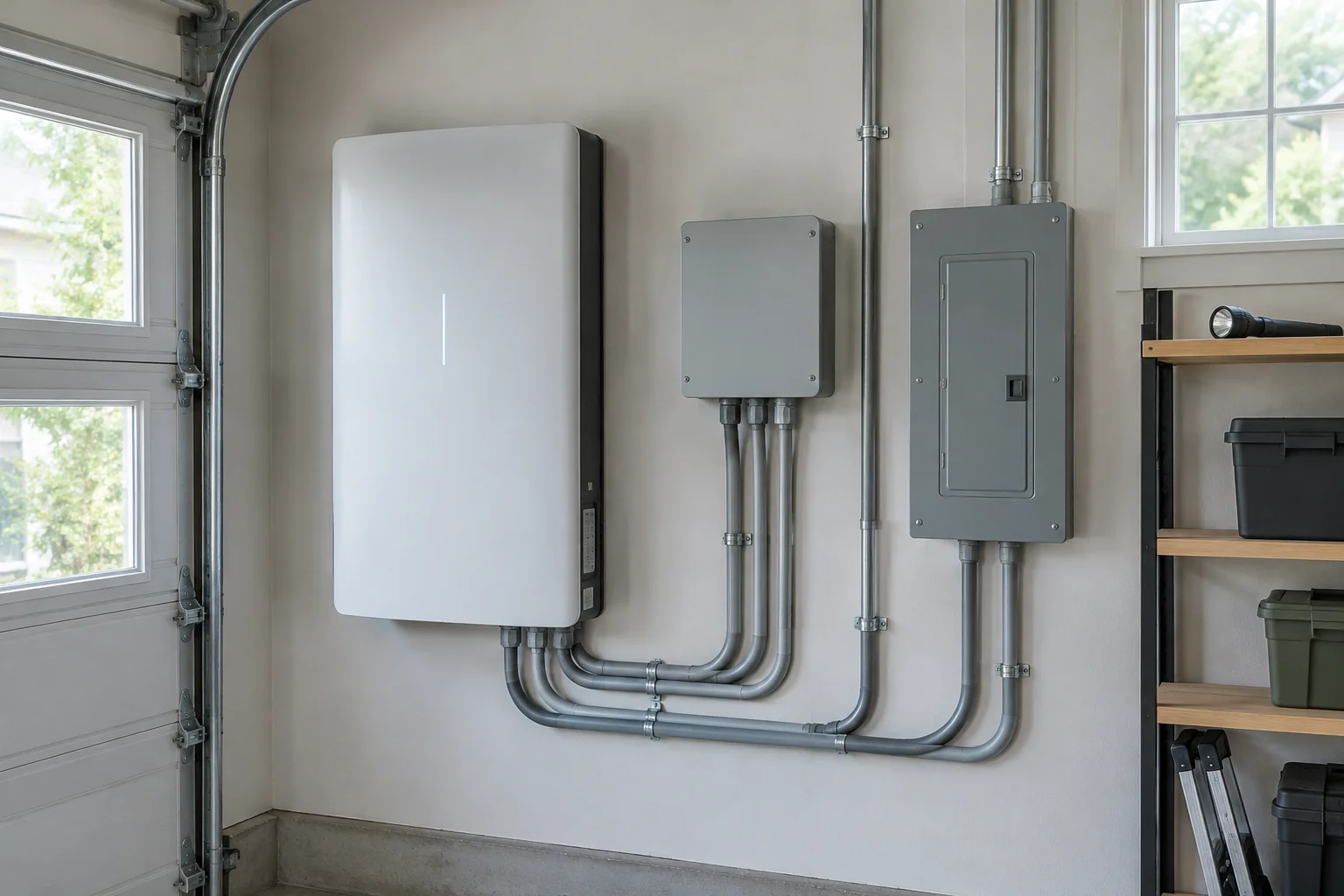
When the grid fails, a gateway or transfer switch detects the loss, disconnects your home from the utility lines, and lets the battery feed a backup circuit. Solar panels can then recharge the battery during daylight. When the grid returns, the system reconnects on its own, with no one needing to flip a switch.
The three pieces that make it work
A home battery system typically has battery modules, an inverter that converts between DC battery power and AC household power, and a control system that manages charging and discharging, as the Rhode Island Office of Energy Resources describes. It connects to your electrical panel.
The gateway or automatic transfer switch is the part that matters most in an outage. It is the referee between your house and the grid. Without it, backup power could push electricity out onto the wires, which is exactly what the safety rule forbids.
The backup subpanel: what is actually on
Most home batteries power a subset of your home, not every circuit. An installer moves the circuits you choose to a backup subpanel or programs the gateway to power them. Your bedroom outlets, the circuit with your medical device, the refrigerator and a few lights are typical picks.
Ask for a printed circuit list and label the outlets on the wall. During a stressful night, nobody wants to guess which outlet is live.
Does the switchover cause a gap?
Some systems transfer quickly enough that most plug-in electronics keep running. Others have a short gap. Do not assume. Ask the installer for the transfer behavior in writing, then ask your device supplier whether your equipment tolerates a brief interruption or needs its own internal battery or a plug-in uninterruptible supply.
Then test it. After install, have the crew trip the system to backup mode with you watching, and run your actual devices on it. That test tells you more than any spec sheet.
Can a solar battery replace a generator for medical devices?
A solar battery can replace a generator for short and medium outages and for quiet, fuel-free operation, but a generator covers longer multi-day outages when sun is weak. Many medical-device households pair them, so the battery handles the first hours and the generator is a second layer.
The right call depends on outage length where you live and the load you must carry. A battery has no fuel to store, no noise in the bedroom and no carbon monoxide risk, and it starts without anyone going outside in a storm. A generator can run as long as it has fuel.
If you already own a generator, you do not have to give it up. We cover the wiring and control side in solar and home backup generator: can you have both. Our own view: for a household where a power gap is a health issue, a battery as the first line and a generator as a second layer is hard to beat. Where winter outages run for days, keep the generator.
What incentives help with a battery in Connecticut?
Connecticut's Energy Storage Solutions program, run under PURA, pays an upfront incentive for home batteries, and the amounts have changed more than once since 2022. Because the rules and rates are revised, get the current figure in writing from your installer before you sign, and confirm it against the program's own pages.
The nine-year program launched on January 1, 2022, with a maximum per-project incentive of $7,500 for residential customers at the start. In January 2024, PURA raised the maximum residential upfront incentive from $7,500 to $16,000 and expanded support for underserved and low-income households.
The program has since moved to a different structure, so do not budget from either old number. Ask which incentive category your address falls into, and what paperwork is needed. Our solar tax credit and rebate paperwork guide walks through the forms. Massachusetts and Rhode Island have their own programs; ask your installer for current details for your town.
Questions to ask any installer before choosing battery backup
Use these with every company you talk to, including us. Each one has an answer that means good and an answer that means walk away.

1. Which circuits will be on backup, and can I see the list?
Good answer: a written list, with your medical device circuits named, agreed before install. Walk away if the answer is "whatever the battery can run" or "we will figure it out on site."
2. What is the expected runtime at my load?
Good answer: the installer asks for your device list, does the watts-times-hours math, and shows usable capacity and output rating. Walk away if you get a single runtime number with no questions about your devices.
3. How does the system transfer to backup, and is there a gap?
Good answer: they name the gateway or transfer switch, state the transfer behavior in writing, and agree to a live test. Walk away if they cannot explain it or will not test it with you present.
4. What happens when the battery runs low?
Good answer: a plan. Solar recharge by day, a reserve setting that saves a share of the battery for outages, and an option to add a second battery or a generator. Walk away if the plan is "that won't happen."
5. Who designs, installs and services it?
Good answer: a named in-house crew that will still be reachable in year five. Ask whether subcontractors do the electrical work. Our own take: for a medical-device household, accountability matters as much as the hardware, which is why we use in-house W-2 crews.
6. Is the contractor licensed?
Connecticut publishes a way to verify a license through the Department of Consumer Protection. State guidance for solar buyers also tells you to be wary of offers that sound too good to be true and of pressure tactics. Pass: the license checks out before you sign. Walk away if the company pushes you to sign the same day.
7. Can you add a battery to my existing solar system?
Good answer: yes, after checking your inverter, panel and wiring, and they will work on a system another company installed. Details are in our guide to how a solar battery retrofit works. Walk away if they refuse without inspecting it.
8. What do the warranty and service terms cover?
Good answer: separate, written terms for the battery, the inverter or gateway and the labor, plus a named person to call. Walk away if coverage is verbal or the number to call is a national queue.
What does Teamsun do for medical-device households?
Teamsun designs, installs and services battery systems across Connecticut, Massachusetts and Rhode Island using in-house W-2 crews, not subcontractors, and retrofits batteries onto solar systems that other companies installed. For a medical-device household, that means the same crew that designs your backup circuit is the one that services it.
We install FranklinWH, Tesla Powerwall and Enphase IQ batteries, and we will tell you which one fits your loads rather than which one is on the truck. If you have solar from another company, we can inspect it and say whether a battery can go on, and what it will take.
We are not your medical advisors, and we will ask you to bring your device supplier's guidance to the design conversation. What we can give you is a written circuit list, a runtime estimate from your own numbers, and a live test after install.
Frequently asked questions
How long will a solar battery run my medical equipment?
It depends on the total watts on your backup circuit and the battery's usable capacity. Divide usable kilowatt-hours by the kilowatts you draw. Sunshine can recharge the battery by day, which stretches runtime. An installer should calculate it from your own device list, not quote a generic number.
Do solar panels work during a power outage without a battery?
Not on a standard grid-tied system. The inverter shuts down when the grid fails, to protect utility workers. To keep power on, you need a battery or other backup source with automatic transfer equipment that isolates your home from the grid.
Can I add a battery to solar panels another company installed?
Often yes. The installer checks your inverter, electrical panel and wiring to see how a battery would connect. Some systems need an added gateway or inverter work. We retrofit batteries onto systems of any brand, after an inspection to confirm what is needed.
Should I still keep a generator if I get a battery?
For many households, yes. A battery handles short and medium outages quietly, and a generator covers multi-day events when sun is weak. If your health depends on power, a second source is a sensible layer. Your installer can design the two to work together.
Plan your backup before the next storm
If someone in your home depends on powered medical equipment, the best time to design a solar battery backup is before the next outage. Request a free quote and bring your device list; we will map which circuits go on backup and how long the battery should carry them.
Want to talk it through first? Talk to a designer, explore our battery and solar services, or call 203-903-4091. Ask for current pricing and incentive details when you reach us, so the design and the numbers arrive together.
Recommended Resources
Written by
Dan Katzman
Teamsun
Teamsun writes practical solar guidance to help property owners compare equipment, project scope, costs, and long-term service before making a decision.
Keep going.
Commercial Solar Depreciation (MACRS)
Commercial solar depreciation under MACRS explained: how 5-year recovery stacks with the federal tax credit, and what to ask your accountant before filing.
Dan Katzman
Teamsun
Commercial Solar for Warehouse Rooftop Owners
Commercial solar for warehouse rooftop owners: roof load limits, interconnection timelines, and financing for 25kW-500kW systems before you sign a contract.
Dan Katzman
Teamsun
FranklinWH Battery Cost: What Goes Into an aPower 2
FranklinWH battery cost explained line by line: aPower 2, aGate, labor, permits, and CT incentives. A guide for CT, MA and RI homeowners reading a quote.
Dan Katzman
Teamsun