How to Find a Local Solar Installer You Can Actually Trust
Find a local solar installer you can trust: check licenses, W-2 crews vs subcontractors, service-area history and real reviews. A New England vetting guide.
Dan Katzman
Teamsun
To find a local solar installer you can trust, run four checks before you sign: confirm an active state license, find out whether the people on your roof are employees or subcontractors, look at how long the company has serviced systems in your area, and verify that its reviews are real and recent. For Connecticut, Massachusetts and Rhode Island homeowners, each check takes minutes and costs nothing.
Key Takeaways
- Check the license on the state's site: Look up the company on the licensing board's page, not on the installer's own website. An inactive or missing license is an automatic walk-away.
- Ask who installs: Get a straight answer on whether your crew is W-2 employees or subcontractors, and who signs the workmanship warranty.
- Look for local history: A real office, branded vehicles, a local phone number and years of service calls nearby tell you who will answer when something breaks in year six.
- Read reviews for patterns: Recent reviews that describe problems and how the company fixed them are worth more than a wall of five-star one-liners.
- Get it in writing: Timeline, equipment models, warranty and service terms should all appear on the quote, so you can compare bids line by line.
Local Solar Installer Vetting at a Glance
| Check | Where to verify | Passing answer | Walk away if |
|---|---|---|---|
| License and insurance | State licensing board lookup | Active license in the company's name, insurance on file | License is suspended, expired or in another company's name |
| Certification | Ask for the credential number; confirm with the issuer | NABCEP-certified staff or other named credentials | Vague "fully certified" claims with no names |
| Crew employment | Ask the salesperson, then ask for it in the contract | Named employer of the install crew, with workers' comp | No clear answer on who is on your roof |
| Service-area history | Street address, years in business, service-vehicle sightings | Local office and a team that services the systems it installs | Only a call center, no local address |
| Reviews | Google, state consumer office, Better Business Bureau-style complaint records | Steady stream over years, with specific details and replies | Bursts of generic praise, no mention of problems being solved |
| Timeline | Written quote and contract | Start and end points defined (contract to power-on) | "About a few months" with no milestones |

Why Do National Sales-Driven Solar Companies Create Accountability Gaps?
National solar companies often split the job into pieces: a sales team signs the contract, a separate crew or subcontractor installs, and a call center handles problems later. When something goes wrong, each piece can point at another. A local installer that sells, installs and services under one roof removes that hand-off.
The gap rarely shows up on day one. The salesperson is friendly, the quote looks fine and the financing paperwork is tidy. The trouble arrives when a roof flashing leaks, an inverter throws a fault, or the person who promised something is no longer with the company.
We should be honest here: local does not automatically mean good. A small shop can have weak workmanship, thin finances or no plan for the day its owner retires. And some national companies have solid local branches. The point of this guide is not to rule out a type of company. It is to test whoever is bidding, using evidence you can check yourself.
If you are weighing a big brand against a regional firm, our breakdown of installers versus dealer networks explains how those business models differ and why it changes who is responsible for your system.
The questions that expose a sales-first company
- Who will be physically on my roof, and who employs them?
- Who do I call after install, and is that person local?
- If I have a problem in year three, who signs off on the repair?
- Will you service the system if I later add a battery or sell the home?
A confident local installer answers these in a sentence each. A sales-first company tends to answer with a policy, a hotline or "we'll have someone get back to you."
1. Verify the License and Insurance on the State Site
Start with the license, because it is the one check with a clear pass or fail. Look up the company on your state's licensing site, not on the installer's own page. The state record shows whether the license is active and often shows discipline or complaint history.
Where to look it up
In Connecticut, the Department of Consumer Protection runs an online license verification portal that checks licenses in real time. Connecticut licenses solar work under dedicated classes, and the contracting company generally needs a Home Improvement Contractor registration as well as a solar electric or electrical contractor license. Ask for the license numbers and confirm each one.
Massachusetts and Rhode Island each have their own state boards for electrical and home improvement contractors. Search the state's licensing board for the company name and the license number printed on the contract. The rules differ by state, so do not assume a Connecticut license covers work across the border.
Other states publish helpful checklists too. Minnesota's Department of Commerce, for example, tells homeowners to verify contractor licenses and insurance and to check whether the contractor has an enforcement action on its record. The same habit works anywhere.
Certifications and trade membership
The U.S. Department of Energy's guide to choosing a solar installer points homeowners to certifications from groups like the North American Board of Certified Energy Practitioners (NABCEP), and says to make sure the installer is licensed and bonded. NABCEP offers voluntary certification, so it is a plus, not a legal requirement.
The Solar Energy Industries Association (SEIA) publishes a Solar Business Code that member companies are expected to follow. Maine's Attorney General suggests asking whether an installer is a SEIA member that agrees to abide by that code. Membership is a signal, not a guarantee, so treat it as one input.
Pass mark and walk-away
- Pass: The license is active, the name matches the contract, and the company can tell you which named employees hold any certifications.
- Walk away: The license is expired or suspended, or the company says it works "under" someone else's license and cannot explain the arrangement in writing.
- Pause and ask: The record shows a past complaint. Ask what happened and how it was resolved. One resolved issue is different from a pattern.
2. Find Out Whether Crews Are Employees or Subcontractors
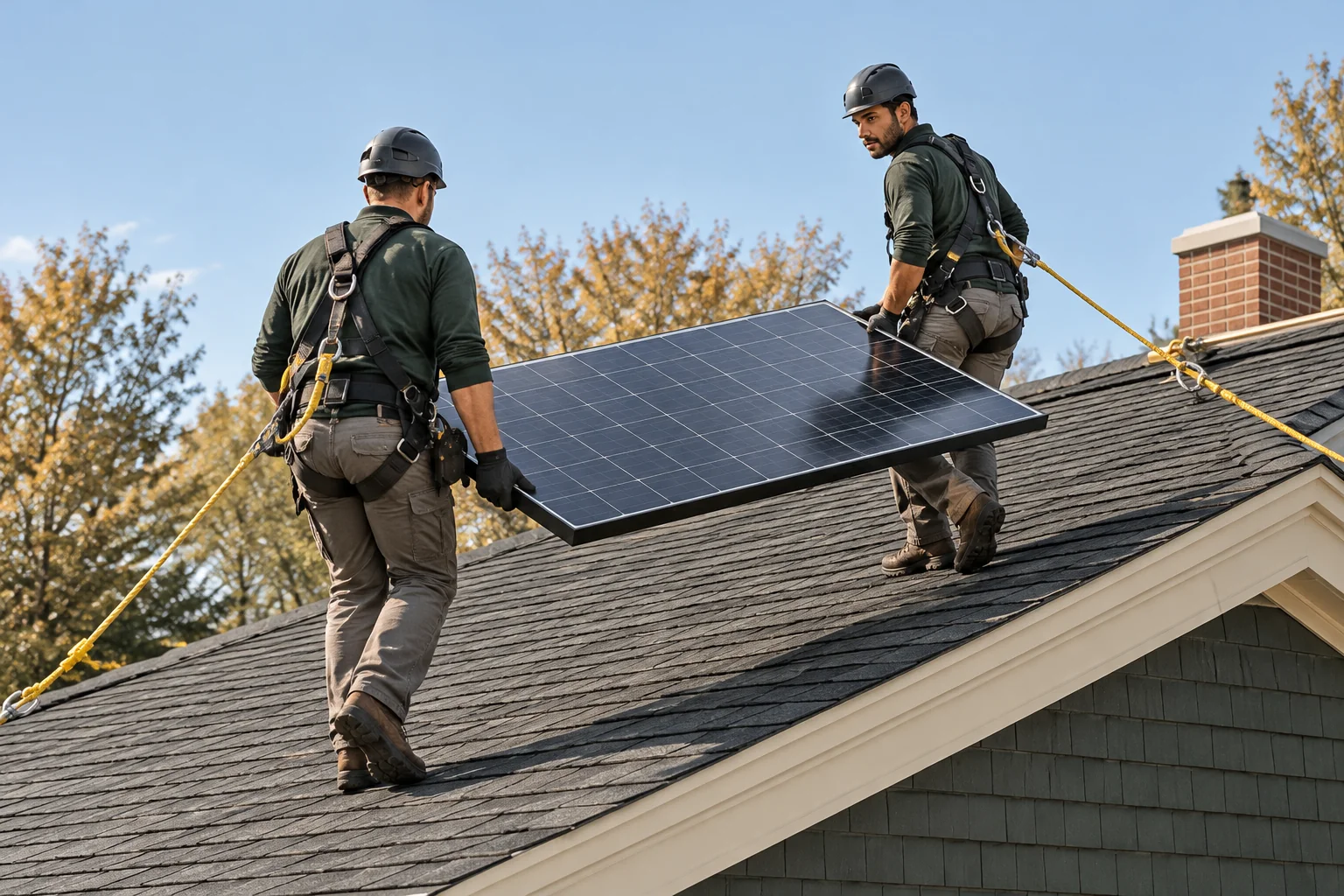
This is the check that separates a local solar installer from many national sales outfits. If the crew works for the company that sold you the system, one employer answers for the quality. If a subcontractor does the work, the company that sold you the job may never meet the crew.
What to ask
Ask three direct questions. Are the installers W-2 employees of your company? Who carries workers' compensation and liability insurance for the crew on my roof? Who signs the workmanship warranty?
Subcontracting is not illegal, and some subcontract crews are excellent. The issue is accountability: you need to know who is responsible and be able to reach them. A company that uses subcontractors should be willing to name them and put the warranty responsibility in the contract.
How we do it at Teamsun: we are a privately owned installer serving Connecticut, Massachusetts and Rhode Island, and our installs are done by our own W-2 crews, not subcontractors. The person who answers a service call works for the same company that built your system. That is a business choice, and you should hold every installer, including us, to the same questions.
Pass mark and walk-away
- Pass: A clear answer, such as "our own employees install, and here is our insurance certificate."
- Acceptable with conditions: Subcontractors are used, but they are named, licensed, insured and covered by the installer's written warranty.
- Walk away: The salesperson dodges, says "it depends on the schedule," or will not put warranty responsibility in writing.
For a deeper look at the trade-offs, see our guide to 15 questions to ask a solar installer before you sign, which covers crew, equipment and contract questions in one list.
3. Judge Service-Area History and Who Services the System Later
A solar system is a 25-year relationship, so the company's staying power matters more than the sticker price. Look for a physical office in your region, service vehicles with the company name, and a local phone number that a person answers. These are simple signs that people there will still be around.
Signs of real local roots
- A street address you can visit or look up on a map, not just a mailing address or virtual office.
- A track record of systems installed in your town or neighboring ones. Ask for addresses you can drive past, or for homeowners willing to take a call.
- Service staff who are employees, so the person fixing a fault in year eight knows the company's older installs.
- Willingness to service other brands. A local installer that supports systems it did not build tends to be one that expects to stay in business.
Ask about the long game
Installers can go out of business, so plan for it. Ask how the company handles warranties if it closes, and check that the panel and inverter warranties come from the manufacturers rather than only from the installer. Our piece on what to do when your solar installer goes out of business walks through the fallback options.
Timelines: ask what is being counted
Speed is a service signal too, but only if everyone counts the same way. A national lab study of state processes found a median of 53 days for the full interconnection process, from the installer submitting the utility application to receiving permission to operate. That is just one stage of the job.
Our own average install timeline is 47 days. That is a Teamsun figure from our own projects, not an independent benchmark, so ask every installer, us included, where the clock starts and stops: contract signing, permit filing or crew arrival, and power-on or just the last panel. A timeline with defined milestones is a good sign. "A few months, depending" is not.
4. Verify That Reviews Are Real and Recent
Reviews are useful only if you read them for patterns instead of star averages. Look at the dates, the detail and how the company responds when something goes wrong. A review that names the crew, the town and the problem that got fixed is far more informative than "great experience, highly recommend."
A review-reading routine
- Sort by newest. Reviews from the last year or two show how the company operates now, not how it did when it was smaller or under different ownership.
- Read the three-star and one-star reviews first. Look for the same complaint repeating, such as billing, delays or no callbacks.
- Check the company's replies. A calm reply that offers a fix and a named contact is a good sign. A copy-paste apology or a fight in public is not.
- Look at timing. A sudden burst of near-identical five-star reviews in a few days can signal solicited or low-quality feedback.
- Check more than one platform. Compare Google, Facebook and any independent directory, then cross-check with your state attorney general's or consumer protection office for complaints.
- Talk to a neighbor. Ask the installer for a few local addresses of systems more than two years old, and knock on a door if you can.
Pass mark and walk-away
- Pass: Reviews spread over several years, with specific details, a few critical ones, and visible company replies.
- Walk away: Reviews that are all vague, all recent, or that mention the same unresolved issue (such as warranty claims that went unanswered).
No review check is perfect. Some honest installers have few reviews because they are small or new, and some large companies have thousands, good and bad. Use reviews to decide whom to ask harder questions, not to crown a winner.
5. Compare Written Quotes and Ask the Closing Questions
Once a company passes the first four checks, get a written quote and line up the offers. Compare system size, equipment models, production estimates, warranty terms, who installs, who services, financing terms and the timeline. Prices that look far apart often differ in what they leave out.
Our guide on how to line up solar bids side by side gives a layout you can copy. If a company will not put its answers about crew, warranty and service in writing, treat that as your answer.
A simple decision rule
Our advice: if two bids are close in price, pick the one with clearer answers on crew employment and post-install service, even if it is slightly higher. Price differences of a small amount disappear over decades; an unreachable installer does not. If one bid is far cheaper, find out what was removed before you assume you found a bargain.
Local Solar Installers in Connecticut, Massachusetts and Rhode Island
Many homeowners start by searching phrases like "best solar companies in Massachusetts," "solar installers RI" or "solar companies in MA." Those lists are a fine starting point for names, but they rarely tell you about licensing, crew status or service history. Use them to build a shortlist of three, then run each name through the four checks above.
Rules and incentives differ by state, which affects what an installer must know. Connecticut, Massachusetts and Rhode Island each have their own licensing boards, utility interconnection rules and incentive programs.
Ask any installer how many systems it has connected with your specific utility, because that experience directly affects paperwork and speed. Our comparison of solar services across the region shows what we install and maintain in all three states, including battery retrofits and repairs for systems built by other companies.
A worked example (hypothetical)
Suppose you collect three bids. Bidder A shows an active license in its own name and says its own W-2 crews install, with the insurance certificate attached. Bidder B has an active license but says "it depends on the schedule" when asked who installs. Bidder C's license number does not match the company name on the state site.
Bidder C is out, because a failed license check is final. Ask Bidder B for the crew answer by email. If it names the subcontractor and puts warranty responsibility in writing, B stays in. If not, B is out, and Bidder A gets your harder follow-up questions on timeline and service.
What If a Check Fails?
If a check fails, do not argue with the salesperson; step back and either get a written fix or move to the next bidder. A failed license check is final. A weak review pattern, vague crew answer or missing service plan can be tested with one written question before you decide.
- License problem: Stop. Ask for the license number again, recheck the state site, and move on if it still does not match.
- Crew answer is unclear: Ask for the answer by email. If it comes back clear and insured, continue. If not, move on.
- Few or odd reviews: Ask for two local references with systems at least a couple of years old and call them.
- Already signed: Read the cancellation terms in your contract right away and contact your state consumer protection office if you believe the company misrepresented its license or crew.
One thing is not settled: even a perfect vetting score cannot guarantee that a company will still be operating in 15 years. What you can do is lower the odds of trouble by choosing a company with roots, insured crews and manufacturer-backed warranties.
FAQ
What makes a solar installer local?
A local solar installer has a physical office in your region, a crew that works nearby, and staff who also handle service calls for systems in your area. Check that the license, address and phone number match a real local operation rather than a sales office that outsources the work.
Is a national solar company ever the right choice?
Sometimes. A national company may offer financing structures or scale that a small shop cannot match. If you are considering one, put it through the same four checks, and compare using our Sunrun versus local installer comparison.
How do I know if solar installer reviews are fake?
Look for patterns: many near-identical five-star reviews posted within a few days, no detail about the work, and no critical reviews at all. Real review histories span years, mention specific crews or towns, and include some complaints with visible, specific company replies.
Should I ask for a NABCEP-certified installer?
It is a positive sign, since NABCEP certification is voluntary and shows an individual has met the board's standards. It does not replace a state license, insurance or a clear warranty, so ask who on the team holds it and whether that person works on your job.
Next Step: Put Us Through the Same Checks
We are happy to be vetted. Ask us for our license numbers, our crew arrangement, our service record in your town and our written timeline, and compare the answers to every other bid you collect. If you want to start, request a free quote and we will put the details in writing.
Prefer to talk first? You can talk to a designer about your roof and goals, or call us at 203-903-4091. Either way, you will hear from a local team that stands behind its own installs.
Recommended Resources
Written by
Dan Katzman
Teamsun
Teamsun writes practical solar guidance to help property owners compare equipment, project scope, costs, and long-term service before making a decision.
Keep going.
Sunrun vs SunPower vs Local Installer Comparison
Sunrun vs SunPower vs local installer comparison: install speed, warranty accountability, and service response, broken down for Connecticut homeowners comparing quotes.
Dan Katzman
Teamsun
Solar for High Electric Bills: How Much Can You Save?
See real bill-reduction numbers from CT, MA, and RI homeowners who sized solar panels for high electric bill homes, including battery add-on payoffs.
Dan Katzman
Teamsun
Can You Get Solar Panels That Match Your Roof Color?
Solar panels that match roof color: your real options in CT, MA and RI, from all-black panels to low-profile racking, plus HOA and historic district rules.
Dan Katzman
Teamsun