Why Is My Solar Production Lower Than Estimated? Common
Solar production lower than estimated? Check shading, dirty panels, degradation, inverter faults and monitoring first, then learn when a service visit is worth it.
Dan Katzman
Teamsun
Solar production usually falls below the original estimate for a handful of ordinary reasons: a cloudier or snowier year than the model assumed, new tree shade, dirty or snow-covered panels, normal panel aging, an inverter that has tripped, or a monitoring app that stopped reporting. Most owners in Connecticut, Massachusetts and Rhode Island can rule out several of these in an afternoon.
Key Takeaways
- Compare like with like: An estimate is a modeled typical year, so judge your system over 12 months or against the same month, never against one bright day.
- Check the free causes first: New shade, snow, pollen, a tripped inverter and a dropped Wi-Fi link explain many shortfalls and cost nothing to check from the ground.
- Expect slow fade: Panel output typically degrades by around 0.5% per year, so a ten-year-old system should not match year-one numbers.
- Stay off the roof: Cleaning with a hose from the ground is fine. Wiring, mounts and inverter covers are a licensed-crew job.
- Call when the pattern is clear: An inverter fault code, one dead string, a steep sudden drop or a gap that persists after the free checks is worth a service visit.
Solar Production Troubleshooting at a Glance
| Likely cause | Quick check | What it looks like | Who fixes it |
|---|---|---|---|
| Normal weather variation | Compare the same month, or a full 12 months, to the estimate | Low in a cloudy or snowy stretch, recovers later | Nobody; no repair needed |
| New shading | Walk the yard and look up at tree growth and new structures | Dips at the same hours each day | You (tree trim) or an installer (optimizers) |
| Soiling or snow | Look at the glass from the ground | Gradual loss, or a sharp loss after a storm | You, from the ground, or a cleaning pro |
| Panel degradation | Compare year-one output to today | A small, steady decline each year | Warranty claim only if far past the stated curve |
| Inverter fault | Read the status light and error code | Zero output, or a sudden step down | Installer or service crew |
| Monitoring dropout | Check the Wi-Fi link and the app's last-reported time | Flat gaps in the graph | You (router), or a crew (gateway) |
| Wiring, mounts, roof wear | Spot visible damage from the ground | Persistent loss with no other cause | Licensed solar crew |
Why Does Solar Production Come In Below the Original Estimate?
Solar production comes in below the estimate because the estimate is a model of a typical year, not a promise for your actual year. Real weather, new shade, dirt, panel aging and equipment faults all pull output down. Some are normal and some need a repair, so the first job is telling them apart.
Your contract usually shows the array's estimated annual production. That number comes from a design tool that uses historical sunshine data for your town, your roof angle and direction, and a list of assumed losses. It is a good planning figure. It cannot know that this February brought three nor'easters or that the maple next door grew six feet.
The practical test is simple. Pull your actual kilowatt-hours for a full 12 months and set them beside the estimate. A gap of a few percent either way is ordinary. A large shortfall that holds month after month points to a cause you can find.
A hypothetical worked example
Say a contract predicted 10,000 kWh in year one. Panels fade by around 0.5% per year, according to Concord, Massachusetts guidance on common PV maintenance issues. After ten years that alone brings the same array to about 9,500 kWh, even in a perfect weather year.
Now add a cloudy year and some pollen buildup. A reading of 9,000 kWh would not be alarming. A reading of 7,000 kWh, with no weather story to explain it, deserves a hunt for the cause. That is the logic behind every section below.
1. Compare Against the Right Baseline First
Before you suspect equipment, check that you are comparing the right numbers. Many "low production" worries are a bad comparison, not a bad system. Three mistakes show up again and again.
- Comparing one day to the estimate. The annual estimate averages sunny July days and dark December ones. Judge months, then the year.
- Comparing winter to summer. In Connecticut, Massachusetts and Rhode Island the sun is lower and the days are short from November to February, so output falls sharply by design.
- Comparing against the wrong figure. Some estimates are in AC kWh, some in DC. Check which one your contract uses, and which one your app reports.
Also check the system's own year-to-year history. If last June and this June are far apart and the weather was similar, something changed. That "something" is the thing to find.
Pass mark: your 12-month total sits close to the estimate once you allow for weather and about 0.5% fade per year. Walk-away signal: a steady gap that does not shrink in sunny months. Move on to the physical checks.
2. New Shading From Tree Growth and Neighbors
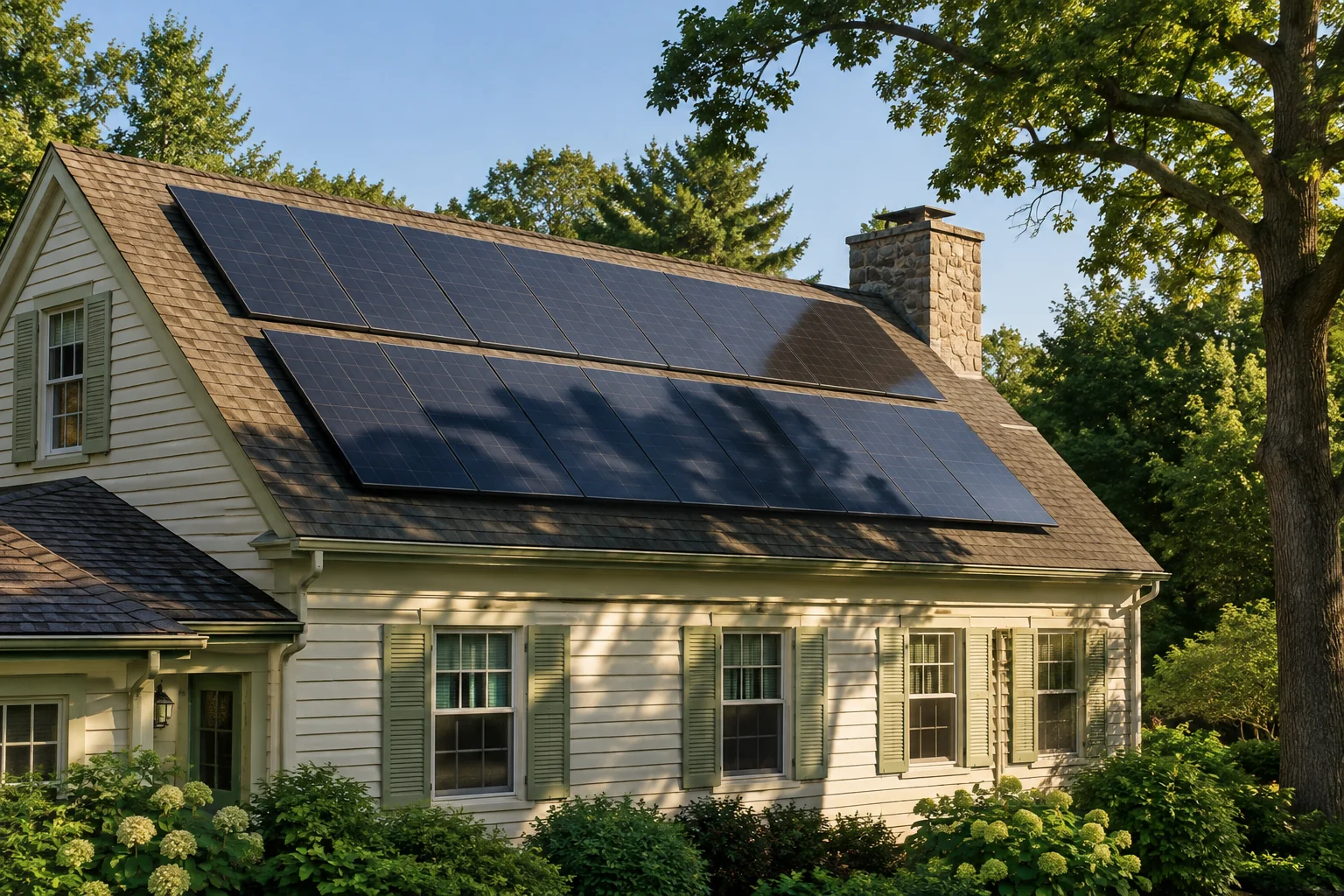
Shade is the most common reason a system that once met its estimate now falls short. Trees grow slowly, so the loss creeps in. A panel that was clear when it was designed can sit in shadow for two hours each afternoon five years later.
Walk your yard and look up. A Department of Energy guide on keeping solar PV performing lists routine planned maintenance as part of a full O&M plan, and watching vegetation is part of that routine. Look for new branches, a neighbor's addition, a satellite dish or a chimney extension that did not exist at design time.
How to confirm shade is the cause
- Open your monitoring graph for a clear day and look for a dip at the same hours every day.
- Stand at the array at that hour and see what is casting the shadow.
- Check whether the dip moves with the seasons. Low winter sun makes shade worse.
Shade hurts a string inverter system more than one with microinverters or optimizers, because a shaded panel can drag down the whole string. If a single tree is the problem, trimming it is cheapest.
If it is not removable, adding module-level power optimizers is a fix an installer can quote. We have written about the topic more fully for homes with trees, but the quick rule is that partial shade is a design problem, not a death sentence.
3. Dirty Panels, Snow, Pollen and Debris
Soiling is real but usually modest in New England, where regular rain washes the glass. The losses that matter are patchy: a bird dropping on one cell, a pile of leaves along the bottom edge, or snow sitting in the lower rows. Because cells are wired in series, a small blocked area can cost more than its size suggests.
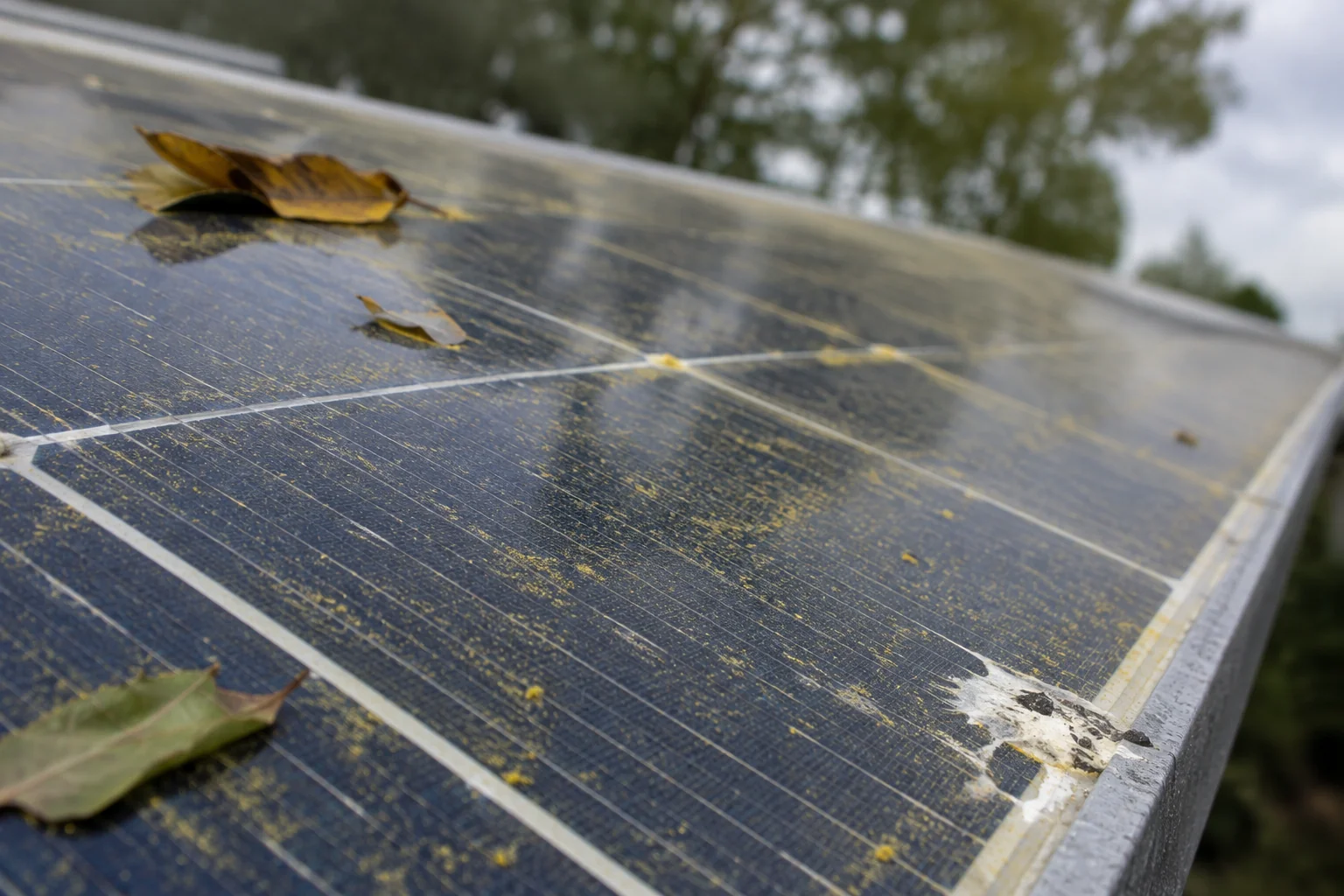
The PNNL solar O&M checklist, published by the Pacific Northwest National Laboratory, includes inspecting the array for dirt or droppings as a standard task. That tells you it is a routine item, not an exotic one.
What you can do safely
- Look at the glass from the ground with binoculars. Note streaks, film, droppings or debris.
- Rinse with a garden hose from the ground on a cool morning, using plain water. Skip pressure washers and harsh scrubbing, which can scratch coatings.
- Never climb onto a snowy or wet roof. For snow, wait for sun to slide it off, or see our guidance on when to clear panels and when to leave them.
If a rinse brings output back, you found the cause. If nothing changes, cross soiling off the list. Keep in mind that a broken or cracked panel, which you may spot from the ground, is an equipment fault and needs a crew, not a hose.
4. Normal Panel Degradation
Every panel loses a little output each year. This is expected and is built into the performance warranty. A figure of around 0.5% per year is a commonly cited typical rate, though individual panels and climates vary.
The useful question is whether your decline is on the normal curve. A 12-year-old system giving about 6% less than year one is unremarkable. The same system giving 25% less is not explained by aging alone, and something else is stacked on top.
Check the warranty for the guaranteed output at your system's age. Panel makers publish a performance curve, and installers cover labor and the roof under a separate workmanship promise. Our guide to product, performance and workmanship coverage explains who owes you what, and it helps you decide whether a claim is realistic before you start the paperwork.
5. Inverter Faults and Error Codes
The inverter converts the panels' DC power into AC power for your home, so when it stops or throttles, production drops across the whole system. It is the single most likely piece of hardware to cause a sudden, large loss.
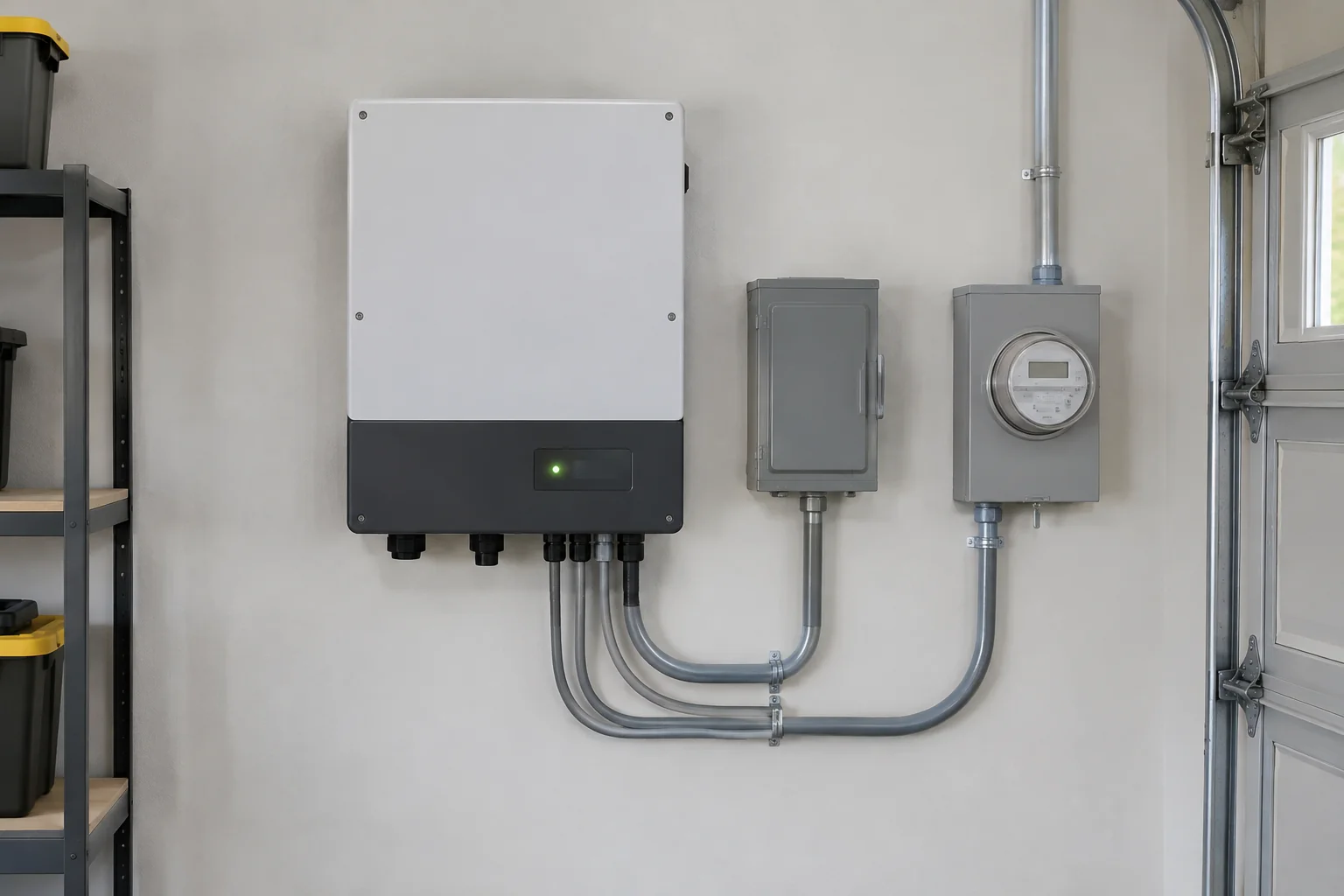
Start with what you can see without touching anything. Look at the inverter's status light or display. A steady normal light in daylight is a good sign. A red or flashing light, an error code, or a blank display on a sunny day is not.
Inverter checks and pass marks
- Status light normal in daylight: pass. Move to other causes.
- Error code showing: write it down exactly, and photograph the screen. Do not clear it repeatedly.
- Display dark in daytime: check the solar breaker and the AC disconnect at your panel, and reset a tripped breaker once. If it trips again, stop and call.
- Output stepped down overnight and stayed down: a failed string or a partial fault is likely.
Do not open inverter covers or touch conduit. High DC voltage stays live while the sun shines, even with the breaker off. If a restart per the manufacturer's instructions does not clear it, the next step is a crew visit. Our crews work on systems other installers put in, and a clear photo of the error code speeds that visit.
6. Monitoring Gaps and Wi-Fi Drops
Sometimes the panels are fine and the data is wrong. If your home router changed, your Wi-Fi password changed or the monitoring gateway lost its link, the app can show zero or flat lines while the system keeps producing.
Look for the tell: a graph that goes flat at one time and stays flat, or an app banner saying the system is offline. Production that is not reported is not production that is lost, and the utility production meter keeps counting. Read your meter or utility statement and compare it to the app total.
If the numbers match, nothing is wrong with the panels. If the meter shows far more than the app, the monitoring is the problem. Our walk-through on how to read your solar monitoring app data shows what each graph line means, so you can spot a real dip versus a data gap.
Restarting the router and the gateway fixes many dropouts. If you recently changed internet providers, the gateway likely needs to be re-paired. That is often a phone call, not a truck roll.
7. Loose Wiring, Mounts, Roof Damage and Equipment Wear
This group is the one you cannot diagnose by looking. It includes loose connections, corroded connectors, worn wire insulation, damaged mounts or roof penetrations that have started to leak. The PNNL checklist names items like signs of electrical arcing, loose wiring, insecure mounts, signs of corrosion and the integrity of roof penetrations, which is the kind of list a trained crew works through.
Warning signs you can spot from the ground include a panel sitting at an odd angle, cracked glass, scorch marks, a wire hanging below the array or a water stain on the ceiling below the roof section. Any of these is a reason to call, not to climb.
This is the area where an installer who services any brand earns the visit. Wiring faults often cause a modest but constant loss, easy to mistake for aging. A thermal imaging pass, the kind a Concord, Massachusetts operations and maintenance plan schedules at least annually for major equipment, can find a hot connection before it fails.
8. Utility, Net Metering and Reading Misunderstandings
Sometimes the system is producing exactly what it should and the bill still looks wrong. Production, export and credits are three different numbers, and they often get blended together.
- Production: what the panels generated, from the inverter or production meter.
- Export: what you sent to the grid after your home used what it needed.
- Credits: what your utility applied to your bill under its program.
If you used a lot of the power at home during the day, export will be low even when production is high. That is not a fault. Our explainer on how solar net metering works with your utility shows how credits are counted so you do not chase a problem that is only an accounting question.
One thing is genuinely unsettled for many owners: how much a grid outage or a utility-side limit trimmed output on a given day. Your inverter log may show it, but your utility does not always say. If that matters to you, ask your installer to read the inverter event log.
Your Troubleshooting Checklist Before Calling for Service
Work through these in order. Each takes minutes, and most cost nothing.
- Set the baseline. Compare 12 months (or the same month last year) to the estimate. Allow for about 0.5% fade per year and for unusual weather. Pass: you are close. Fail: a steady gap remains.
- Check the monitoring. Is the app online? Does the meter total match the app total? Pass: they match. Fail: fix connectivity first.
- Read the inverter. Normal light in daylight is a pass. An error code, red light or dark screen is a fail. Photograph it and write the code down.
- Check breakers. Look at the solar breaker and AC disconnect. Reset a tripped breaker once only. A repeat trip means stop.
- Look for shade. Compare clear-day graph dips with what is casting shadow. Pass: no recurring dip. Fail: a dip that repeats at the same hours.
- Look at the glass. From the ground, check for dirt, droppings, snow or leaf piles. Rinse from the ground if it is safe. Pass: output recovers.
- Look for damage. Cracked glass, a panel at an odd angle, scorch marks or hanging wire is an automatic call.
- Gather your records. Contract estimate, last 12 months of kWh, the error code photo, and your warranty papers.
When Is a Service Visit Actually Worth Calling For?
A service visit is worth booking when you see an inverter fault code, a dead string, visible damage, a sudden steep drop, or a large gap that persists after the free checks. Skip the visit when the explanation is weather, snow, a Wi-Fi dropout or normal fade.
Here is our plain rule. If the cause is a thing you can see and fix from the ground, fix it. If the cause is electrical, on the roof or unclear, call a licensed crew. Roof work and inverter work carry real risk, and the savings from doing it yourself are small.
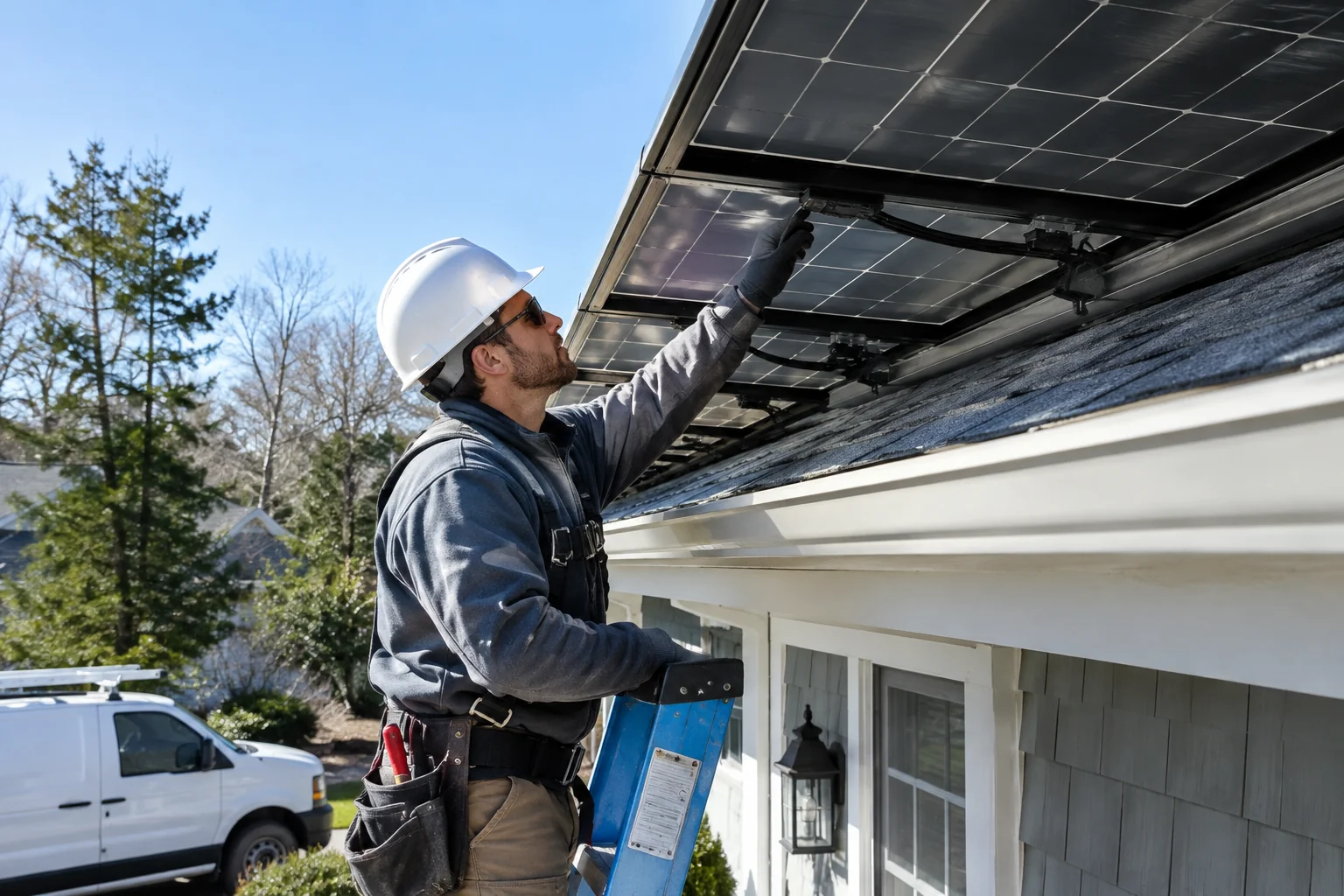
Who to call, and how to vet them
Your original installer is the first call, especially if the system is under a workmanship warranty. If that company has closed, or will not service the system, you still have options. We service systems that other installers put in, across all brands, in Connecticut, Massachusetts and Rhode Island, using our own W-2 crews rather than subcontractors.
In Connecticut, the state's eLicense lookup lets you verify a contractor's license, and the state's solar panel buyer's guide advises caution about offers that sound too good to be true or involve pressure tactics. The same common sense applies to a service call: get a written scope, and ask what the diagnostic visit costs before the truck rolls.
What to bring to the call
- The contract estimate and the last 12 months of production.
- A photo of the inverter display and any error code.
- The date you first noticed the drop, and anything that changed near then (storm, tree work, roof work, router swap).
- Panel and inverter model numbers from the equipment labels.
If the shortfall is tied to an aging inverter or older equipment, it may be a good moment to ask whether repair or upgrade makes more sense. If you are thinking about storage, our guide to how a solar battery retrofit works explains what a retrofit adds to an existing system, and a crew can check your production at the same visit.
Frequently Asked Questions
How much lower than the estimate is too low?
A gap of a few percent over a full year is normal, since estimates model a typical year. A large gap that persists, or a sudden step down, is worth investigating. Judge over 12 months, and allow for about 0.5% fade per year on older systems.
Should I clear snow off my solar panels?
Usually not. Tilted panels shed snow within a day or two of sun, and climbing a snowy roof is dangerous. Only consider clearing from the ground with a soft roof rake made for solar, and only when snow is heavy, stuck and has been there for days.
Can a monitoring app show low production when the panels are fine?
Yes. If the gateway loses Wi-Fi, the app shows flat lines or zeros while the system keeps producing. Compare the app total to your utility production meter or statement. If the meter is higher, the panels are fine and the connection needs fixing.
Do I need to remove my panels to fix low production?
Almost never. Removal and reinstallation is done for roof replacement or major roof repair, not for output problems. Most low-production fixes involve a tree trim, a cleaning, an inverter repair or a wiring repair with the panels left in place.
Will you service a system another company installed?
Yes. We diagnose and repair solar systems of any brand and age across Connecticut, Massachusetts and Rhode Island, and we can add battery storage to an existing system. Bring your estimate, your recent production and a photo of the inverter display.
Next Step: Get a Straight Answer on Your Numbers
If you worked through the checklist and the gap is still there, you have the facts a crew needs to find the cause quickly. Request a free quote or a system check, and tell us your estimated and actual production. You can also talk to a designer, explore our service and repair options, or call 203-903-4091 to describe the symptoms with someone who has seen your kind of system before.
Low solar production is rarely a mystery for long. It is usually weather, shade, dirt, a tripped inverter or a data gap, and the rest has a name once a trained crew looks.
Recommended Resources
Written by
Dan Katzman
Teamsun
Teamsun writes practical solar guidance to help property owners compare equipment, project scope, costs, and long-term service before making a decision.
Keep going.
EV Charger Installation Cost for Massachusetts Homeowners
What EV charger installation costs Massachusetts homeowners in 2026: Level 2 hardwired pricing, panel upgrades, permits, rebates and solar bundling.
Dan Katzman
Teamsun
Solar Panel Warranty Explained
Solar panel warranty explained for CT, MA and RI homeowners: product, performance, inverter, battery and workmanship coverage, and what voids each.
Dan Katzman
Teamsun
Why is my solar quote so different from my neighbors
Why is my solar quote so different from my neighbors? Compare kW, equipment, crew type, and financing to spot what's really driving the price gap.
Dan Katzman
Teamsun