Solar Panel Warranty Explained
Solar panel warranty explained for CT, MA and RI homeowners: product, performance, inverter, battery and workmanship coverage, and what voids each.
Dan Katzman
Teamsun
A solar panel warranty is not one document. It is several separate promises from different companies: the panel maker covers defects and output, the inverter and battery makers cover their own equipment, and your installer covers the labor and the roof. For homeowners in Connecticut, Massachusetts and Rhode Island, the installer's workmanship warranty is usually the one that decides whether a problem costs you money.
Key Takeaways
- Five promises, not one: panel product, panel performance, inverter, battery and installer workmanship each have their own issuer, length and claim process.
- Parts versus labor: manufacturer warranties often replace the part but do not pay anyone to remove, ship and reinstall it, so ask in writing who covers labor.
- Longest does not mean strongest: a 25-year panel warranty means little if the company that installed the system is gone in year three.
- Common voiders: unapproved repairs, metal tools used to clear snow, and roof work by another contractor can all put coverage at risk.
- Installer closure: manufacturer warranties generally outlive the installer, but workmanship coverage may not, so keep your paperwork and system records.
Solar Panel Warranty at a Glance
| Warranty | Issued by | What it covers | Typical length (manufacturers in general) | Who you claim from |
|---|---|---|---|---|
| Panel product | Panel manufacturer | Defects in materials and manufacturing | 12 to 30 years | Manufacturer, usually through your installer |
| Panel performance | Panel manufacturer | Minimum power output over time | 25 to 30 years | Manufacturer, with production data |
| Inverter | Inverter manufacturer | Equipment failure that converts panel output into usable power | Usually 10 years | Manufacturer or your installer |
| Battery | Battery manufacturer | Defects and capacity loss, often with a throughput limit | Set by the maker; read the years and the energy limit | Manufacturer or certified installer |
| Workmanship and roof penetration | Your installer | Mounting, wiring, leaks at roof attachments | Set by the installer; get it in writing | Your installer |
| Labor for repairs | Varies by contract | Cost of removing and reinstalling a part | Often excluded from manufacturer terms | Check each warranty document |

Why Does a Solar System Have Several Warranties Instead of One?
Because several companies build the system. The panel maker, the inverter maker, the battery maker and the installer each stand behind only their own work, and each warranty runs on its own clock. One contract may bundle them on paper, but the promises stay separate.
The Federal Trade Commission tells buyers to ask about the full cost of installation, whether any output is guaranteed, and what warranties apply to the panels and inverters. That is the right starting list. Ask who issues each warranty and what each one actually pays for.
Typical warranty lengths in this article describe what manufacturers commonly offer. They are not Teamsun's terms, and they change by brand and model. Always read the document for the exact equipment on your quote.
What Does the Panel Product Warranty Cover?
The panel product warranty covers manufacturing defects in the module itself, such as faulty materials, delamination or a failed junction box. Manufacturers commonly offer anywhere from 12 to 30 years. It does not cover damage from storms, bad installation or accidents, which fall to insurance or the installer.
Reported product warranty terms across the industry run from about 12 to 30 years, and the longer terms tend to come with premium panels. A longer term is useful, but read what counts as a defect and what the remedy is.
Parts only is the usual catch
Many panel warranties promise a replacement panel and stop there. They may not pay for a crew to take the bad panel off the roof, install the new one and retest the string. Some manufacturers add a labor allowance, and many do not.
If labor is not covered by the manufacturer, it falls on you or on whatever the installer promised. That is why a labor clause in your installer's contract deserves as much attention as the panel's 25-year headline.
Tier-1 equipment and why it matters here
We install Tier-1 equipment, which in practice means panels from large manufacturers with long track records. A manufacturer that is still operating in year 15 is one you can actually claim from. A warranty is only as good as the company behind it.
What Is the Performance (Output) Warranty?
The performance warranty guarantees your panels will still produce a stated percentage of their original rated output after a set number of years. Terms commonly run 25 to 30 years, ending at roughly 86% to 92% of original output. If a panel falls below the guaranteed curve, the manufacturer must remedy it.
The South Carolina Energy Office notes that systems come with a 25-year output warranty, but maintenance may be required to comply with a manufacturer's warranty. In other words, keep your records.
A worked example (hypothetical numbers)
Suppose a 10 kW system carries a hypothetical guarantee of 90% of rated output at year 25. At that point the panels should still be able to deliver about 9 kW under standard test conditions. If a tested panel delivers noticeably less than its guaranteed curve, you have a claim.
Note the catch. Weather, shade, a dirty array and a failing inverter all lower production without any panel defect. A drop in your monitoring app is a reason to investigate, not proof of a claim. Our guide to reading your solar monitoring app data helps you separate the causes.
Product warranty versus performance warranty
The product warranty is about whether the panel is built right. The performance warranty is about whether it keeps producing. A panel can pass one and fail the other, and they can have different lengths and different claim steps.
Inverter and Battery Warranties
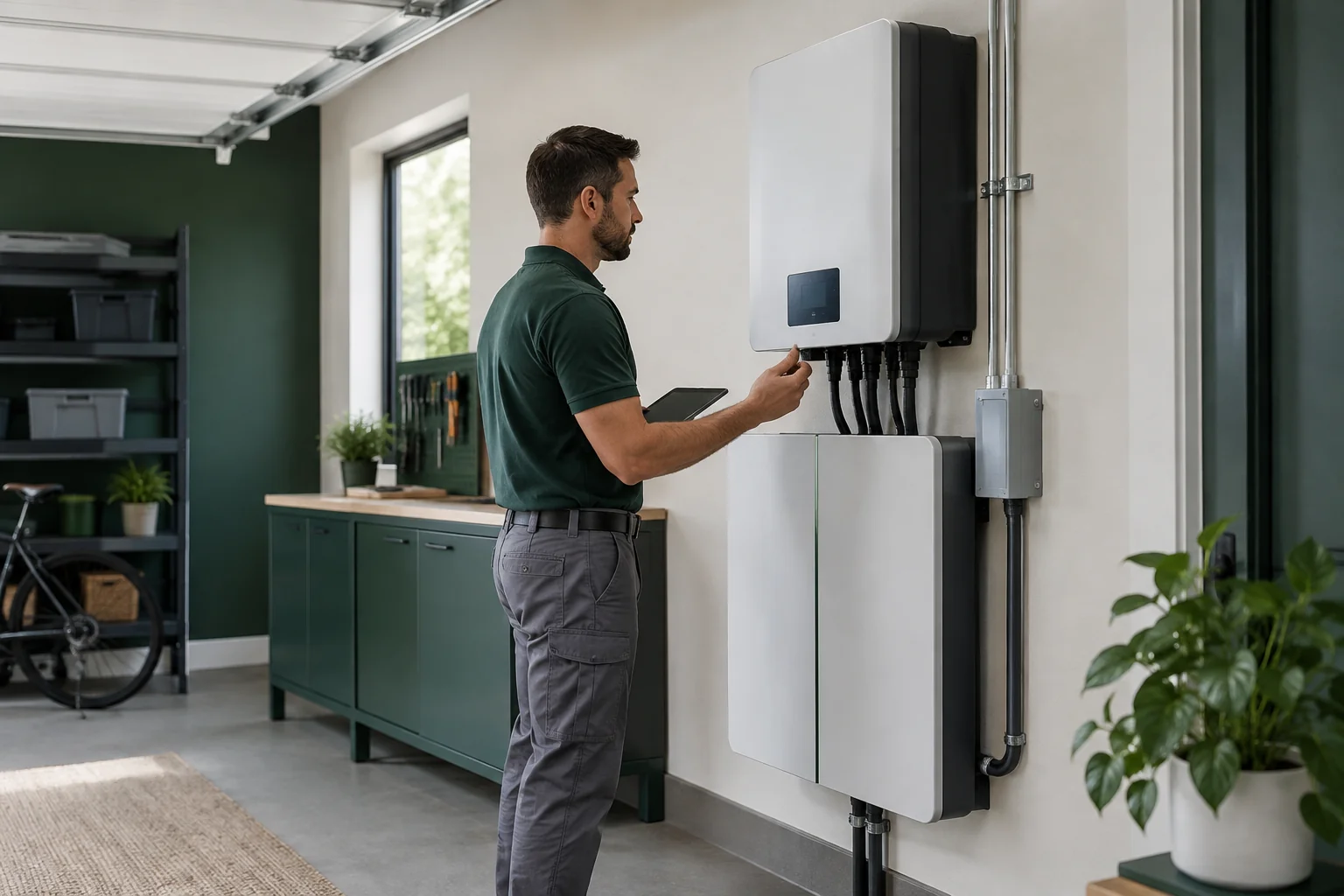
The inverter is the part most likely to need attention first. The South Carolina Energy Office says inverter warranties are usually 10 years, and consumers can reasonably expect to have to replace the inverter during the life of the system. Plan for that, rather than being surprised by it.
Inverter coverage to check
- Type: string inverters, microinverters and optimizers carry different terms, so read the one on your quote.
- Remedy: a replacement unit, a repair, or a credit toward a new one.
- Extension: some makers sell longer coverage. Decide at purchase, since it is often harder to add later.
- Labor: confirm who pays for the swap, as with panels.
Battery coverage to check
Battery warranties usually combine a number of years with a limit on the energy the battery can cycle, plus a minimum capacity it must keep at the end. That means a battery used heavily for backup in a stormy region can reach its throughput limit before the years run out.
Read both numbers. We install FranklinWH, Tesla Powerwall and Enphase IQ batteries, and each maker writes its own terms. If you are adding storage later, our walkthrough on how a solar battery retrofit works covers what changes when the battery goes onto an existing system.
The Installer's Workmanship and Roof-Penetration Warranty
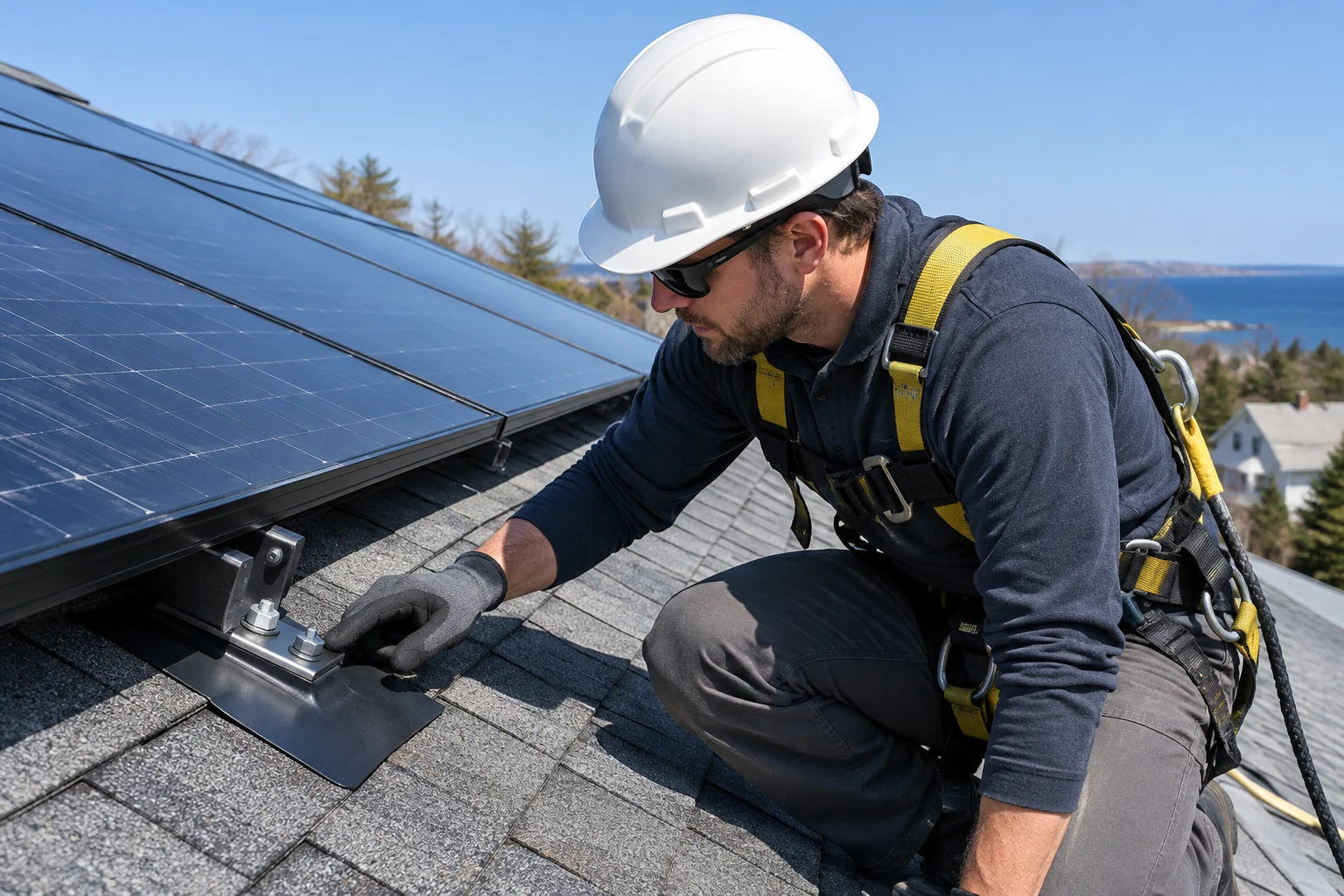
This is the warranty written by the company that put the system on your roof. It covers the quality of the install: mounting, wiring, flashing and any leak at a roof attachment. Its length is set by the installer, not the manufacturer, so it varies widely and must be read in the contract.
For a New England home, this is the warranty to scrutinize. Snow load, ice dams and freeze-thaw cycles all stress roof attachments. A leak around a mounting point is a workmanship issue, not a panel defect, and no panel maker will pay for it.
What a good workmanship clause spells out
- The number of years it runs, in writing.
- Whether it covers roof leaks at penetrations and the resulting interior damage, or only the repair of the attachment.
- Whether labor for warranty service is included at no charge.
- Who performs the work: the installer's own crew or a third party.
- How to request service, and the expected response time.
Why in-house crews change the answer
We use in-house W-2 crews and no subcontractors. When the people who mounted your array are our employees, there is one company responsible for the work. With subcontracted installs, a workmanship problem can turn into a dispute over who hired whom.
That is a structural point, not a guarantee. Whatever installer you choose, ask for the workmanship terms on paper before you sign.
Who Do You Claim From for Each Problem?
Claim from whoever made the failed item. A defective or underperforming panel goes to the panel maker, an inverter fault goes to the inverter maker, a battery problem goes to the battery maker, and a roof leak or loose mount goes to the installer. Your installer often handles the paperwork for the rest.
| What went wrong | Likely responsible party | What to have ready |
|---|---|---|
| Cracked cell or failed junction box from a defect | Panel manufacturer (product warranty) | Serial number, photos, install date |
| Output well below the guaranteed curve | Panel manufacturer (performance warranty) | Monitoring history, test results |
| Inverter error or no production | Inverter manufacturer | Error codes, serial number |
| Battery will not charge or lost capacity | Battery manufacturer | App data, cycle history |
| Roof leak at a mount | Installer (workmanship and roof penetration) | Photos, date first noticed, contract |
| Storm, falling branch or fire damage | Your homeowner's insurance | Photos, claim documents |
One practical tip: take photos and note the date the moment you notice a problem. Most claims go smoother when you can show when it started and what the system was doing before.
What Voids a Solar Panel Warranty?
Warranties are typically put at risk by unapproved repairs, modifications by anyone other than a qualified installer, damaging cleaning or snow removal methods, and roof work done by another contractor without coordination. Exact wording differs by document, so a clause you violate by accident may still cost you coverage.
Unapproved repairs and modifications
Opening an inverter, rewiring a string or adding panels without the maker's approval can void parts of the warranty. Have a qualified technician do the work and keep the invoice. Service on any brand is something we handle, so you do not need to be our install customer.
DIY snow removal with metal tools
A metal shovel or rake scratches the glass and coating, and that damage is mechanical, not a defect. If you must clear snow, use a soft foam roof rake from the ground. Better still, read when to clear your panels and when to leave them, because most of the time the snow slides off on its own.
Roof work by someone else
A roofer who walks on the array, removes mounts, or disturbs flashing can cause a leak that your installer then refuses to cover, since another contractor touched the roof. If the shingles are near the end of their life, replace the roof before solar goes on. Our guide on when to replace a roof before solar explains the timing.
If you already have panels and need roofing later, have the panels detached and reinstalled by a solar crew, not the roofer. Get written confirmation that the workmanship warranty continues afterward.
Skipped maintenance
Some manufacturers require basic upkeep as a condition of coverage. Keep a simple log of cleanings, inspections and service visits. If a claim comes up in year 12, a dated record is worth more than anyone's memory.
What Happens to Your Warranty If the Installer Goes Out of Business?
The manufacturer warranties on panels, inverters and batteries generally continue, because they are issued by the equipment makers. The installer's workmanship warranty is the one at risk, since the company promising it no longer exists. You then need another qualified company to service the system.
This is the real weakness of long warranty headlines. A 25-year promise from a panel maker still stands, but nobody may be left to climb on the roof and honor it for you. We covered the step-by-step response in our published post on what to do when your solar installer goes out of business, including how to gather your documents.
What to keep in a warranty folder
- Your signed contract and any change orders.
- Warranty certificates for panels, inverter and battery, with serial numbers.
- The permit, inspection and utility interconnection approval.
- Installation photos, including roof attachments and wiring.
- Monitoring login details and a record of production in the first year.
Some questions here are still unsettled in the industry. Whether a warranty can be transferred to a new owner after a sale, or whether another installer will accept work on a system they did not build, depends on the maker and the company. Ask before you need it.
Warranty Questions to Ask Before Choosing a Company in CT, MA or RI
Ask every installer you are comparing the same warranty questions, and get the answers in writing. The list below focuses on coverage, labor and what happens if something goes wrong. For a wider list that covers licensing, pricing and process, use our 15 questions to ask a solar installer before you sign.
- Which panel, inverter and battery models are on my quote, and what are their exact warranty terms?
- How many years is your workmanship warranty, and does it include roof leaks at the mounts?
- Is labor covered when a part is replaced under warranty, and for how long?
- Do your own employees do the work, or subcontractors?
- Who do I call, and how fast do you respond to a warranty request?
- Will you service my system if I did not buy it from you, and if I add a battery?
- What happens to my warranty if I need roof work or a panel detach and reset?
- Can the warranty transfer if I sell the house?
- What maintenance or records do I need to keep to stay covered?
- If your company closes, what is the plan for my workmanship coverage?
If cost is part of your comparison, our solar panel installation cost breakdown for 2026 helps you see what is inside each quote. A lower price that comes with weaker coverage is not really lower.
Solar Panel Warranty FAQ
How long does a solar panel warranty last?
It depends on which warranty you mean. Manufacturers commonly offer 12 to 30 years on panel products and 25 to 30 years on performance, while inverters are usually around 10 years. Installer workmanship coverage is set by the installer and is often much shorter than the panel terms.
Does a solar warranty cover roof leaks?
Not from the panel maker. A leak at a mounting point is a workmanship matter, so it falls under the installer's roof-penetration or workmanship coverage if one exists. Read that clause closely, and ask whether it covers the repair only or also interior damage.
Is labor included in a solar panel warranty?
Often it is not. Many manufacturer warranties replace the defective part but do not pay for removing and reinstalling it. Check each document, and ask your installer in writing whether labor for warranty service is covered and for how long.
Can I claim a warranty on a system someone else installed?
Yes, manufacturer warranties belong to the equipment, not the installer. You will need serial numbers and your paperwork. A qualified service company can handle the claim and repair, even if it did not install the system.
Get Your Solar Panel Warranty Questions Answered Before You Sign
A warranty only helps if the company behind the install is still around to honor it. We design and install with in-house crews, use Tier-1 equipment, and service systems of any brand across Connecticut, Massachusetts and Rhode Island. You can explore our services to see what we handle.
If you have a quote in hand and want the warranty terms checked, talk to a designer or call 203-903-4091. Ready to see the equipment, workmanship and service terms on your own roof? Request a free quote and we will put them in writing.
Recommended Resources
Written by
Dan Katzman
Teamsun
Teamsun writes practical solar guidance to help property owners compare equipment, project scope, costs, and long-term service before making a decision.
Keep going.
EV Charger Installation Cost for Massachusetts Homeowners
What EV charger installation costs Massachusetts homeowners in 2026: Level 2 hardwired pricing, panel upgrades, permits, rebates and solar bundling.
Dan Katzman
Teamsun
Solar Panel Hail Damage: How Panels Hold Up and What to Do
Solar panel hail damage explained for CT, MA and RI homeowners: how panels are tested, signs to check from the ground, safety steps, insurance and repairs.
Dan Katzman
Teamsun
Solar Panel Installation Cost Breakdown for 2026
See the real 2026 solar panel installation cost breakdown: equipment, labor, permits, and financing, line by line, so you can compare quotes with confidence.
Dan Katzman
Teamsun