Solar Panel Hail Damage: How Panels Hold Up and What to Do
Solar panel hail damage explained for CT, MA and RI homeowners: how panels are tested, signs to check from the ground, safety steps, insurance and repairs.
Dan Katzman
Teamsun
Solar panel hail damage is uncommon in Connecticut, Massachusetts and Rhode Island, because modern panels are impact-tested and most New England hail is small. When damage does happen, it usually shows up as cracked glass, bent frames or a sudden drop in output. After a storm, stay off the roof, check from the ground, shut the system down if anything looks unsafe, and document everything.
Key Takeaways
- Panels are tested, not invincible: Standard certification tests fire ice balls at the glass, but passing them is a baseline, not proof a panel survives every storm.
- Attachment often fails before glass: In high wind and falling-limb events, loose racking, clamps and wiring are as likely to be the problem as the panel itself.
- Some damage is invisible: Microcracks can sit under intact glass and only show up as lost output, so a ground check is not a clean bill of health.
- Safety comes first: Do not climb the roof. If panels are cracked or wiring is exposed, shut the system down and keep people away.
- Ownership decides who files: An owned system is usually a homeowners insurance claim. A leased system is usually the leasing company's claim.
Quick Facts: Solar Panel Hail Damage at a Glance
| Question | Short answer |
|---|---|
| Are panels tested for hail? | Yes. Certification tests such as IEC 61215 fire ice balls at the glass, and stricter tests exist for hail-prone sites. |
| Can you spot damage from the ground? | Sometimes: cracks, chips, spiderweb glass, bent frames, hanging wires. Microcracks are not visible. |
| What does the monitoring app show? | A drop in production versus similar sunny days, or one string or panel reporting far less than its neighbors. |
| When should the system be shut down? | Any time panels are cracked, wiring is exposed or you smell burning. Follow your inverter's shutdown steps. |
| Who files the claim? | Owned system: usually you, through homeowners insurance. Leased system: usually the leasing company. |
| When should an inspection happen? | The Department of Energy advises IR, UV or EL scanning within one month of a damaging event. |
How Are Solar Panels Tested for Hail and Impact?
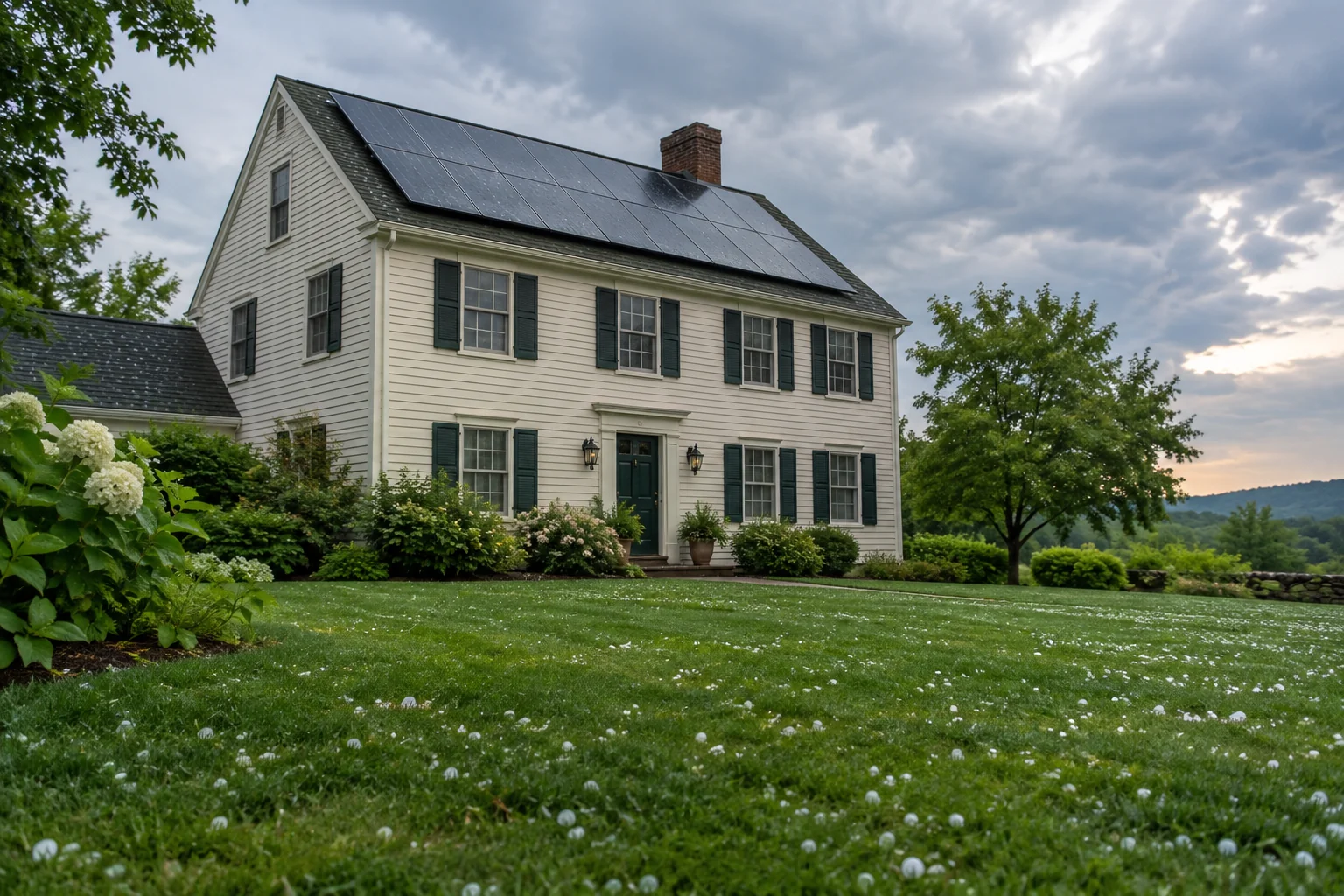
Panels are tested by firing ice balls at the glass under controlled conditions. The baseline is IEC 61215 for design qualification, alongside safety testing under IEC and UL 61730. Stricter hail tests exist for storm-prone sites. Passing the baseline shows a panel handles ordinary hail, not that it survives every severe storm.
The baseline test uses 25 mm ice balls, roughly one inch across, fired at the module. That covers the small to moderate hail most New England thunderstorms produce. The Department of Energy's solar FAQ says panels are designed to resist small to moderate hail, at least one inch in diameter, and that damage from extremely large hail is possible but unlikely.
For sites with a higher hail risk, federal guidance asks for more. The Department of Energy's severe weather resilience guidance says that for moderate to severe hail sites, the module should meet the FM Global Very Severe Hail Rating (FM 4478), the Renewable Energy Test Center hail durability test, or the PV Evolution Labs hail test standards.
What the tests do not tell you
A lab test is one ice ball, at one speed, hitting a known spot on a new panel. Real storms deliver many stones, at an angle, with wind behind them, onto panels that may be ten years old. Panel age, glass thickness and frame design all change the outcome.
The tests also say little about the rest of the system. Racking, clamps, wiring and the roof itself are not part of the glass test. That is why a post-storm inspection looks at the whole array, not only the panel faces.
Hail vs Wind vs Fallen Branches: Which Does the Most Damage?
For most homes, fallen branches and high wind cause more serious damage than hail. A limb delivers a heavy point load that can crack glass and bend frames, while wind stresses the attachment points. Typical New England hail is small enough that tempered glass often shrugs it off.
Each threat harms the system differently, and each leaves different clues. The table below sorts them out.
| Threat | What it usually hits | Typical signs | Hidden risk |
|---|---|---|---|
| Hail | Glass surface, cells under the glass | Chips, spiderweb cracks on larger stones; often nothing visible | Microcracks that cut output over time |
| High wind | Racking, clamps, roof attachment | Panels shifted, lifted edges, loose wiring, debris | Loosened hardware and flashing that leaks later |
| Fallen branch | Frame and glass at one point | Local crater, bent frame, shattered section | Cracked cells and wire damage near the impact |
| Ice and snow slide | Lower edge of the array | Bent frames at the bottom row | Gutter and snow guard damage |
Why wind is really an attachment problem
Solar glass is built to take a hit. In a high-wind event, the weak point is more often how the array is held to the roof than the glass itself. That is a workmanship and hardware question, which is one reason in-house crews who install and service their own work matter.
Our solar panel warranty guide explains why product, performance and workmanship coverage each respond to different kinds of failure.
Tilt, trees and where you live
Steeper roofs tend to deflect some hail energy. A 2025 review in the journal Technologies notes that tilt angles of roughly 45 to 60 degrees can reduce the effect of vertical hail, though energy yield and wind load also matter. You rarely choose roof pitch for hail alone, so treat this as a side benefit.
Trees are the other local factor. Many New England lots have mature oaks and maples near the house. Dead limbs over the array are the single most predictable storm risk, and they are the cheapest one to fix before storm season.
What Does Solar Panel Hail Damage Look Like From the Ground?
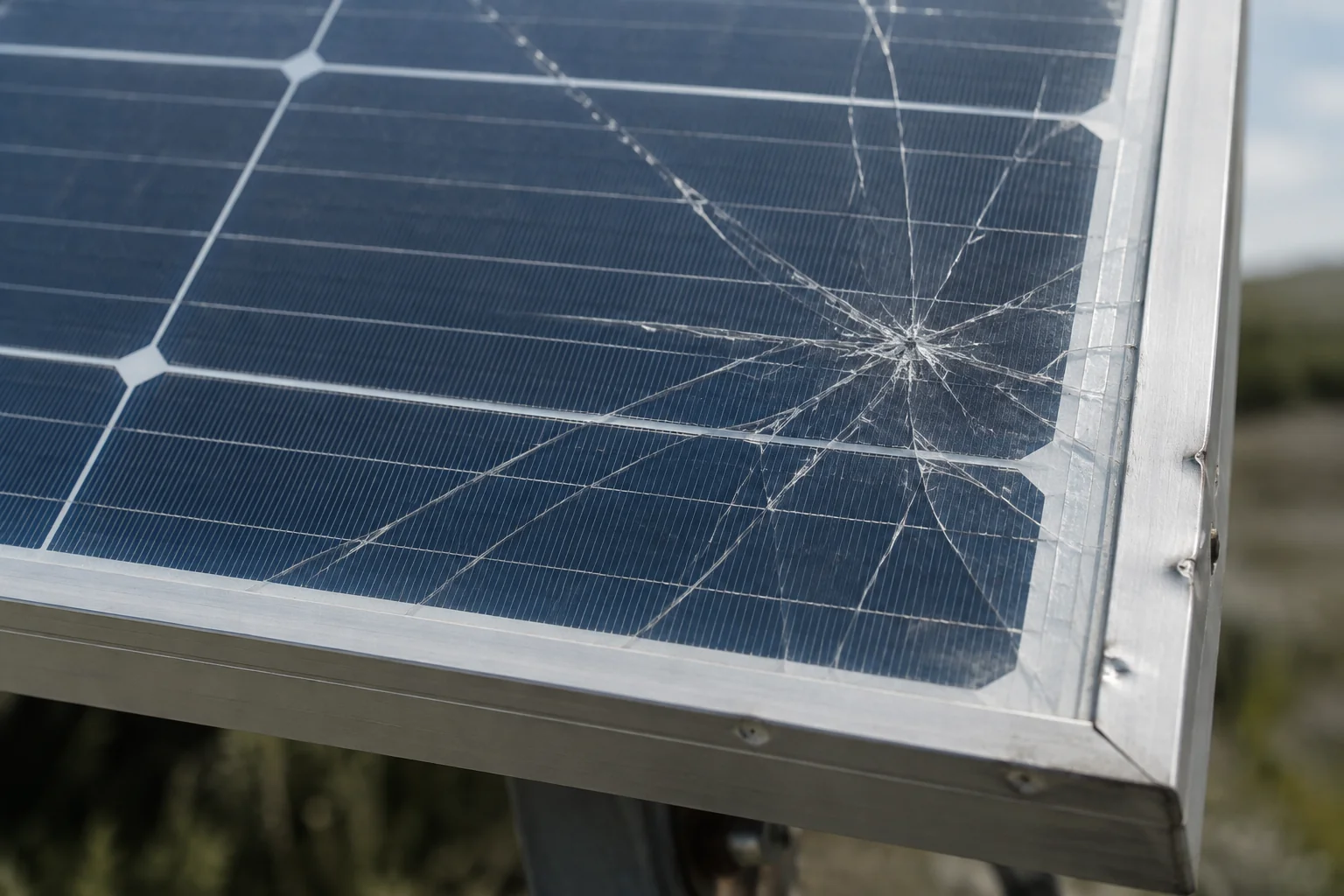
Visible damage includes cracked or spiderwebbed glass, chips, dents in the aluminum frame, shifted panels, hanging wires and debris on the array. Invisible damage, such as microcracks in the cells, does not show from the ground and only appears as lower output or in specialized scans.
Signs you can check without leaving the lawn
Walk the yard and look up. Binoculars help. Never step onto a ladder or the roof, and keep clear of any area below a damaged panel, since broken glass can slide.
- Spiderweb cracks, chips or shattered glass on any panel
- Bent, dented or separated frames, especially on the bottom row
- Panels that sit crooked or lifted compared with their neighbors
- Wires hanging below the array or insulation that looks torn
- Branches, shingles or debris resting on or under the panels
- Granules or shingle pieces in the gutters, which can point to roof damage as well
- Water stains on ceilings below the array in the following days
Signs in your monitoring app
Production data is your second set of eyes. Compare the days after the storm with similar sunny days before it. A drop that does not recover, or one panel or string reporting much less than its neighbors, points to a problem you cannot see.
Our guide on reading your solar monitoring app data covers what normal day-to-day swings look like, so you can tell weather from damage. If your system has panel-level monitoring, an outlier is easy to spot. With string inverters, you may only see a drop in total output.
Damage you cannot see
Hail can damage cells beneath glass that looks intact. The Department of Energy's hail damage mitigation guidance says some damage may be visible while other damage is not, and advises an infrared, UV or electroluminescence scan of panels within one month of the event to look for invisible damage.
That matters for claims too. If you wait a year, it is harder to show the damage came from a specific storm. A visual check alone cannot rule out cell damage, so a clean-looking array after a hailstorm still deserves a professional look.
What Should You Do Right After a Storm?
Stay off the roof, check the array from the ground, and keep people and pets away from any damaged panels. If panels are cracked, wiring is exposed or you smell burning, shut the system down using your inverter's shutdown procedure, then call a qualified solar technician. Do not touch broken equipment.
The Department of Energy's guidance on operating and maintaining an existing photovoltaic system says the priority after a damage event is to make the system physically and electrically safe pending inspection, testing and repair. Its recommended practice includes shutting down and disconnecting the system.
A safe-first checklist
- Look from the ground only. Panels can be slick, wet and live. Roof falls cause far more harm than most storm damage.
- Treat sunlight as live power. Panels produce electricity whenever light hits them, even when the grid is down and the main breaker is off.
- Shut the system down if it looks unsafe. Use your inverter's documented shutdown steps and the AC disconnect. If you are not sure how, leave it and call for help.
- Keep clear of fallen lines and tree limbs. If a limb is on the array or wires are down, call the utility or emergency services first.
- Do not hose or scrub damaged panels. Water on cracked glass and exposed wiring is a shock risk.
- Do not patch with tape or tarps yourself. A tarp on a live array can trap heat and shift in wind. Let a technician decide on temporary covers.
If you have a battery, check its status in the app and follow its own shutdown steps. Our guide on combining solar panels with battery backup explains how the pieces connect, which helps you tell a technician what you have.
How Do You Document Damage for an Insurance Claim?
Document damage with dated photos from the ground, screenshots of production data before and after the storm, a short written timeline, and weather details such as the date and hail size. Add a written inspection report from a solar technician. Insurers decide faster when evidence ties damage to a specific event.
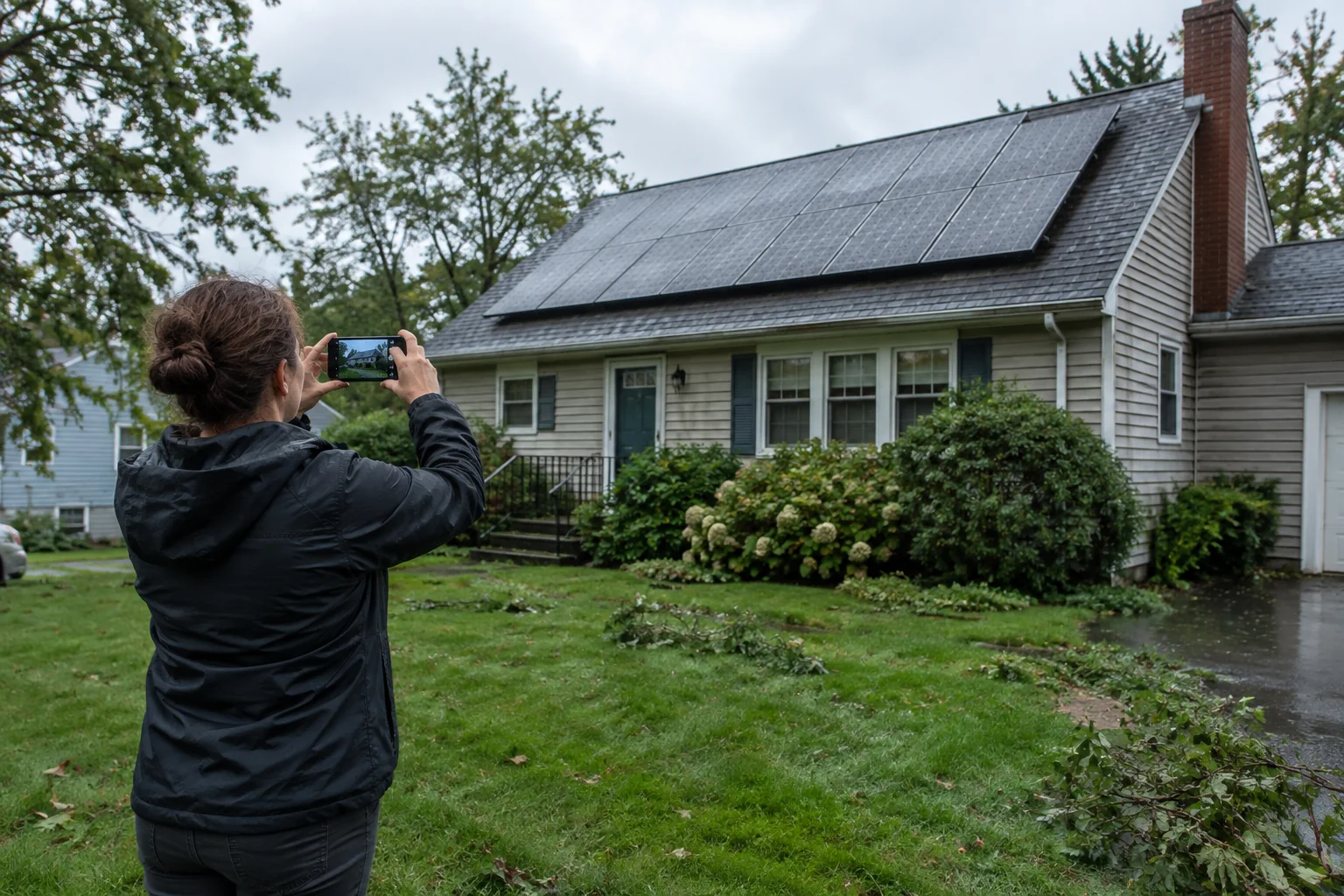
Start before anything gets moved or repaired. Photos taken before cleanup are the most useful ones, and you can always take more later. Do this from the yard, not the roof.
What to collect
- Wide and close photos. Show the whole array and the house, then each damaged area. Include fallen branches and debris where they landed.
- Hail evidence. Photograph stones on the ground next to a coin or ruler, and note the date and time. Dents on cars, siding and gutters support the story.
- Production data. Screenshot daily output for the weeks before and the days after. Export the history if your app allows it.
- A timeline. Write down when the storm hit, when you noticed damage, what you shut off and who you called.
- Paperwork. Find your installation contract, equipment list, permit records and warranty documents.
- A technician's report. A written inspection with findings and a repair scope gives the adjuster something concrete.
Keep every receipt for temporary safety work or emergency services. Ask your insurer before authorizing major repairs, since many policies expect you to protect the property from further damage but also want to see it first.
How Does Insurance Treat Rooftop Solar and Leased Systems?
Homeowners insurance usually treats an owned rooftop system as part of the dwelling, so storm damage may be covered up to policy terms. A leased or PPA system usually belongs to the leasing company, which typically files the claim under its own coverage. Policies differ, so confirm details with your agent.
If you own the system
Many policies cover solar like other roof-mounted fixtures, subject to your deductible and any limits. Some New England policies carry a separate wind or hail deductible, and those can differ from your standard one. Read yours before a storm, not after.
Tell your agent you have solar when you buy the system. Ask three things: whether the panels are covered as part of the dwelling, whether there is a separate wind or hail deductible, and whether the policy pays to remove and reinstall panels when a roofer needs access. That last item connects to our guide on removing and reinstalling solar panels for a new roof.
If you lease or have a PPA
With a lease or power purchase agreement, you usually do not own the panels. The company that does generally carries the insurance and handles repair under the contract. Your job is to report the damage promptly, send your photos and production data, and keep your own homeowners insurer informed about any roof or house damage.
Read your agreement for who is responsible for what. Our comparison of solar loan vs PPA vs lease explains the ownership differences that decide this.
What is still unsettled
Insurers vary widely on how they treat age, depreciation and prior microcracking. A claim for a ten-year-old array may be paid at depreciated value under some policies and replacement cost under others. We cannot tell you which applies to you. Your policy language and your agent can.
Getting an Inspection and Repair Scheduled
Call a qualified solar company soon after the storm, even if the array looks fine. At Teamsun, we repair and maintain solar systems of any brand, with in-house W-2 crews serving homeowners across Connecticut, Massachusetts and Rhode Island. You do not need to have bought your system from us.
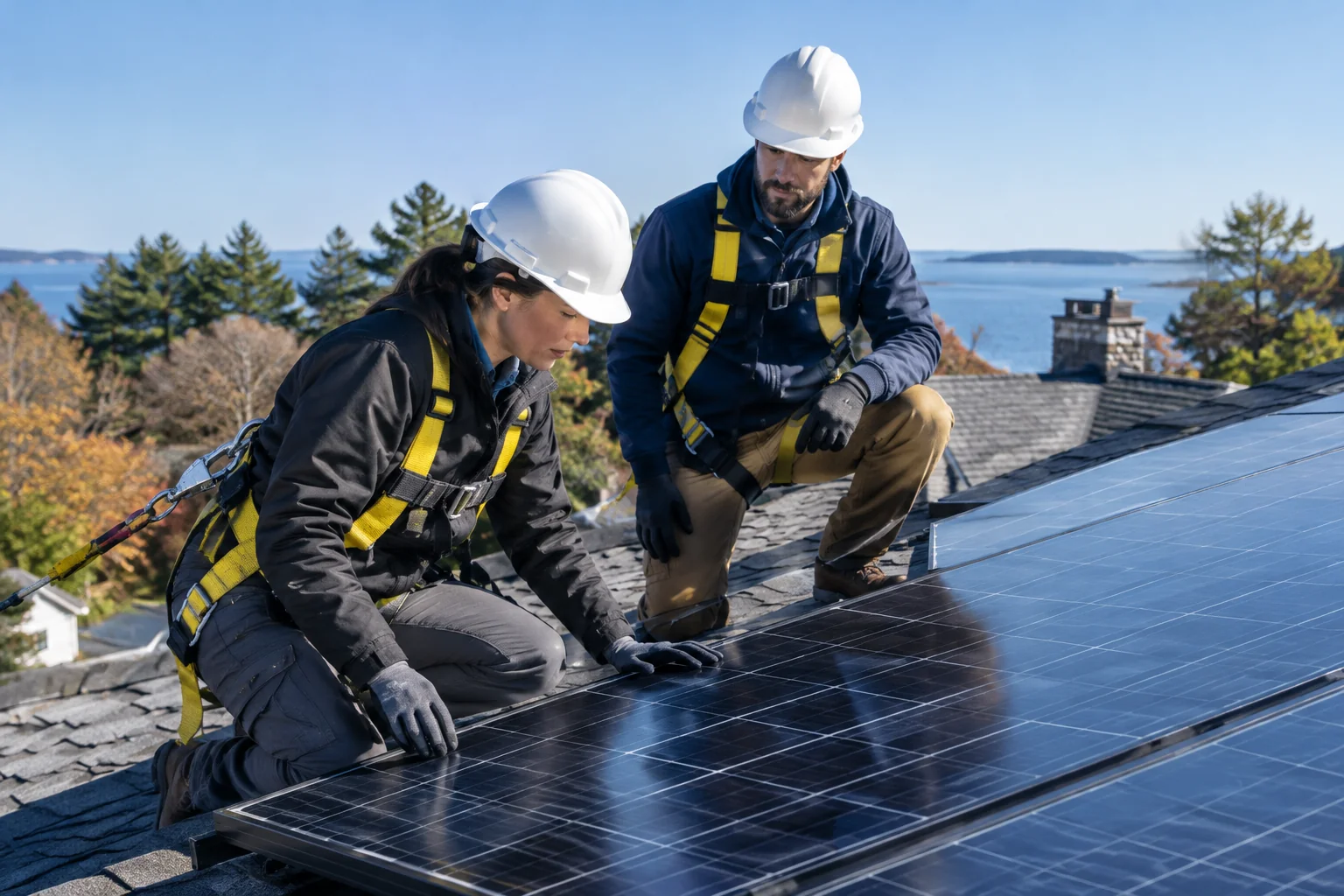
What a post-storm inspection covers
- Panels: glass, frames, backsheets and junction boxes, with scanning where damage is suspected.
- Electrical: wiring, connectors, optimizers or microinverters, and the inverter's fault history.
- Mounting: clamps, rails, flashing and the roof penetrations that hold the array down.
- Roof: shingles and decking around the array, since a roofer may need to coordinate with the solar crew.
- Performance: a comparison of actual output to expected output for the period.
We do not promise a specific response time, because storms hit many homes at once and every site is different. What we can say is that the same local crews that inspect your system are the ones who repair it, so there is one team to hold accountable.
Repair or replace?
A single cracked panel is usually replaced, not patched. If the panel is an older model that is no longer made, a compatible replacement may need matching voltage and size. Mounting damage is often repaired in place, while damaged flashing needs a roof fix as well.
If several panels are affected on an older system, it may be the moment to ask about an upgrade. Our guide on when to upgrade an older solar system lays out how to weigh repair costs against newer equipment. Warranties may also apply to defects, though storm damage is usually an insurance matter, not a warranty one.
Buying Solar in New England: How to Lower Hail Risk
If you are shopping for solar rather than repairing it, ask for the module's hail test results and what the mounting is rated for. Federal guidance for hail-prone sites points to specific test standards. For most New England homes, good attachment and trimmed trees do more than any hail upgrade.
- Ask for test documentation. Request the module's certification and any high-energy hail test results.
- Check glass and frame details. Thicker glass improves impact resistance. Ask what the datasheet says.
- Check the mounting plan. Ask how the array is attached and who warrants that work.
- Trim overhanging limbs. Do it before the array goes on, and keep it up.
- Confirm your insurance. Call your agent before signing, and ask about any wind or hail deductible.
- Keep the maintenance habit. A yearly look catches loose hardware and early wear.
Our solar panel maintenance checklist for New England homeowners covers the seasonal checks that make storm damage easier to catch early.
Frequently Asked Questions
Do solar panels break in hailstorms?
Rarely. Certified panels are built to resist small to moderate hail, and most New England storms fall in that range. Large hail, a branch strike or an older panel with existing microcracks can still cause damage. Check from the ground after a storm and watch your production data.
Is a cracked solar panel dangerous?
Yes, it can be. A cracked panel may expose live conductors and can keep producing electricity in daylight. Stay off the roof, keep people away and shut the system down using the inverter's steps. Have a qualified technician inspect it before turning anything back on.
Will my output drop if panels have microcracks?
Often, yes. Microcracks can reduce output right away or worsen over time, depending on the module and the extent of damage. Compare your app's production with similar sunny days. A lasting drop after a storm is a reason to book an inspection, even if nothing is visible.
Does homeowners insurance cover solar panel hail damage?
Often, if you own the system, because many policies treat rooftop solar as part of the dwelling. Deductibles and limits apply, and some policies set separate wind or hail deductibles. Leased systems are usually insured by the leasing company. Confirm everything with your agent.
Can Teamsun repair a system another company installed?
Yes. We repair and maintain solar systems of any brand across Connecticut, Massachusetts and Rhode Island. Our in-house W-2 crews handle inspection and repair, so you do not need to be a past customer to call us after a storm.
Next Steps After a Storm, or Before You Buy
If a storm has hit your array, start with safety, photos and production screenshots, then get a professional look. You can request a free quote for inspection and repair, or review our solar repair and maintenance services to see what we cover for any brand.
If you are still weighing solar and worried about storms, talk to a designer about mounting, equipment choices and tree clearance on your lot. You can also call us at 203-903-4091. Solar panel hail damage is manageable when you know what to check, who files the claim and who will fix it.
Recommended Resources
Written by
Dan Katzman
Teamsun
Teamsun writes practical solar guidance to help property owners compare equipment, project scope, costs, and long-term service before making a decision.
Keep going.
Solar Panel Snow Removal: When to Clear Your Panels and
Solar panel snow removal explained for New England homeowners: when to wait, safe ground methods, what voids warranties, and when to call a crew.
Dan Katzman
Teamsun
How Many Solar Panels Does a Small Business Need?
Learn how many solar panels for small business use based on kWh usage, roof size, and budget, plus the 25kW-500kW range Teamsun installs across CT, MA, RI.
Dan Katzman
Teamsun
How Much Power Do Solar Panels Actually Produce in Cloudy
Solar panel output in cloudy New England weather: what overcast days, short winters and seasons really do to production, plus how to size a system.
Dan Katzman
Teamsun