Solar Panel Snow Removal: When to Clear Your Panels and
Solar panel snow removal explained for New England homeowners: when to wait, safe ground methods, what voids warranties, and when to call a crew.
Dan Katzman
Teamsun
For most New England homes, solar panel snow removal is not needed. Tilted panels have smooth, dark glass, so snow usually slides off within a day or two of sun. Clear snow only when it is heavy, stuck or covering a low-tilt array, and only from the ground with a soft foam roof rake made for panels.
Key Takeaways
- Default to waiting: A normal snowfall melts and slides off tilted panels on its own, and the lost output is temporary.
- Ground only: Never climb an icy roof. If you clear snow, use a long-handled soft foam roof rake from the ground.
- Keep these away from the glass: Metal shovels, ice picks, hot water, de-icing salt and pressure washers can scratch, crack or stress the panels.
- Watch the slide zone: Snow and ice releasing in one sheet can hit walkways, gutters, cars and anyone standing below the eave.
- Use your app as the judge: If output stays near zero for days after the snow should have melted, call a service crew rather than scraping.
Solar Panel Snow Removal at a Glance
| Situation | Best move | Why |
|---|---|---|
| Light, fluffy snow on a typical roof-tilt array | Wait | It slides off as the glass warms in sun |
| Heavy, wet nor'easter snow, array still partly clear | Wait 1 to 3 sunny days, then reassess | Dark glass warms and breaks the bond with the snow |
| Low-tilt or flat array holding deep snow | Gentle ground-level clearing with a foam rake, or call a crew | Low angles shed snow poorly |
| Sheet of ice over the glass | Do not scrape; call a professional | Scraping risks scratches and frame damage |
| Snow above a door, walkway or car | Keep people clear; consider snow guards | Sliding sheets can injure people or damage property |
| Output still near zero after snow is gone | Check the app, then book service | The cause may be an inverter or wiring fault, not snow |
How Do Solar Panels Shed Snow on Their Own?
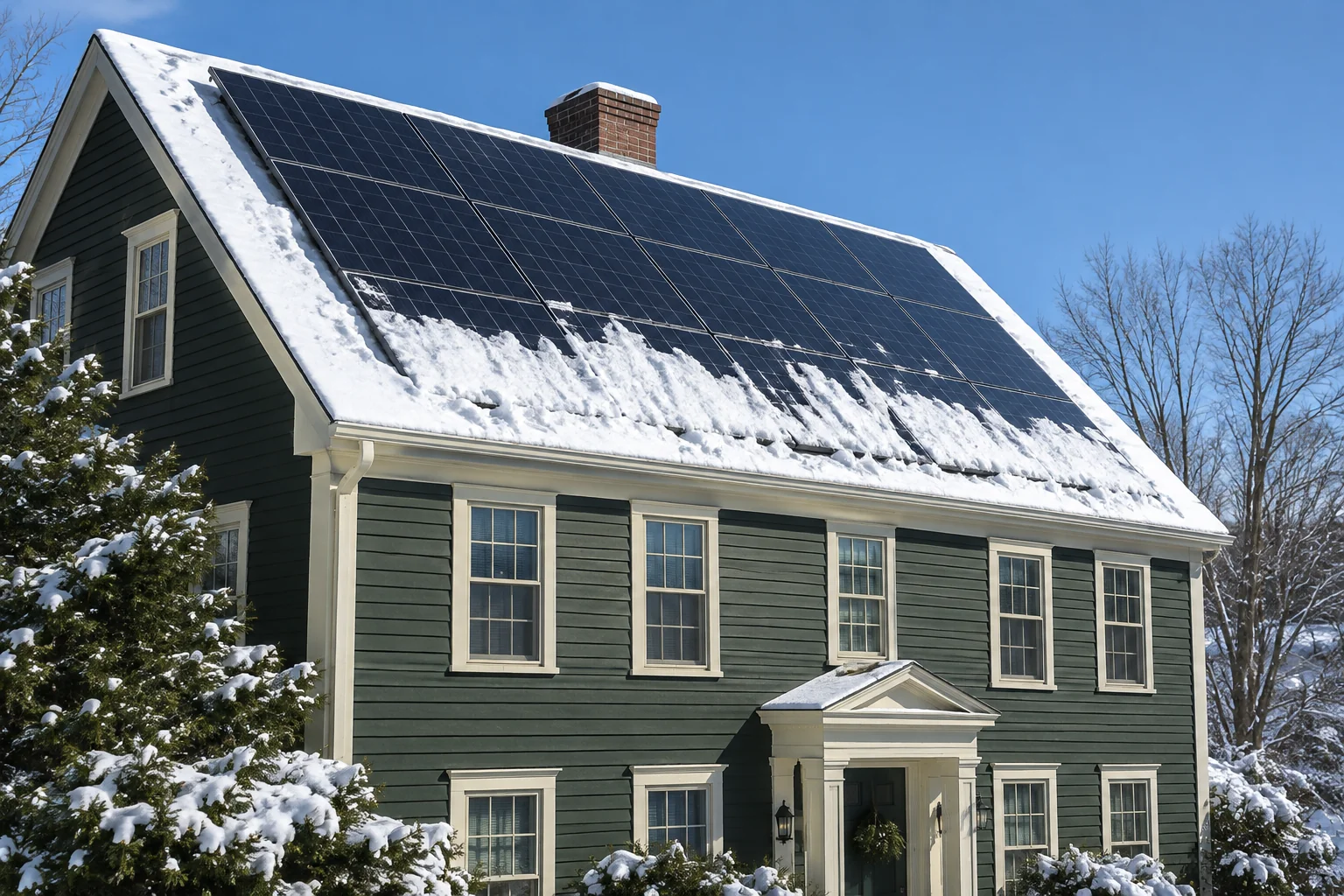
Solar panels shed snow because they are tilted, slick and dark. Even weak winter sun warms the glass slightly, which melts the thin layer touching the panel. Gravity then pulls the whole blanket down the smooth surface. Steeper panels shed faster, and panels with no frame lip at the bottom edge shed best.
The U.S. Department of Energy notes that removal of accumulated snow or ice is not recommended, and that if it is attempted, it should be done with extreme caution. That is a federal agency telling owners to default to patience.
Why panels clear faster than your shingles
Your roof shingles are rough and light enough in color to hold snow for days. Panel glass is smooth and absorbs light. On a sunny 28 degree morning in Connecticut, you will often see the array shed its snow while the surrounding roof stays white.
Snow also does a little work for you. A utility filing from the Kentucky Public Service Commission describes snow as a natural cleaning agent that wipes away dirt as it melts and slides away. Your spring output may be a touch cleaner after a snowy winter.
How much production does snow really cost?
Less than most people fear. The National Laboratory of the Rockies' O&M guide says snow cuts output by about 3% on average and up to 15% in very snowy climates. Those are broad averages, and your roof's tilt, shading and storm pattern will move the number.
Winter is also your lowest-production season already. Days are short and the sun sits low, so a snow-covered day costs fewer kilowatt-hours than a snow-covered day in June would. The loss is real but small, and it is temporary.
What makes some arrays hold snow longer?
Four things matter most in New England:
- Tilt angle: Low-slope roofs and flat-roof racking shed snow poorly.
- Orientation: South-facing arrays warm up first. North- or east-facing strings can stay buried longer.
- Snow type: Wet, heavy coastal snow packs down. Powder blows off.
- Frames and obstructions: A raised frame edge at the bottom of a panel can trap a lip of snow or ice.
Should You Remove Snow From Solar Panels?
Usually no. Leave the snow if your panels are tilted, the sun is expected within a few days and nothing is hanging over a walkway. Clear it only when snow is deep, compacted or on a low-tilt array, and when you can do it from the ground with a soft tool.
The honest trade is a small, temporary loss of production against a real fall risk and possible glass damage. In our view, that trade rarely favors climbing or scraping. The DOE's solar program notes that snow can be carefully removed with a long-handled snow rake if you want the system back to full production faster. The word is carefully.
A simple decision rule
Run through these questions in order. Stop at the first "yes."
- Is there ice on the glass, or is the roof icy? Do nothing yourself. Wait or call a crew.
- Are you tempted to go on the roof or use a ladder? Do not. Stay on the ground.
- Is the forecast sunny within three days, and is your array tilted? Wait.
- Is the array low-tilt or flat, with deep snow and no melt in sight? Gently clear the lower portion from the ground with a foam rake, or book a crew.
- Does a storm warning mean a second heavy snowfall is coming? Clearing now rarely helps, because the new snow will cover the glass again.
When clearing is worth the effort
Clearing earns its keep in a narrow set of cases. A flat-roof commercial or garage array that does not shed, a ground mount with a low bottom edge, or a long February stretch of cold with no sun are the common ones. Ground mounts are the easiest to reach, since you can stand beside them.
Weight is the other reason. The lab's guide says removal is sometimes necessary to avoid limits on roof weight loading. If your roof is old or a big snow load is sitting on it, that is a structural question, not a production one. Call a roofer or engineer rather than guessing. Our post on solar on an old roof covers why roof condition matters from the start.
When clearing is not worth it
Skip it when the loss is a few sunless days in January. Skip it when the roof is steep, wet or icy. Skip it when you would need to buy a tool you will use once. The panels will be back at work after the next clear, mild day.
Safe Ways to Clear Snow From the Ground
Every safe method has the same rule: your feet stay on the ground. If a method needs a ladder, a harness or a trip onto the roof, it is a job for a trained crew. What follows is what a careful homeowner can do from the yard.
The right tool: a soft foam roof rake
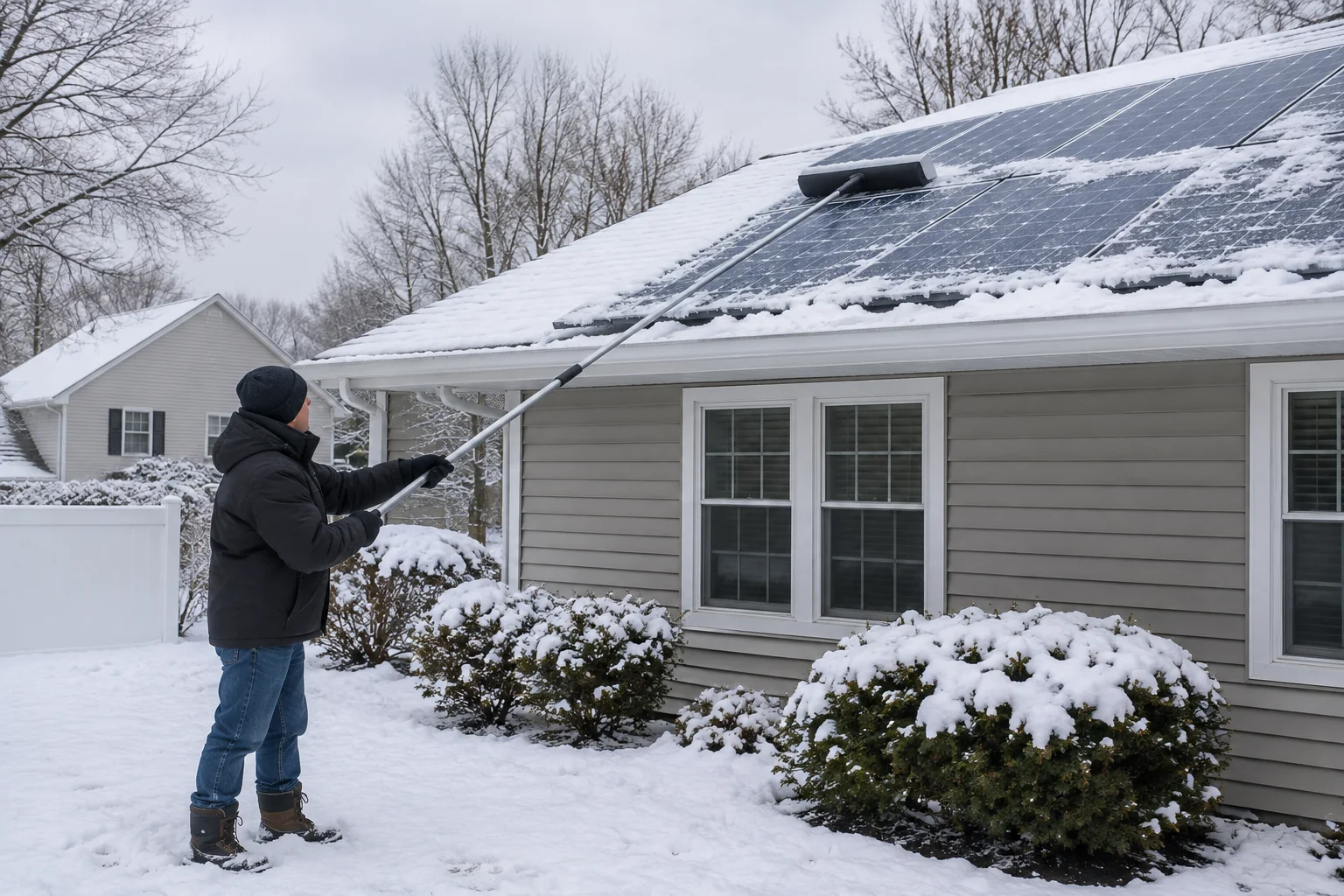
Use a long-handled snow rake with a soft foam head sold for solar panels. The foam should be smooth, with no exposed metal edge and no hard plastic blade. Extendable aluminum poles are fine, as long as nothing metal can touch the glass.
Look at the head before you buy. Run your hand over it. If anything on it could scratch your car's paint, it can scratch your panels.
Step by step
- Check the roof and the slide zone. Make sure no one, including pets and kids, is standing below the eave. Look for ice sheets hanging off the array edge.
- Stay out of the fall line. Stand to the side of where snow will drop, not directly beneath it.
- Start at the bottom edge. Pull small amounts downward in short strokes. Do not drag a full load.
- Take the top layer only. Leave a thin film of snow. The sun will melt it faster than you can safely scrape it.
- Stop at ice. If the rake meets a hard crust, quit. Ice bonds to the glass, and forcing it loose is how scratches and cracked cells happen.
- Clear the landing zone. Move fallen snow away from foundations, walkways and the gutter line.
The DOE adds a simple rule: if you remove snow at all, gently remove snow using a broom and not a shovel. A soft broom works for panels you can reach from a ground mount or a low porch roof, but a foam rake is better for a pitched roof.
What to never use
- Metal shovels, ice scrapers and ice picks: They scratch the anti-reflective coating and can crack glass.
- Hot water or a kettle: Thermal shock can crack a cold panel, and the water refreezes as ice below.
- Rock salt or de-icing chemicals: They can corrode frames and run onto your gutters and landscaping.
- Pressure washers or heat guns: Too much force or heat for cold glass and sealed edges.
- Climbing the roof: An icy slope plus a person with a rake is how people end up in the emergency room.
What Can Damage Panels or Affect Your Warranty?
Scratches, cracked glass, bent frames and damaged seals are the main risks of clearing snow wrongly. These can shorten panel life and may give a manufacturer or installer reason to deny a claim. Read your own warranty papers before you pick up a tool.
Most solar owners hold three layers of coverage: a product warranty on the equipment, a performance warranty on output, and a workmanship warranty on the install. The DOE says the warranty on major components will likely be 25 years. Terms vary by brand, and we are not going to guess at yours.
Where owners get into trouble
Mechanical damage from cleaning is typically treated as an owner-caused issue, not a defect. That is a common reason claims get questioned. A scratched coating or a cracked cell after someone hacked at ice is hard to argue as a manufacturing fault.
Roof penetrations raise another question. If a person climbs up and cracks a tile, or knocks flashing loose, the leak is a roofing problem and could touch your workmanship coverage. If your install is relatively new, tell us or your installer before attempting anything beyond a foam rake.
A quick way to protect your coverage
- Pull your warranty documents and look for cleaning or maintenance language.
- Photograph the array before and after a storm if you plan to clear it.
- Keep receipts for any service call, and ask the crew to write up what they found.
- If you are unsure what your warranty covers, call your installer before you act.
Our existing guide to the New England solar maintenance checklist covers the full seasonal routine, so we will not repeat it here.
Ice Dams, Sliding Snow, Gutters and Walkways
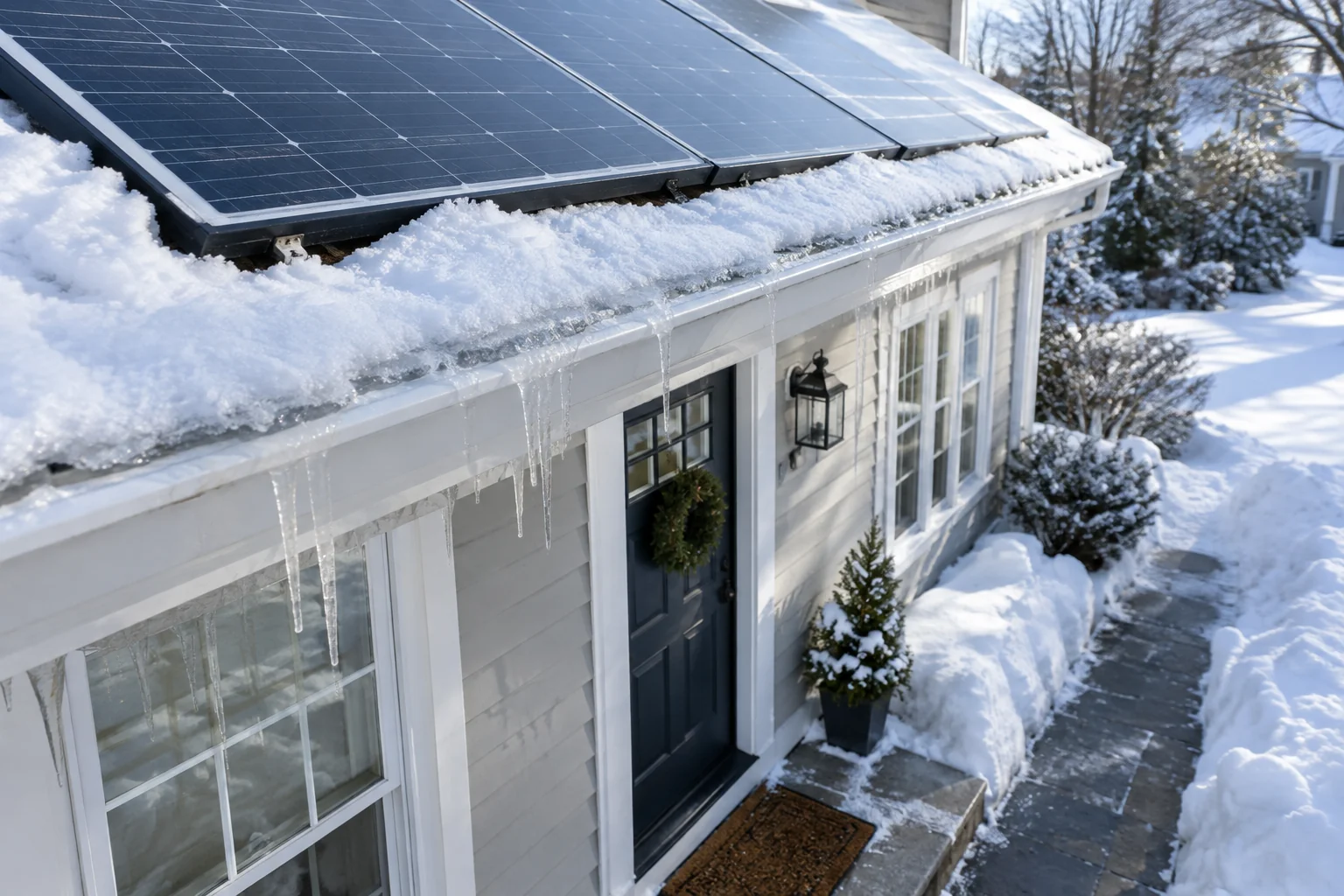
The biggest practical risk from a solar array is often not the lost power. It is where the snow goes when it finally lets go. Panels shed snow in one fast sheet, and that sheet lands on whatever sits below.
Sliding snow and who is standing under it
A slick panel surface releases snow suddenly, and a mass of wet snow and ice can come off the roof with real force. The danger zone is under the eave: front doors, garage entries, driveways, the path to the mailbox, and the spot where you park a car.
Think about the layout before the first storm. If your main walkway runs under the array, shovel a detour or mark a keep-out spot after heavy snow. Snow guards, which are small stops fixed to the roof, can hold snow in place so it melts gradually. Ask your installer whether they suit your racking and roof.
Gutters and ice dams
A sheet of snow that slides off the array can land in the gutter and bend it. It can also pile up at the eave, where melting and refreezing can feed an ice dam. Ice dams are common across Connecticut, Massachusetts and Rhode Island when warm attic air melts snow from below and it refreezes at the cold edge.
Solar does not cause ice dams, but a heavy slide of snow can make an existing problem worse. If you see ice building up at the eave or water stains inside after a thaw, address the roof first. Do not chip at ice near the array. Call a roofer or a crew experienced with both roofing and solar.
If you have a flat or low-slope section
Low-slope arrays do not slide, so they pile up. Plan on waiting for a thaw, or ask a crew to clear them. We often see these on additions, porch roofs and garages.
Commercial flat roofs are a bigger version of the same problem, and a business with a 25 kW or larger rooftop system should ask about snow plans at design time. Our guide on how many panels a small business needs is a good starting point for sizing.
How to Check Production in Your Monitoring App After a Storm
Open your monitoring app on the first sunny day after the storm and compare that day's production curve with a clear day from the same week or a similar week. A normal snow loss looks like a late start that recovers by midday. A flat line near zero all day points to a different problem.
Your app is the best tool you have. It tells you whether snow is the cause before you decide whether to act. For a walkthrough of the screens and what each graph means, see our guide to reading your solar monitoring app data.
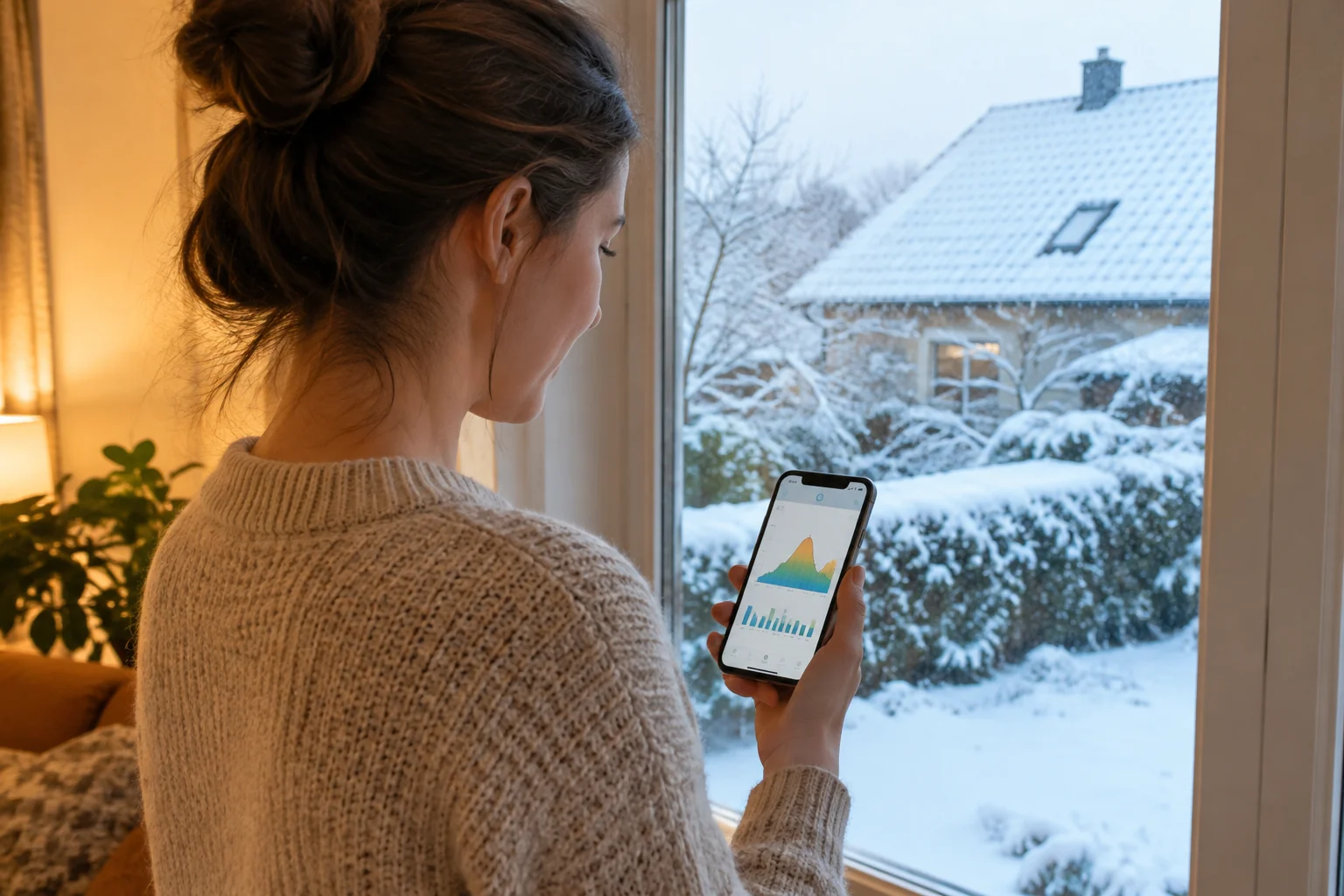
What the graph tells you
- Delayed start, then a normal climb: Snow is sliding off as the sun warms the glass. Do nothing.
- Low but steady curve: Part of the array is still covered, or only some strings are producing. Wait another sunny day.
- Flat near zero in full sun, snow gone: This is not snow. Look at inverter status lights and any alerts in the app.
- Uneven panel-level data (with microinverters or optimizers): One or two panels at zero while neighbors produce suggests a local shading, ice or hardware issue.
A hypothetical worked example
Suppose a Rhode Island homeowner's app shows a normal clear January day peaking at midday. After a nor'easter, day one shows nothing. Day two is sunny and cold, and output begins at 11 a.m. and builds to a solid midday peak. That pattern is snow sliding off, and nothing is wrong.
Now suppose day four is bright, the roof is bare, and the graph is still flat. Waiting longer will not fix it. That is when a service call is worth it. These numbers are made up to show the logic, not real customer data.
Storm outages are a separate issue
Many grid-tied systems shut off during a power outage by design, even when the panels are clear of snow. That is a safety feature, not a fault. If you want power during a winter outage, you need a battery, and our guide on combining solar panels with battery backup explains how it works.
When to Call a Professional
Call a professional when there is ice on the glass, when the array is out of reach from the ground, when you see visible damage, or when output stays low after the snow is gone. A crew has the equipment, fall protection and system knowledge that a homeowner does not.
Signs it is time to call
- A hard layer of ice on the panels that has not moved for several days
- Cracked glass, a bent frame, loose wiring or a panel that has shifted
- A heavy snow load on an old or sagging roof
- Water stains inside the home after a thaw, or ice dams at the eaves
- Output near zero on clear days with no snow left
- Error codes or warning lights on the inverter
- A low-tilt array that keeps holding snow
What to expect from Teamsun
We provide maintenance and repair service for solar systems of any brand, including systems another company installed. Our work is done by in-house W-2 crews, not subcontractors, so the people who show up are trained employees working under our name. You can see the full range on our solar services page.
We serve homeowners in Connecticut, Massachusetts and Rhode Island, with a wider service area across New England. A crew can inspect for damage, check inverter and string performance, and tell you whether the issue is snow, ice or equipment. If a panel or inverter is failing, we will say so plainly. Our post on when to upgrade an older solar system helps you judge whether repair or replacement makes sense.
What a professional can do that you should not
- Work at height with proper fall protection
- Remove ice without scratching coatings or stressing frames
- Test circuits and inverters safely
- Recommend snow guards or layout changes
- Document findings for warranty claims
Snow Removal Checklist and FAQ
Before the storm
- Locate your warranty papers and installer contact details.
- Note where snow will slide and move cars, planters and furniture out of the way.
- Confirm your monitoring app is working and notifications are on.
- Buy a soft foam roof rake sized for your roof reach, if you want one.
After the storm
- Check the slide zone before anyone walks below the eave.
- Wait for the first sunny hours before judging production.
- Check your app, not the roof, to see how the array is doing.
- Take photos of any damage, ice buildup or unusual pooling.
Is it safe to use a roof rake on solar panels?
Yes, if the rake has a soft foam head made for panels, you stay on the ground, and you only pull off the top layer of loose snow. It is not safe on ice, with a metal-edged rake, or if you have to climb or lean out to reach the array.
Will snow damage my solar panels?
Normal snow does not damage panels, which are built to carry snow and wind loads. Problems come from very heavy accumulation on a weak roof, sliding ice hitting gutters or objects below, or improper clearing tools. The panels themselves are rarely the weak point.
Can I pour warm water on my panels to melt snow?
No. Warm or hot water on cold glass can cause thermal shock and cracking, and the runoff can refreeze into ice on the panel or the roof edge. Wait for the sun, or ask a crew to handle it safely.
Do panels produce power under snow?
A thin layer of snow can let some light through, so panels may still produce a little. A thick, packed layer blocks most sunlight and output drops sharply. Production returns as the snow thins, slides or melts, which can happen quickly once the sun hits.
Leave the Roof to the Pros
Good solar panel snow removal in New England mostly means patience, a good monitoring app and a safe distance from the roof edge. Most snow clears on its own. When it does not, a foam rake from the ground or a trained crew is the right answer, not a shovel or a ladder.
If you have a stubborn array, a low-tilt section, ice dams or output that will not recover, request a free quote or talk to a designer about service, snow guards or a system check. You can also call us directly at 203-903-4091. We service panels of any brand, and our in-house crews will tell you straight whether the problem is snow or something else.
Recommended Resources
Written by
Dan Katzman
Teamsun
Teamsun writes practical solar guidance to help property owners compare equipment, project scope, costs, and long-term service before making a decision.
Keep going.
Solar Panel Hail Damage: How Panels Hold Up and What to Do
Solar panel hail damage explained for CT, MA and RI homeowners: how panels are tested, signs to check from the ground, safety steps, insurance and repairs.
Dan Katzman
Teamsun
Battery Storage vs More Solar Panels
Battery storage or more solar panels? Compare outage protection, self-consumption and net metering in CT, MA and RI to decide where your next dollar goes.
Dan Katzman
Teamsun
Can Solar Panels Work With Your Home Generator?
Learn how a solar panel system with existing home generator setups can work together, what transfer switch changes are needed, and when a battery skips the generator.
Dan Katzman
Teamsun