EV Charger Installation Cost for Massachusetts Homeowners
What EV charger installation costs Massachusetts homeowners in 2026: Level 2 hardwired pricing, panel upgrades, permits, rebates and solar bundling.
Dan Katzman
Teamsun
Most Massachusetts homeowners pay between $1,200 and $2,400 to install a hardwired Level 2 EV charger when the panel has room, and $3,800 to $6,800 when a panel upgrade is needed. Rebates can trim several hundred dollars. Here is what moves the price, and how to avoid overpaying.
Key takeaways
- Typical range: $1,200 to $2,400 for a Level 2 install with a free 240V breaker slot in a 200-amp panel.
- Panel upgrade: This is the biggest swing factor and can push the total to $3,800 to $6,800.
- Cheaper workaround: A load-management device can sometimes avoid a service upgrade on a 100A or maxed-out 200A home.
- Rebates: Mass Save has offered a rebate of about $700 for home chargers, and utility programs may add more. Confirm current terms before you buy.
- Solar bundling: One panel assessment, one permit visit and one crew can cut duplicated labor when you add a charger alongside solar.
EV charger installation cost at a glance
| Scenario | Typical Massachusetts cost | What it assumes |
|---|---|---|
| Panel has space, short wire run | $1,200 to $2,400 | 200-amp panel, free 240V slot, charger included |
| Panel upgrade required | $3,800 to $6,800 | Capacity must be freed before the charger goes in |
| National average, single-family home | $1,400 | Chargers and outlets, US Department of Transportation estimate |
| Mass Save charger rebate | About $700 | Eligibility and amount change; verify first |
| Permit and inspection | Part of electrician quote | Electrical permit pulled by a licensed electrician |
| Load-management alternative | Often well below an upgrade | Device pauses charging when the house is busy |
What does a Level 2 EV charger installation cost in Massachusetts?
A hardwired Level 2 charger installation in Massachusetts usually costs $1,200 to $2,400 all in, if the electrical panel already has a free 240-volt breaker slot. The total covers the charger, a dedicated circuit, wiring, labor and permit. Complex homes with older panels cost far more.
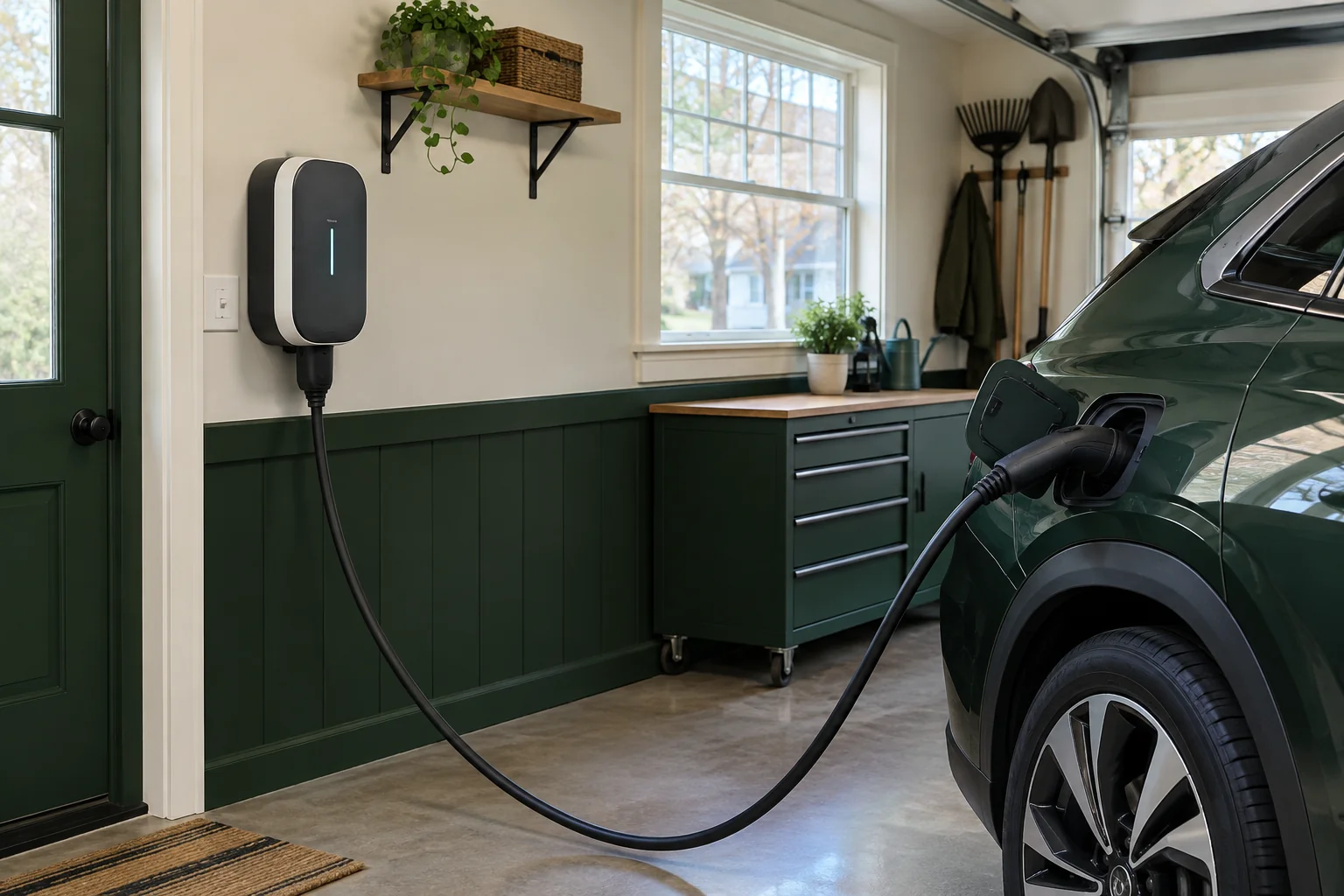
For context, the US Department of Transportation's ITS evaluation lists $1,400 as the estimated average to install chargers and outlets for Level 2 charging at a single-family house. Massachusetts runs higher than that because of labor rates and older housing stock.
Think of the bill in four parts: the charger unit, the circuit and wire, labor, and the permit. The charger itself is often a few hundred dollars. The wiring and labor are where your house decides the price.
What drives the price up or down?
Four things set your final price: spare capacity in the panel, the distance from the panel to the charger, how hard the wire is to run, and whether you choose a hardwired unit or a plug-in. Of these, panel capacity matters most.
Wire run and finished walls
A panel in the garage with the charger on the next wall is the cheap case. A basement panel with the charger at a detached garage means trenching or a long conduit run. Finished ceilings and brick add labor hours.
Hardwired vs plug-in
Hardwired chargers skip the outlet, which removes a common heat failure point on continuous loads. They also allow higher amperage. Our guide on how to install a hardwired EV charger at home walks through the steps.
Charger features
Wi-Fi scheduling, built-in load sharing and solar-aware charging add to the unit price. If your utility offers time-of-use savings, scheduling pays back. If it does not, a basic unit is fine.
Do you need a panel upgrade?
Not always. You need one only if your panel cannot supply an extra continuous 240-volt circuit, typically 40 to 50 amps, without exceeding its rated load. An electrician confirms this with a load calculation, not by guessing from the panel's size.
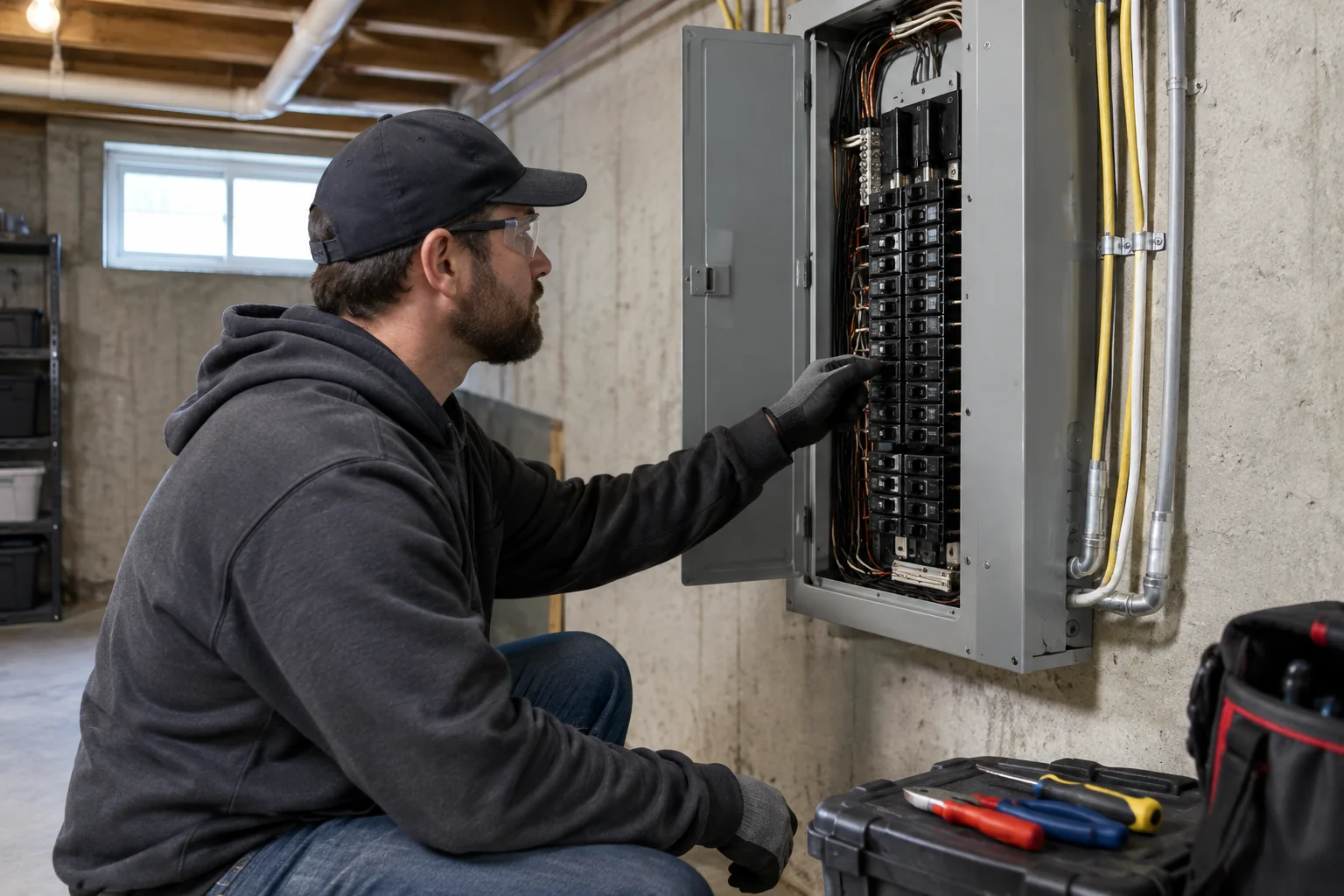
Many Massachusetts homes have 100-amp service, and plenty of 200-amp panels are already crowded with electric heat pumps, induction ranges and dryers. That is why the quotes scatter so widely.
The load-management option
A code-listed device can monitor whole-house current and pause the charger when the home is busy. On many 100A or maxed-out 200A homes, this avoids a service upgrade entirely. It is worth asking about before you accept a $5,000 panel quote.
A simple decision rule
- Free slot and room on the load calculation: install directly.
- No slot but real headroom: swap breakers or add a subpanel.
- No headroom and you also plan a heat pump or solar: upgrade once, size it for all of it.
- No headroom, nothing else planned: price load management first.
My view: if you are adding a second EV or a heat pump within five years, upgrade now. Paying for two separate electrical visits costs more than one properly sized one. Whether load management holds up as households electrify further is still an open question.
How do permits and inspections work in Massachusetts?
A licensed Massachusetts electrician pulls an electrical permit with your local building or wiring inspector, and the town inspects the finished circuit. Permit fees vary by municipality and are usually folded into the installer's quote. Never skip the permit; it affects insurance and resale.
Ask the installer to state in writing who pulls the permit, who schedules the inspection, and whether the quote includes a re-inspection if the first visit fails. Our article on mistakes homeowners make choosing an EV charger installer covers the questions worth asking.
If you use a utility rebate, the paperwork often needs the permit number and an itemized invoice. Keep both.
Which rebates can you stack?
Massachusetts homeowners can often combine a Mass Save charger rebate, currently reported around $700, with utility programs from Eversource or National Grid. Stacking depends on your utility, your charger model and the program year. Always confirm eligibility before purchasing, since many require pre-approval.
The state's Department of Public Utilities EV charging resources page describes the EV programs, including make-ready infrastructure and rebates for customers. Utility-specific offers change, so treat any dollar figure you read, including ours, as a starting point.
How to stack without losing money
- Check your utility and confirm which program covers you.
- Get pre-approval before buying a charger, if required.
- Buy a qualifying, network-capable model.
- Keep the invoice and permit, and submit within the deadline.
For the wider picture on state programs, see our comparison of solar incentives across Massachusetts, Connecticut and Rhode Island.
Worked example
Suppose a hypothetical Worcester home gets a $1,900 quote with a free breaker slot. A $700 rebate would bring it to $1,200 net. Now suppose the same home needs a $4,500 upgrade. The rebate barely dents it, so load management is worth pricing.
How does bundling with solar change the math?
Bundling a charger with a solar installation usually lowers your per-job cost because one crew handles a single panel assessment, one permit cycle and one set of trips. It also lets you size a panel upgrade for both loads at once. The savings are in labor and duplication, not the charger.

Teamsun installs solar, batteries and hardwired Level 2 chargers with in-house W-2 crews, so the electrician who assesses your panel is the same team that interconnects your array. That avoids the handoffs that cause delays when separate contractors split the work. See how to pair an EV charger with solar panels for the design details.
The charging itself gets cheaper too. A car that charges mid-day on your own panels uses power you generated instead of buying it at utility rates. The size of that benefit depends on your net metering terms and when you actually plug in.
The honest caveat: if you only want a charger and have no interest in solar, bundling gives you nothing. Get a straight electrician quote.
Pre-quote checklist for Massachusetts homeowners
- Panel amperage and a photo of the open panel with its labels.
- Number of free breaker slots.
- Distance from the panel to the planned charger spot.
- Your vehicle's maximum onboard charging rate.
- Your utility (Eversource, National Grid or a municipal provider).
- Any planned heat pump, solar or battery projects.
- A written quote that lists permit, inspection and warranty.
FAQ
How long does installation take?
A straightforward install usually takes a few hours to a day once the permit is in hand. Panel upgrades add utility coordination and can stretch the timeline by weeks.
Is a hardwired charger worth it over a plug-in?
For most homeowners, yes. It avoids outlet heat issues and supports higher amperage, and the added cost is small when an electrician is already on site.
Can a 100-amp home support a Level 2 charger?
Often yes, with a load calculation and sometimes a load-management device. Do not assume you need a full service upgrade.
Get an exact number for your home
Every figure above is a range, and your panel decides where you land. Request a free quote and we will assess your panel, tell you if load management can avoid an upgrade, and price a charger alone or bundled with solar.
You can also talk to a designer, explore our services, or call 203-903-4091. If you are planning an EV charger installation in Massachusetts, a quick panel check now saves a surprise later.
Recommended Resources
Written by
Dan Katzman
Teamsun
Teamsun writes practical solar guidance to help property owners compare equipment, project scope, costs, and long-term service before making a decision.
Keep going.
5 Mistakes Homeowners Make Choosing an EV Charger Installer
Avoid these 5 mistakes homeowners make choosing an EV charger installer, from skipped permits to unlicensed electricians, before you sign a contract.
Dan Katzman
Teamsun
Solar Panel Installation Cost Breakdown for 2026
See the real 2026 solar panel installation cost breakdown: equipment, labor, permits, and financing, line by line, so you can compare quotes with confidence.
Dan Katzman
Teamsun
Battery retrofit cost for old solar system
Battery retrofit cost for old solar system owners in CT, MA & RI: real 2026 price ranges by inverter type, battery brand, and panel condition.
Dan Katzman
Teamsun