Solar Quote Comparison: How to Line Up Bids Side by Side
Solar quote comparison made simple: build a side-by-side table, check equipment, production, warranties, installer and financing before you sign.
Dan Katzman
Teamsun
A fair solar quote comparison puts every bid into one table with identical rows: system size in kW, price and cost per watt, exact equipment models, yearly production and its assumptions, warranties, who does the install, timeline, and financing terms. Bids that look far apart on price often differ on those lines. Homeowners in Connecticut, Massachusetts and Rhode Island can do this in an evening.
Key Takeaways
- Same rows, every bid: Build one table with a column per installer and mark any missing figure as missing, not as a guess.
- Cost per watt is one line, not the verdict: Divide price by DC watts, then also check price per expected yearly kWh.
- Model numbers or it does not count: "Premium panels" without a manufacturer and model cannot be compared with anything.
- Test the production number: Bids on the same roof should land close together; an outlier usually hides a generous assumption.
- Read the financing line last, and slowly: A loan price can sit well above the cash price because of dealer fees.
Solar Quote Comparison at a Glance
| Line to compare | What to ask each installer for | Walk-away signal |
|---|---|---|
| System size and price | DC kW, panel count, total price, cost per watt before and after incentives | Only a monthly payment is offered |
| Equipment | Panel, inverter and battery manufacturer and model numbers | Brand-tier language with no models |
| Production | Yearly kWh plus shading, tilt, direction and loss assumptions | Estimate far above the other bids with no explanation |
| Warranties | Product, performance and workmanship terms in writing, and who honors each | "Lifetime" claims with no document |
| Installer | Whether employees or subcontractors will be on your roof | Vague answer or unwillingness to say |
| Timeline | Contract to permit to power-on, in weeks | No dates, or dates only for the sale |
| Financing | Cash price vs loan price, fees, PPA rate and escalator, lease terms | Fees folded into the price without a line item |
1. How Do You Compare Solar Quotes Side by Side?
Put each bid in its own column of one table, with the same rows for every column: system size in DC kilowatts, price, cost per watt, equipment models, yearly production, warranties, installer type, timeline and financing terms. If an installer leaves a row blank, mark it missing instead of guessing.

Open a spreadsheet or use a sheet of paper turned sideways. Name the columns Bid A, Bid B and Bid C. The rows are the lines in the table above. Fill in only what the proposal actually states. A blank cell is useful information: it tells you what to ask for.
The FTC's consumer advice on home solar points to the same basics: the system's size, how much power it is expected to deliver, the full installation cost including permit fees, and whether any output is guaranteed. Those are rows in your table.
Try to hold at least three bids. The Maryland Energy Administration's solar guide advises getting bids from at least three contractors before choosing. Two bids show a gap; three show which one is the outlier.
Send every installer the same request
Quotes differ partly because each installer starts from different assumptions. Give all of them the same inputs: your last 12 months of electric bills, whether you plan to add an EV or heat pump, the age and condition of your roof, and whether you want a battery. Then you are comparing designs for one house, not for three imagined houses.
If you want to know why two neighbors can get very different numbers, we covered it in why a solar quote differs from your neighbor's. This article assumes you already hold the bids and need to line them up.
2. Start With System Size and Cost Per Watt
Solar cost per watt is the total price divided by the system's DC size in watts. A 10 kW system (10,000 watts) priced at $32,000 costs $3.20 per watt. It is the fastest way to put bids of different sizes on one scale. It is also easy to game, so treat it as one row.
Calculate it both ways
Compute cost per watt twice: before incentives and after. For homeowners buying a system with cash or a loan, the 30% federal residential credit ended for systems placed in service after December 31, 2025, so do not accept a bid that still subtracts it for a purchased system. State and utility programs still differ across CT, MA and RI; our comparison of solar incentives in Massachusetts, Connecticut and Rhode Island sorts out which programs apply.
Use the DC system size, not the AC inverter rating. The DC figure is the panel count times the panel wattage. If a bid lists only AC output, ask for the DC number, or the per-watt math will flatter the bid.
A hypothetical worked example
These numbers are invented to show the method, not market prices. Suppose Bid A is a 10.0 kW system for $32,000 and Bid B is an 8.0 kW system for $27,200.
- Bid A: $32,000 ÷ 10,000 W = $3.20 per watt.
- Bid B: $27,200 ÷ 8,000 W = $3.40 per watt.
Bid A looks cheaper per watt. Now add production. Say Bid A estimates 11,500 kWh a year and Bid B estimates 9,600 kWh. That is $2.78 per yearly kWh for A ($32,000 ÷ 11,500) and $2.83 for B. The gap nearly closes. If B uses higher-output panels in a smaller footprint, that may be worth paying for on a small roof.
The lesson: a lower per-watt price does not automatically mean a better deal, and a higher one does not mean padding. Hardware choices move the number. A National Renewable Energy Laboratory study of 2015 residential quotes found that quotes with panels above 18% efficiency averaged $0.70 per watt more than quotes with standard-efficiency panels. That data is old, but the pattern holds: equipment drives price.
For a line-by-line view of what goes into a price, see our solar panel installation cost breakdown for 2026. It explains the pieces so you can spot which ones a bid is missing.
3. What Equipment Should Each Quote List?
Each quote should name the panel manufacturer and exact model, panel wattage and count, the inverter or microinverter model, any battery model and quantity, and the racking. A line like "premium panels" or "Tier-1 brand" without a model number is not comparable, so ask for the model before you compare anything else.
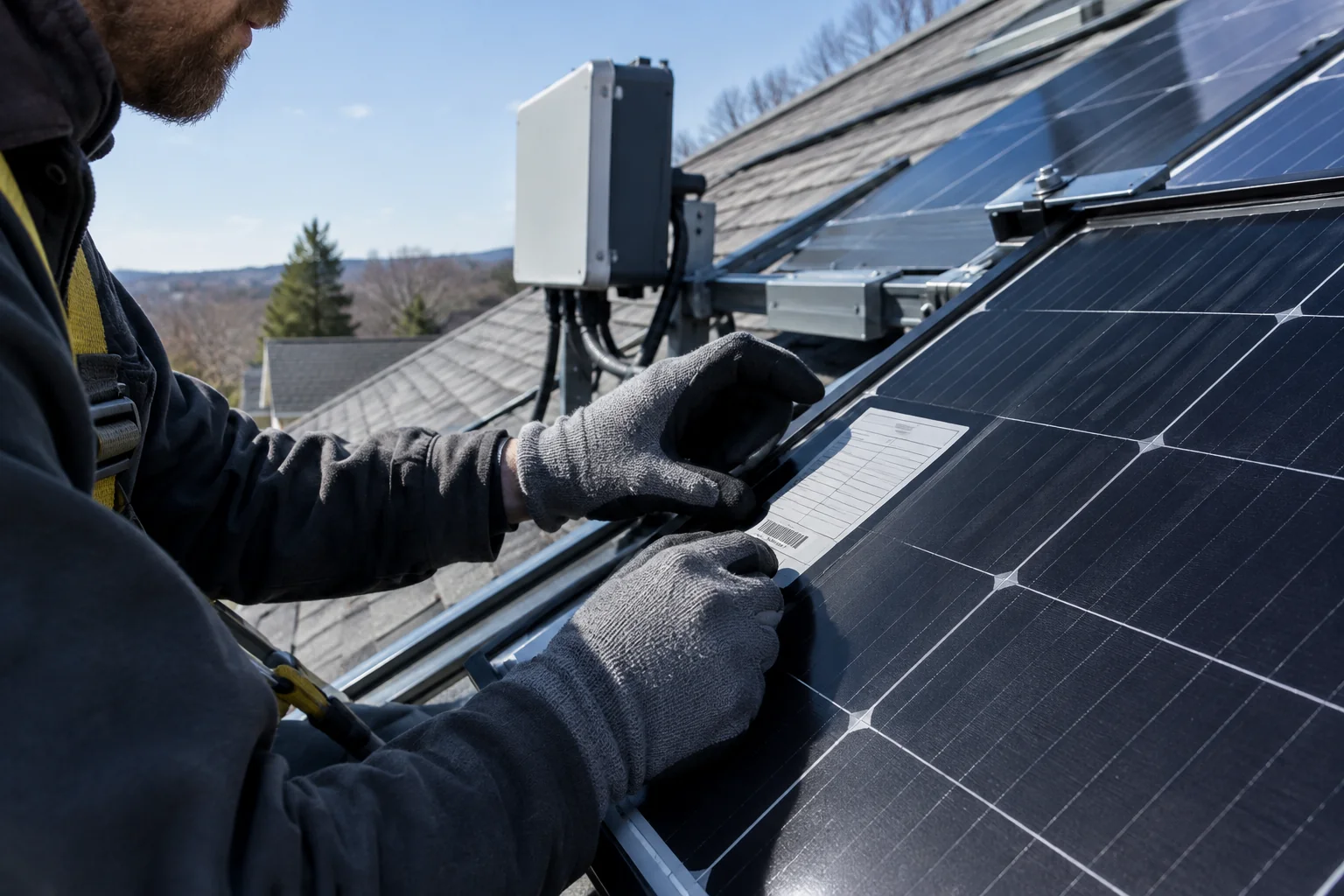
Once you have model numbers, look each one up on the manufacturer's spec sheet. You are checking three things: panel wattage, the inverter's rated output against the array size, and the product warranty length. Put those in the table.
What a vague equipment list usually means
Sometimes it is only a sales shortcut. Sometimes it leaves the installer free to swap in cheaper gear after you sign. Ask for the list in the contract itself, with a clause saying substitutions need your written approval. If an installer refuses, that tells you how the rest of the project may go.
Batteries need their own rows
If a bid includes storage, list the battery model, number of units, usable capacity, continuous power output, and what it will back up. A battery sized to run a few circuits is a different product from one sized for most of the house. Compare options like Tesla Powerwall, FranklinWH and Enphase IQ Battery on those facts. If you are weighing them, our guide to combining solar panels with battery backup explains the sizing.
Design method matters too
Ask how the system was designed. At Teamsun we build custom designs in Aurora, a solar design platform that models a 3D version of your roof and the production of the system on it.
You can ask any installer the same question: was this layout designed for my actual roof, or is it a template? A custom layout and its shade analysis are what a production estimate should rest on. You can explore Teamsun's services to see what we install and what we design for.
4. How Do You Test Production Estimates?
Compare yearly kilowatt-hours per installed kilowatt across bids, then ask what shading, roof tilt, direction, system losses and panel degradation each estimate assumes. Bids built on the same roof should land close together. An estimate far above the others usually rests on a generous assumption, not better panels.
Divide each bid's yearly kWh by its DC kW. In the earlier example that gives 1,150 kWh per kW for Bid A and 1,200 for Bid B. If a third bid on the same roof says 1,450, ask why.
Questions that expose a generous number
- What shade loss did you assume, and where did the shade data come from (a site visit, drone or satellite model)?
- Which roof faces are used, and at what tilt and direction?
- What overall system loss factor (wiring, inverter, dirt, snow) is built in?
- How much yearly degradation is assumed over the system's life?
- Does the number come from a design file I can see?
A good answer is specific: a named shade source, roof faces with their directions, a stated loss figure. A weak answer is "that's what our software says." Treat the weak answer as a failed check and ask for the design report in writing.
Is there a guarantee behind the number?
The Maine Attorney General's solar guidance lists a guarantee of annual kilowatt-hours, a good-faith estimate of price, and clear warranty responsibility among the items to look for in a proposal. Not every installer guarantees production. If one does, record the terms: what the guarantee covers, how it is measured, and what the remedy is.
If you already own a system that is underproducing, our look at reading your solar monitoring app data shows how to check real output against an estimate. It is a good test of how far an installer's numbers can be trusted before you buy.
5. Warranties, Installer and Timeline
Three lines in your table decide how much the project will cost you later: warranties, who installs, and the schedule. They are easy to skip because they do not change the price on the first page. They do change who answers the phone in year six.
Warranties: three layers
List product, performance and workmanship coverage separately. The panel maker covers defects and output. The inverter and battery makers cover their equipment. The installer covers labor and roof penetrations. Write down the years for each and, importantly, who is responsible for honoring it.
The pass mark is a written document for every layer, with a named company behind it. A "lifetime warranty" that is only a sales claim is a fail. A workmanship warranty from an installer that may not exist in ten years is worth less than it looks; ask how long the company has operated locally.
Who actually does the install?
Ask whether the people on your roof are the installer's own employees or subcontractors. Neither answer is automatically wrong, but you need it in writing, because accountability follows the contract. Teamsun uses in-house W-2 crews with no subcontractors, so the team that installs your system works directly for the company that sold it. When a roof detail goes wrong, there is one party to call.
Connecticut's consumer department publishes a solar panel buyer's guide that notes you can verify the license or registration of electricians, home improvement contractors and engineers. Do that for every company in your table, and for the installer's subcontractors if they use them.
Timeline
Ask for the schedule from signed contract to power-on, broken into design, permit, install and utility approval. Our average is 47 days. Whatever a competing bid says, ask what the number includes and whether it covers utility interconnection. A bid that quotes only the install day is leaving out the weeks that matter. For the stages, see how long solar installation takes from contract.
For a longer list of questions on all three lines, use our 15 questions to ask a solar installer before you sign. It works well as a script for follow-up calls.
6. Financing Terms and Dealer Fees
Financing is where two bids with the same equipment can end up thousands of dollars apart. The four common structures are cash, loan, power purchase agreement (PPA) and prepaid lease. Teamsun offers all four. Each belongs in your table with its own terms, not as a single monthly figure.
Ask for the cash price, always
Even if you plan to borrow, ask for a cash price in writing. Then compare it with the loan price. Some lenders charge the installer a dealer fee, and the installer may fold it into the system price. A hypothetical example: a $30,000 cash price and a $34,000 loan price means $4,000, or about 13%, is going to financing costs that never appear as a line item.
That does not make a loan wrong. A low monthly payment can be worth it. But you should be able to see the cost of the money, not discover it later.
What to record for each structure
- Loan: interest rate, term, fees, loan amount vs cash price, and any prepayment penalty.
- PPA: price per kWh, yearly escalator, contract length, buyout terms, and what happens if you sell the house. Teamsun underwrites PPAs from a 620 FICO.
- Prepaid lease: total up-front payment, term, who maintains and insures the system, and the end-of-term options.
- Cash: payment schedule, deposit size and what the deposit secures.
For leases and PPAs, the FTC's solar consumer page is a useful reminder to read what happens with transfer and maintenance. Our solar loan vs PPA vs lease guide compares them in detail.
One caution: you cannot compare a PPA bid with a purchase bid on cost per watt alone. A PPA has no up-front price. Compare it on total payments over the term against the savings, and on the escalator.
7. Red Flags: Padded Add-Ons and Same-Day Pressure
Most bad bids do not contain one obvious trick. They contain several small ones. Here is what to mark in your table when you see it.

Pressure to sign today
A discount that disappears at midnight is a sales tool, not a cost. A good bid is still good next week. Ask for the quote to be held for at least a week, in writing. If the answer is no, treat it as a failed check and move on.
Add-ons that do not fit your roof or usage
Look for lines you did not ask for. A battery on a home that rarely loses power may not pay back. A roof upgrade line on a roof that is five years old may be padding. A monitoring package or "energy management" bundle with a separate price needs a reason. Ask: what does this do for my house, and what happens if I remove it?
The reverse also applies. If your roof is old, a bid with no roof discussion is a problem. Compare notes in solar on an old roof: what to do before you install.
Other red flags to mark
- Production numbers well above competing bids with no design report.
- Equipment listed by tier or brand family, not by model.
- Monthly payment quoted without the total price.
- Incentives subtracted that you may not qualify for.
- No named installer or crew type.
- No license number on the proposal.
If you hit two or more, either ask for a revised bid or drop that column. If a company will not revise, that is your answer.
8. How Do You Ask an Installer to Explain or Match a Price?
Ask for a written line-by-line breakdown, point to the specific line you question, and request a match only on a like-for-like basis: same equipment, same system size, same warranty and same installer type. Never ask an installer to match a price that leaves out things the other bid includes.
Start by sharing what you are comparing, not who bid. A simple script works: "Here is my side-by-side table. Your bid is higher per watt than another on this line. Can you explain what drives that, and is there anything you can adjust?"
What a good response looks like
- It names the difference: different panel, longer warranty, in-house crew, custom design, or a larger system.
- It offers options: a standard-efficiency panel, a smaller battery, a different financing structure.
- It does not attack the other company or rush you.
If the installer cannot explain the gap, ask whether a line can be removed. If it can, the line was padding. If it cannot, the price may be fair, and the other bid may be missing something. Check the other bid for the missing item before you decide.
A decision rule
If two bids pass every check and differ by price, take the lower one. If the lower one fails a check, such as no model numbers or a production figure no one can explain, ask for a fix and give it a week.
If the more expensive bid is the only one with in-house crews, a custom design file and written warranties, decide whether those are worth the gap. We think they usually are, but that is your decision and your roof.
What stays open: no table can tell you how long a company will be around, or how it will treat you in year ten. Local history, reviews and complaint records help. So does the SEIA Solar Business Code, a published industry code on transparency and good faith; ask whether a company follows it. If you want a designer to walk through your bids, talk to a Teamsun designer.
FAQ
Which solar companies in CT use their own employees instead of subcontractors?
Some Connecticut installers use their own employees, some subcontract the install, and some do both. Ask each one in writing who will be on your roof and who employs them. Teamsun uses in-house W-2 crews with no subcontractors, so the crew on your roof works directly for us.
How do I find the best solar companies in Massachusetts or Rhode Island?
Skip rankings and judge each company on the same checklist: named equipment models, a production estimate with its assumptions, written warranties, a clear answer on who installs, and transparent financing. Verify licences with your state, read complaint records, and get at least three bids. The best company is the one whose bid passes every line.
Is there a federal solar tax credit in 2026?
Not for homeowners who buy a system themselves. The 30% residential credit ended for systems placed in service after December 31, 2025. Third-party-owned systems, such as PPAs and leases, may be treated differently because the owner is a business, so ask each installer who claims what and how that shows in your price.
Our solar tax credit and rebate paperwork guide covers what still applies.
How many solar quotes should I get?
Get at least three. Three bids give you a middle value and make an outlier obvious, whether it is too high, too low or built on a rosy production number. More than four or five usually adds confusion, not information, so stop once you have bids you can compare line by line.
Next Step: Bring Your Bids and We Will Line Them Up
A solar quote comparison is a one-evening job once you have the table. If you are holding two or more bids in Connecticut, Massachusetts or Rhode Island and one of them is ours, we will give you model numbers, a design-based production estimate, written warranties and clear financing terms, with no subcontracted crews. If your other bids are from someone else, we will still show you how to read them.
Request a free quote and send us your current bids to compare, or call us at 203-903-4091.
Recommended Resources
Written by
Dan Katzman
Teamsun
Teamsun writes practical solar guidance to help property owners compare equipment, project scope, costs, and long-term service before making a decision.
Keep going.
15 Questions to Ask a Solar Installer Before You Sign
The essential questions to ask a solar installer before signing, covering crew type, timelines, financing, and warranty coverage for CT, MA, and RI homeowners.
Dan Katzman
Teamsun
Commercial Solar for Warehouse Rooftop Owners
Commercial solar for warehouse rooftop owners: roof load limits, interconnection timelines, and financing for 25kW-500kW systems before you sign a contract.
Dan Katzman
Teamsun
Solar for High Electric Bills: How Much Can You Save?
See real bill-reduction numbers from CT, MA, and RI homeowners who sized solar panels for high electric bill homes, including battery add-on payoffs.
Dan Katzman
Teamsun