15 Questions to Ask a Solar Installer Before You Sign
The essential questions to ask a solar installer before signing, covering crew type, timelines, financing, and warranty coverage for CT, MA, and RI homeowners.
Dan Katzman
Teamsun
A homeowner who signs a solar contract without asking who actually installs the panels can end up with a subcontracted crew that never touches the job again after the inverter powers on. The right questions to ask a solar installer before signing cover five areas: crew type, timeline, financing credit minimums, warranty terms, and who answers the phone if something breaks in year six.
Key Takeaways
- Crew type changes accountability: Ask whether W-2 employees or third-party subcontractors will be on your roof, since the answer determines who you call if the install goes wrong.
- 47 days is a real benchmark: Teamsun's average contract-to-power-on timeline is 47 days, tracked across actual installs, not a marketing range.
- Credit minimums vary widely: Many installers require 700+ FICO for financing, while PPA underwriting at a 620 FICO minimum keeps solar accessible to more homeowners.
- Warranty coverage has two parts: Equipment warranties (25 years typical for panels) and workmanship warranties (often 10 years) are separate, and installers should quote both clearly.
- Post-install service is not guaranteed: Some installers stop responding once the system is live, so ask specifically who handles repairs, retrofits, and monitoring support after year one.
At a Glance: What a Trustworthy Installer Should Offer
| Question Category | Weak Answer | Strong Answer |
|---|---|---|
| Crew type | "We use trusted partners" | In-house W-2 employees, named and insured |
| Install timeline | "Usually a few months" | Tracked average with a specific number, e.g. 47 days |
| Financing credit minimum | "We'll see what we can do" | A stated minimum, e.g. 620 FICO for PPA underwriting |
| Panel warranty | Not mentioned unless asked | 25-year manufacturer warranty disclosed upfront |
| Workmanship warranty | Bundled vaguely into "warranty" | Separate labor warranty, typically 10 years |
| Post-install service | Routed to a third-party call center | Same company that installs also services and retrofits |
| Roof coordination | "That's on you" | Coordinates roof replacement timing before install |

1. Who Actually Installs Your System: W-2 Crew or Subcontractor?
Ask directly: are the people on my roof employees of your company, or subcontracted labor hired for this one job? The answer determines who is accountable when something needs to be redone.
National solar brands often rely on dealer networks or subcontractor crews that rotate in and out of a region. A crew that installed your neighbor's system last month might not be the same one that shows up for a warranty repair next year. That gap matters when a roof penetration leaks or a wiring issue surfaces two winters later.
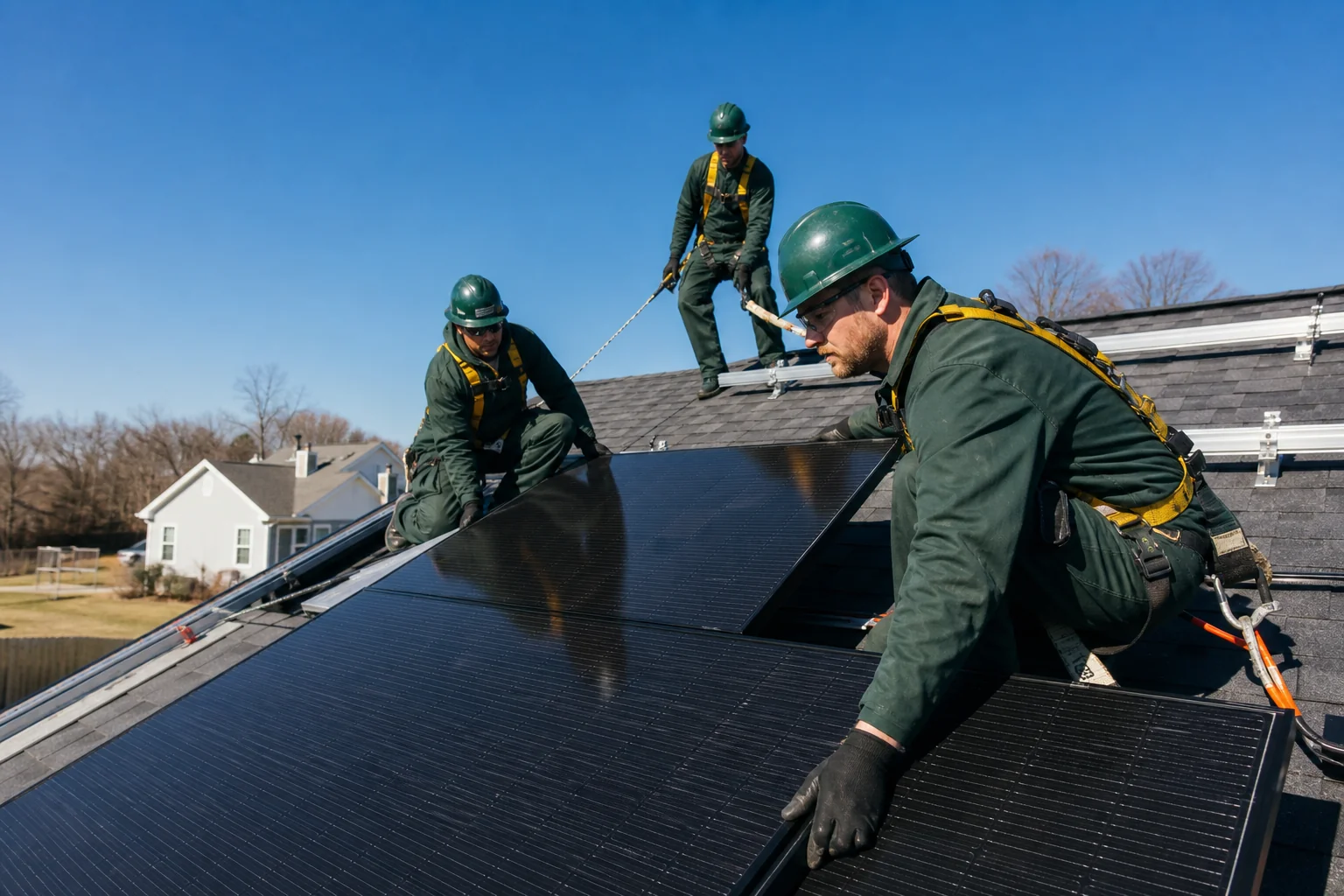
Teamsun uses in-house W-2 crews across Connecticut, Massachusetts, and Rhode Island rather than subcontractors. The same technicians who design and install the system are the ones who come back if it needs service. For a deeper breakdown of how this affects install quality and long-term accountability, see in-house crew vs subcontractor installation practices.
2. What's Your Average Timeline From Contract to Power-On?
A trustworthy installer states a specific, tracked average timeline, not a vague seasonal estimate. Ask for a number based on completed installs in your state, not an industry-wide range pulled from a national brochure.
Teamsun's tracked average across Connecticut, Massachusetts, and Rhode Island installs is 47 days from signed contract to system activation. That figure accounts for permitting, utility interconnection, and inspection, the three stages where most delays actually happen. A full breakdown of each stage is available in how long solar installation takes from contract to power-on.
Timelines vary by town depending on permitting office speed and utility interconnection queues. Ask the installer to name the specific permitting authority for your address and whether they've worked with that office before.
3. What Happens If the Timeline Slips?
A serious installer explains the specific causes that typically push a timeline past its average, rather than promising a date with no accountability if it's missed. Ask what recourse exists if the install stretches well beyond quoted expectations.
Permitting delays and equipment backorders account for most missed timelines. Ask whether the installer pre-orders equipment before permits clear, and whether they track permitting status proactively or wait for the town to call them. A company that monitors its own pipeline daily catches slippage before it becomes a six-month wait.
4. What Financing Options Do You Offer, and What's the Credit Minimum?
Ask for every financing path the installer offers, cash, loan, prepaid lease, or Power Purchase Agreement, along with the credit score minimum for each. This single question eliminates installers who quietly turn away applicants with sub-700 credit.
Many installers advertise financing without disclosing that their loan partners require a 700+ FICO score. Homeowners with fair or average credit find out only after a rejected application. Teamsun underwrites PPA financing at a 620 FICO minimum, which keeps solar within reach for a wider range of applicants. Details on how this structure works are covered in how solar PPA financing works and in a side-by-side comparison at solar loan vs PPA vs lease.
Small business owners face a parallel issue when applying for commercial solar financing, where credit requirements can be even stricter for equipment loans than for residential PPAs.
5. Who Services My System After Installation?
Ask whether the company that sells and installs the system is the same one that answers service calls five or ten years later. This matters more than almost any other question on this list.
National installers frequently route post-install service through third-party contractors or regional call centers, which slows response time and dilutes accountability. If the original sales rep or installer has left the company, homeowners can be left with no clear contact at all.
Teamsun services systems it installs and also retrofits or repairs systems installed by other companies, regardless of brand or age. If your existing system already has issues, finding a repair company for any brand outlines what to check before calling for service.
6. What Warranty Coverage Comes With the Equipment and the Labor?
Ask the installer to state the panel warranty, inverter warranty, and workmanship warranty as three separate numbers, since bundling them into one vague "warranty" often hides gaps in coverage.
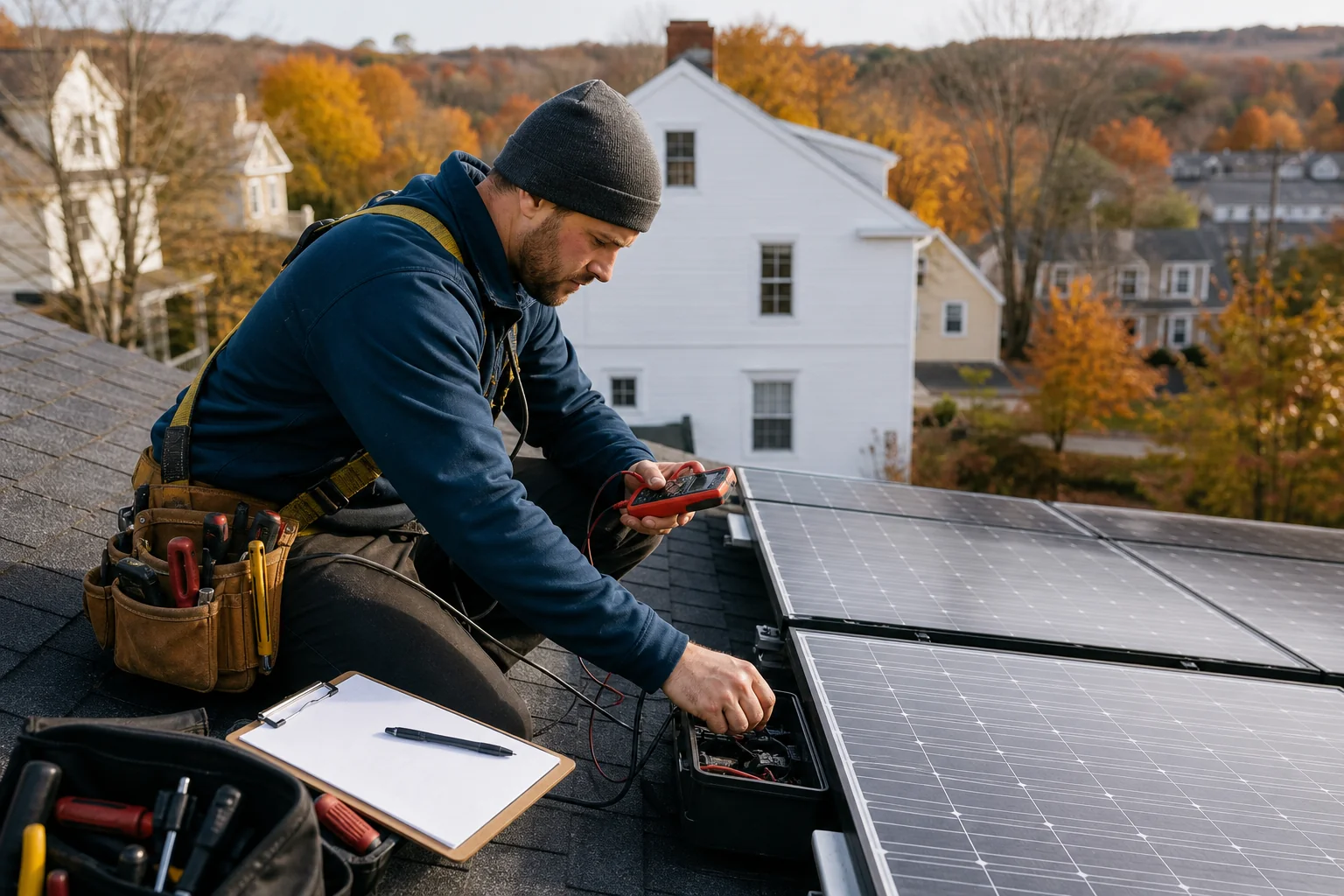
Panel manufacturers typically warranty output for 25 years, while inverters range from 10 to 25 years depending on the brand. The workmanship warranty, covering the installer's own labor and roof penetrations, is usually shorter, often 10 years, and comes directly from the installer rather than the equipment manufacturer. If that installer goes out of business, the workmanship warranty becomes worthless. Ask how long the company has operated locally and whether it has weathered past market downturns.
7-15. The Rest of the Checklist
Beyond crew, timeline, financing, and warranty, nine more questions round out a full pre-signing checklist for any solar contract.
- What's the remaining life of my roof? An installer should assess roof condition before quoting a system, since panels installed on an aging roof mean tearing them off within a few years. See when to replace a roof before installing solar.
- Who handles permitting and utility interconnection? Confirm the installer files paperwork directly with your town and utility rather than outsourcing it.
- What equipment brands and tier do you install? Ask specifically for Tier-1 panel manufacturers and named battery brands rather than generic "premium equipment" language.
- How did you size my system? A proper sizing methodology uses 12 months of actual utility usage data, not a rough square-footage estimate.
- How does net metering work with my utility? Credit rates and rules differ by utility company. Review how net metering works with your utility before signing.
- What monitoring app will I use, and who explains the data? Ask if the installer walks you through the app after activation or leaves you to figure it out alone.
- Can this system support a battery later? Ask about retrofit compatibility even if you're not adding storage on day one.
- Can you integrate an EV charger with this system? If an EV purchase is on the horizon, confirm the array and panel are sized with future charging load in mind.
- Can I see verifiable references or a local install history? Ask for addresses or project counts in your specific town, not just a statewide total.
Comparing Installer Types Before You Sign
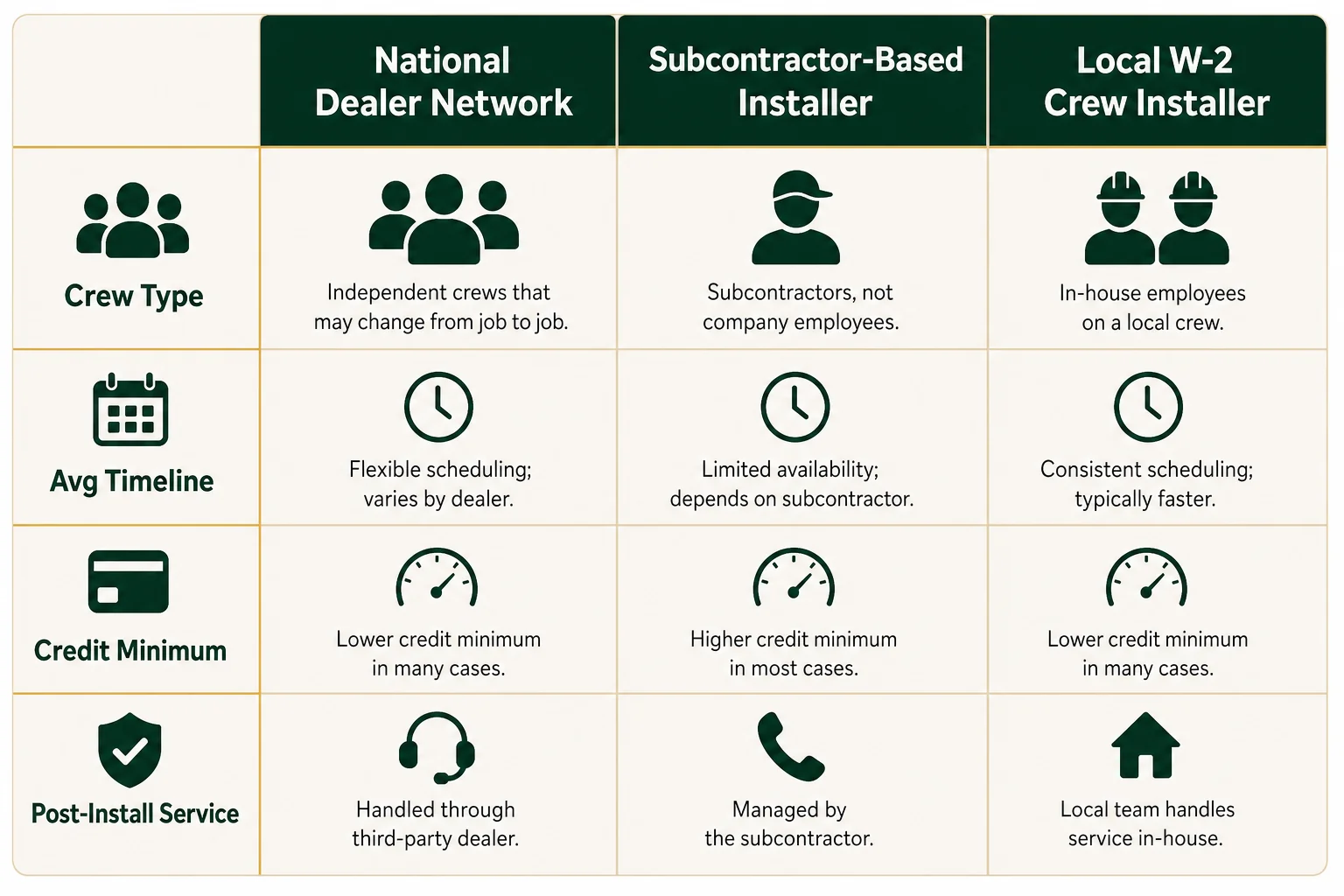
Installer models fall into three broad categories, and each answers these questions differently by default. The table below shows what to typically expect from each type.
| Factor | National Dealer Network | Subcontractor-Based Installer | Local W-2 Crew Installer |
|---|---|---|---|
| Crew accountability | Sales rep separate from install crew | Rotating third-party crews | Same employees design, install, and service |
| Average timeline | Varies widely by region | Depends on subcontractor availability | Tracked average, e.g. 47 days |
| Financing credit minimum | Often 700+ FICO for loans | Varies by third-party lender | Can go as low as 620 FICO for PPA |
| Post-install service | Often routed to regional call center | May be difficult to trace back to original crew | Direct line to the installing company |
| Retrofit on other brands | Rarely offered | Rarely offered | Commonly offered |
For a direct look at how one national brand compares against a local, employee-based model, read Sunrun vs a local solar installer.
Red Flags That Mean You Should Keep Looking
Certain answers, or the lack of them, signal that an installer isn't ready to earn your signature.
- Vague crew answers: Phrases like "trusted partners" instead of naming employees directly.
- No specific timeline number: An installer who can't quote an average in days hasn't tracked their own performance.
- Reluctance to disclose credit minimums: Waiting until after you apply to reveal the score requirement wastes your time and hurts your credit inquiry count.
- No local service commitment: If the answer to "who fixes this in five years" is unclear, assume you're on your own after activation.
- Pressure to sign same-day: A legitimate quote should hold for at least a few days while you compare options.
Frequently Asked Questions
Should I get multiple quotes before signing?
Yes, getting two or three quotes lets you compare crew type, timeline claims, and financing terms side by side. It also reveals which installers give specific, verifiable answers versus generic sales language.
Does a lower quote always mean a better deal?
No, a lower upfront price can mean lower-tier equipment, a shorter workmanship warranty, or a subcontracted crew with less accountability. Compare the full package, not just the bottom-line number.
Can I ask to see the actual install crew's credentials?
Yes, a reputable installer will confirm whether crew members are licensed, insured, and directly employed. If they hesitate or redirect the question, treat that as a signal to keep asking.
Every question on this list exists because the answer changes what happens after you sign, not just what the quote looks like on paper. Teamsun answers all fifteen directly: W-2 crews across Connecticut, Massachusetts, and Rhode Island, a 47-day average install, PPA underwriting down to a 620 FICO score, and service on any system it touches. Before you commit to any contract, request a free quote and compare it against what you've read here, or talk to a designer about your specific roof and usage. You can also explore Teamsun's full range of services or call 203-903-4091 to ask these fifteen questions directly.
Recommended Resources
Written by
Dan Katzman
Teamsun
Teamsun writes practical solar guidance to help property owners compare equipment, project scope, costs, and long-term service before making a decision.
Keep going.
Commercial Solar for Warehouse Rooftop Owners
Commercial solar for warehouse rooftop owners: roof load limits, interconnection timelines, and financing for 25kW-500kW systems before you sign a contract.
Dan Katzman
Teamsun
In-House Crew vs Subcontractors: Who Installs Your Solar?
Solar installer subcontractors vs in house crew: learn how each model affects quality, accountability, and warranty before you sign a solar contract.
Dan Katzman
Teamsun
Sunrun vs SunPower vs Local Installer Comparison
Sunrun vs SunPower vs local installer comparison: install speed, warranty accountability, and service response, broken down for Connecticut homeowners comparing quotes.
Dan Katzman
Teamsun