Solar panels for Florida hurricane season durability
Solar panels for Florida hurricane season durability explained: wind ratings, racking, UL/IEC certs, and what actually fails when hurricanes hit.
Dan Katzman
Teamsun
A solar array doesn't fail in a hurricane because the glass shatters. It fails because a clamp works loose. FEMA documented that pattern after Hurricanes Irma and Maria, and it's the single most useful fact a Florida homeowner can know before buying a system.
Solar panels for Florida hurricane season durability comes down to three things: the wind rating on the panel, the racking that holds it to the roof, and whether an installer bothered to engineer the attachment for your specific address.
Key Takeaways
- Racking hardware, not panel glass, is the weak point: loose clamps and under-torqued rails cause most hurricane-related solar failures, not cracked cells.
- Wind ratings vary by site, not just by product: the design wind speed for your roof (Vult) typically falls between 100 and 140 mph across most of the U.S., with coastal Florida zones pushing past 150 mph, per ASCE 7-22 wind speed maps.
- Edge and corner roof zones need stronger attachment: panels near a roof's perimeter face uplift forces roughly two to three times higher than the field, according to ASCE 7 edge zone design guidance.
- Removal before a storm rarely makes sense: a planned electrical shutdown is the standard move; taking panels off the roof introduces more risk than it removes, per commercial hurricane preparedness guidance.
- UL and IEC numbers answer different questions: one is a safety certification, the other is a mechanical durability test, and neither one alone tells you whether your specific roof attachment will hold.
Solar Panels for Florida Hurricane Season Durability at a Glance
| Factor | What it covers | What to check |
|---|---|---|
| Wind speed rating | Design wind speed (Vult) for your address, typically 100-150+ mph | Ask your installer to show the ASCE 7 calculation for your roof |
| Racking/mounting | Rails, clamps, and roof attachment points | Engineered layout, not a generic kit |
| Building code | Florida Building Code, HVHZ in Miami-Dade and Broward | Confirm your county's wind zone requirements |
| Certifications | UL 1703/61730 (safety), IEC 61215 (durability testing) | Panel spec sheet should list both |
| Common failure point | Loose clamp hardware, per FEMA post-storm review | Annual torque check on racking bolts |
| Pre-storm action | Planned shutdown, not removal | Know your inverter's disconnect procedure |
What Actually Breaks First in Hurricane-Force Winds?
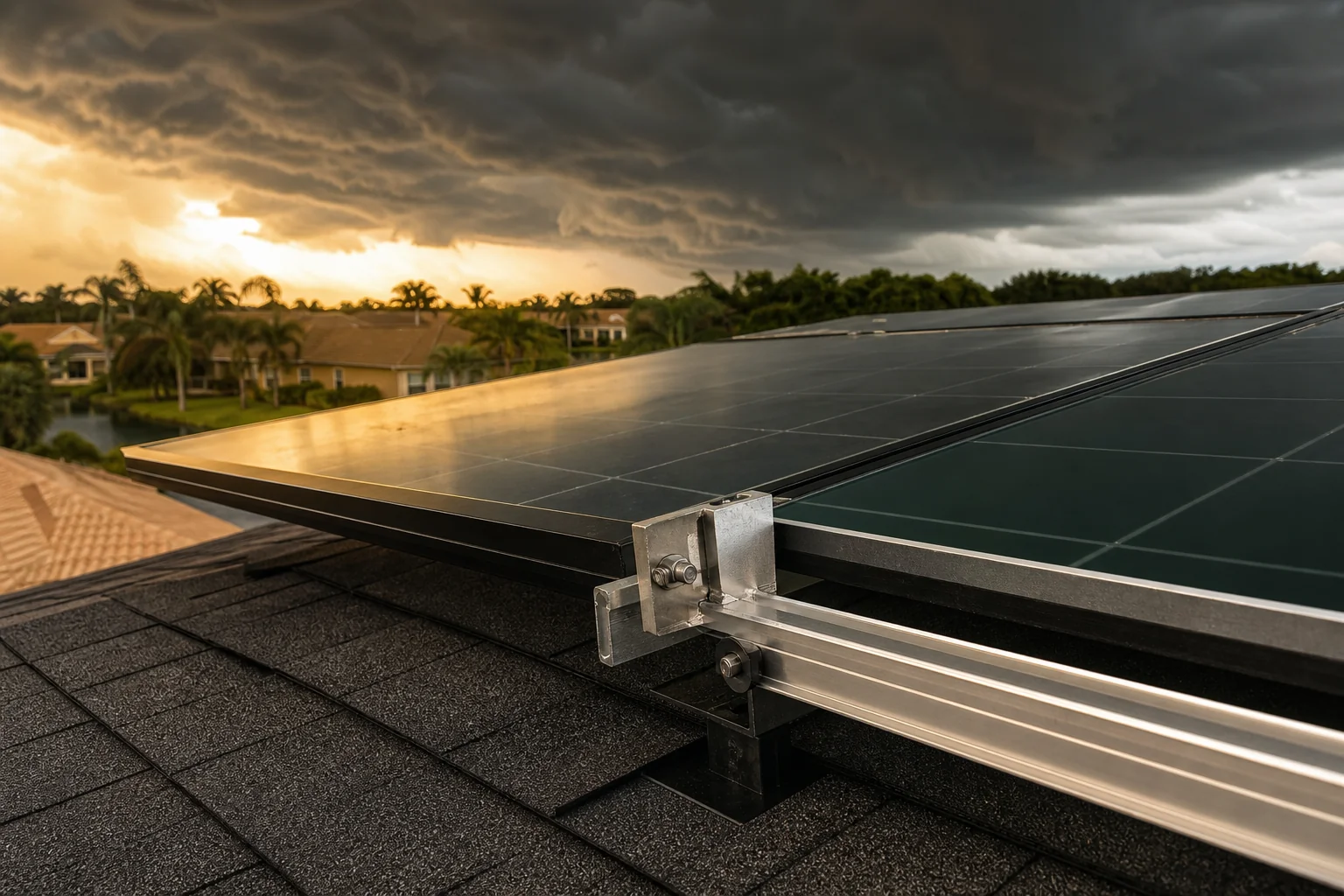
The panels themselves rarely break. What fails is the hardware connecting the panel to the roof, specifically the clamps and rail attachment points that were under-torqued or installed without engineering behind them. FEMA's post-hurricane reviews after Irma and Maria found this pattern repeatedly in damaged commercial and residential arrays.
Wind doesn't push down on a roof the way most people picture it. It creates uplift, a suction force that tries to peel the array off the deck. That force isn't even across the roof. Corners and edges take the worst of it.
Per ASCE 7 edge zone modeling, panels mounted near a roof perimeter face uplift loads roughly two to three times higher than panels in the middle of the field, according to high wind zone mounting guidance. An installer who treats every panel position the same, using identical clamp spacing across the whole roof, is skipping a step that matters most exactly where the wind hits hardest.
Flying debris is a separate risk from wind uplift, and it's the one marketing materials tend to skip. A palm frond or roof tile moving at hurricane speed can crack a panel's tempered glass regardless of how well the racking is engineered. That's a real but limited risk. Debris damage is typically localized to one or two panels, while a racking failure can take out an entire string or the whole array at once.
How Wind Load Ratings Actually Work
A wind load rating tells you the maximum design wind speed a mounting system is engineered to withstand at a given site, not a fixed number stamped on every panel everywhere. It's called Vult, and it's calculated from your address, roof height, and exposure category.
Most residential sites across the U.S. fall between 100 and 140 mph Vult, with coastal Gulf and Atlantic zones, which includes most of Florida, pushing past 150 mph, per ASCE 7 Hazard Tool data. That range matters because a panel rated for 180 mph in a lab test still needs a roof attachment engineered for your specific wind zone. The panel's own rating is only half the equation.
Modern residential panels are commonly tested to withstand wind loads in the 90 to 150 mph range as measured by uplift, shear, and overturning force, according to wind and structural load testing standards. A homeowner in Miami-Dade needs a different calculation than a homeowner in Tampa or Orlando, and a competent installer runs that math before quoting a job rather than after.
This is also where Florida's building code stands apart. It requires solar installations to meet the same wind resistance standard as the roof itself, and counties inside the High-Velocity Hurricane Zone, Miami-Dade and Broward, apply the strictest structural engineering standard for solar racking in the country, per HVHZ design and permitting requirements.
If you're outside those two counties, ask your installer whether they still design to that standard voluntarily, because a lot of them don't.
Racking and Mounting Systems: Where Durability Really Comes From
Racking is the metal skeleton that carries wind load from the panel down to your roof deck, and it's where a well-designed system and a cheap one diverge fastest. The panel glass and frame usually survive a storm intact. What separates a system that stays on the roof from one that doesn't is whether the racking was engineered for your specific roof type, pitch, and wind exposure, or bolted down using a one-size-fits-all kit.
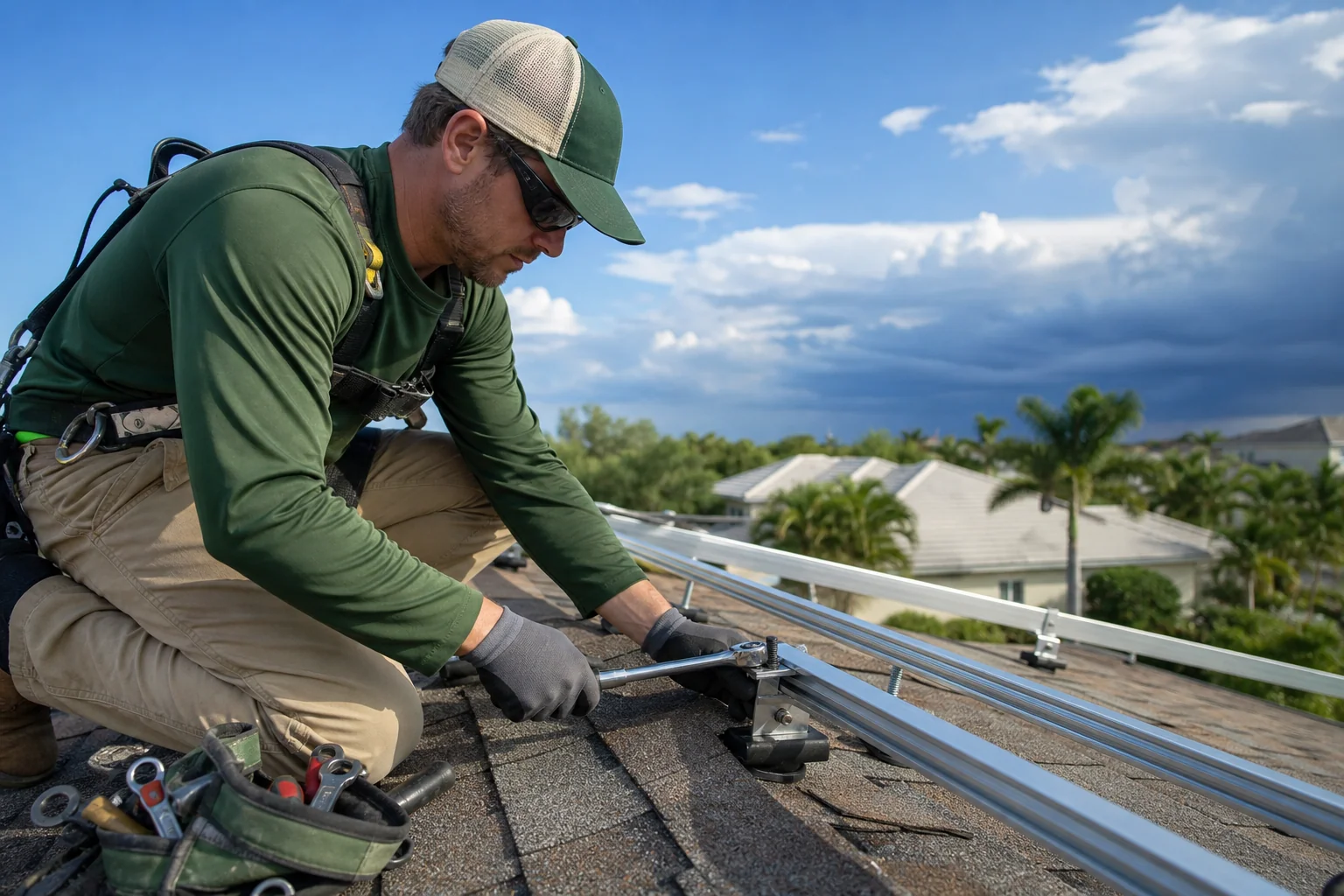
Engineered mounting accounts for rafter spacing, deck material, and the wind zone calculation described above. It also determines clamp count and spacing, which is exactly the detail that failed in the FEMA-reviewed storm damage. A rushed install cuts corners here because it's invisible once the panels go up, and nobody notices until a storm arrives.
Homeowners considering solar on an aging or marginal roof should read up on what to do before installing on an old roof, since racking is only as strong as the deck it's bolted to. A perfectly engineered attachment point means little if the roof underneath it is already compromised.
Decoding UL and IEC Certifications in Plain Language
UL and IEC certifications test different things, and neither one alone tells you whether a specific installation will survive a hurricane. Together they establish that the panel itself was built and tested to a recognized standard, which is the baseline you want before engineering the site-specific mounting on top of it.
UL certification, most commonly UL 1703 or the newer UL 61730, is a safety standard. It confirms the panel won't create an electrical or fire hazard under normal and fault conditions. It's a product safety credential, not a storm survival guarantee.
IEC 61215 is a mechanical and environmental durability test. It puts panels through mechanical load cycling, temperature extremes, and humidity exposure to confirm they hold up over years of outdoor use. This is closer to what a hurricane-prone buyer actually cares about, but it's still a lab test on the panel alone, not a test of your roof's specific racking attachment.
The honest takeaway: both certifications are a floor, not a ceiling. A panel that passes UL and IEC testing still depends entirely on how it's mounted to your particular roof. That's engineering work an installer does at your address, not a number printed on a spec sheet.
3 kW vs 8 kW vs Commercial Rooftop: Wind Exposure Compared
System size changes the wind engineering conversation more than most homeowners expect. A small residential array, a full-size home system, and a commercial rooftop each carry different exposure profiles and inspection needs.
| System type | Typical footprint | Wind exposure profile | Inspection frequency |
|---|---|---|---|
| 3 kW residential | 8-10 panels | Lower total load, but edge-zone risk if panels sit near roof perimeter | Annual visual + post-storm |
| 8 kW residential | 20-24 panels | Full roof coverage, more edge-zone panels, higher total uplift force | Annual visual + post-storm |
| Commercial rooftop (25kW+) | 60+ panels across flat or low-slope roof | Larger surface area, parapet and edge conditions dominate, often ballasted or penetrating mounts | Semi-annual + post-storm, often contractual |
Commercial roofs bring their own set of durability questions, and business owners weighing a rooftop array should look at how many panels a small business roof actually needs before assuming bigger is automatically better. A larger array on a flat commercial roof concentrates more edge-zone panels around the perimeter, exactly where FEMA's failure data points.
Should You Shut Down or Remove Panels Before a Storm?
Shut the system down electrically; don't remove the panels. A planned inverter shutdown protects your equipment and your crew without introducing the fall risk, water intrusion, and re-attachment errors that come with pulling panels off a roof days before a hurricane makes landfall.
Removal sounds protective, but it rarely is. Taking panels down means creating new roof penetrations to reinstall them, paying for labor twice, and leaving exposed mounting hardware and open holes right as high winds and rain arrive. A properly engineered array, per the guidance above, is built to stay attached through the storm it was rated for.
What you should do is know your shutdown procedure ahead of time, not figure it out during a hurricane warning. Most residential systems have a simple disconnect at the inverter or a rapid shutdown switch required by code. Confirm where yours is and how to use it before June, not during an active watch.
After the storm passes, get a professional inspection before re-energizing, even if the system looks fine from the ground. Homeowners who already had a battery installed alongside their array should also check how solar and battery backup work together, since a battery-equipped system changes what "shutdown" actually means for critical loads during an outage.
A Pre-Season Durability Checklist for Florida Homeowners
Most of what determines whether your array survives hurricane season happens months before the storm, not the week of. Run through this list every spring:
- Torque check on racking bolts: hardware loosens over years of thermal cycling; a technician should verify clamp torque annually, not just at install.
- Visual corrosion inspection: salt air corrodes aluminum racking faster near the coast; look for white oxidation or rust at attachment points.
- Roof condition under the array: flashing, underlayment, and deck integrity matter as much as the panels bolted on top.
- Document your system: photograph panel serial numbers, racking layout, and inverter model before storm season so an insurance claim moves faster if damage occurs.
- Know your shutdown switch location: confirm it with whoever installed or last serviced your system.
If you're not sure your current system was engineered to this standard in the first place, especially if it's an older install or one done by a company that no longer answers the phone, it's worth having someone who services any brand of system, not just their own installs, take a look before June.
Frequently Asked Questions
Are solar panels really hurricane proof?
No system is fully immune to a direct hit from a major hurricane, and no honest installer will claim otherwise. What determines survival is whether the racking was engineered for your specific wind zone, not whether the marketing calls it "hurricane proof."
What wind speed can Florida solar panels withstand?
Most residential panels are engineered to withstand design wind speeds between 100 and 150+ mph depending on your site's Vult calculation, with coastal Florida zones often at the higher end, per ASCE 7-22 wind mapping. The number that matters is calculated for your address, not a single figure that applies statewide.
Do I need to remove solar panels before a hurricane?
No. A planned electrical shutdown is the standard approach; removing panels creates more risk through new roof penetrations and reinstallation errors than leaving a properly engineered system attached through the storm.
Does solar installation void my roof warranty during storms?
It depends on your roofing manufacturer and how the racking was attached. This is exactly why timing solar around a roof replacement matters, and homeowners weighing that sequence should look at when to handle a roof replacement before going solar.
Solar durability in Florida isn't settled by a single spec sheet number. It's decided by whether an installer actually ran the wind load math for your roof, your county, and your exposure, then backed it with hardware installed to spec rather than to a deadline. That's a conversation worth having before you sign anything, not after a storm has already tested the answer.
If you want that engineering conversation started now, talk to a designer about wind load calculations for your specific roof, or request a free quote to see what a properly engineered system costs for your address. You can also explore the full range of services Teamsun offers across Connecticut, Massachusetts, and Rhode Island, or call 203-903-4091 to talk through your roof's specific wind exposure before hurricane season tests it for you.
Recommended Resources
Written by
Dan Katzman
Teamsun
Teamsun writes practical solar guidance to help property owners compare equipment, project scope, costs, and long-term service before making a decision.
Keep going.
Why is my solar quote so different from my neighbors
Why is my solar quote so different from my neighbors? Compare kW, equipment, crew type, and financing to spot what's really driving the price gap.
Dan Katzman
Teamsun
Can Solar Panels Work With Your Home Generator?
Learn how a solar panel system with existing home generator setups can work together, what transfer switch changes are needed, and when a battery skips the generator.
Dan Katzman
Teamsun
Do Solar Panels Make Sense for Rental Properties?
Solar panels for rental property owners: how tenant savings, added property value, and financing stack up for landlords in CT, MA, and RI.
Dan Katzman
Teamsun