Solar Inverter Replacement Cost
Solar inverter replacement cost depends on inverter type, labor, permits and warranty. Learn the warning signs and your options in CT, MA and RI.
Dan Katzman
Teamsun
Solar inverter replacement cost usually runs about $1,000 to $3,500 for a string inverter, $150 to $650 per unit for a microinverter, and $2,000 to $5,000 for a hybrid inverter. Labor, permits, electrical work and warranty status move the final bill. Check the manufacturer warranty first, because a covered part can still leave you paying for labor.
Key Takeaways
- Warranty first: many string inverters carry 10 to 12 year terms, and current Enphase IQ microinverters carry 25 years, so a failed unit may cost you labor only.
- Type sets the price: a single microinverter is the cheapest fix, a string inverter sits in the middle, and a hybrid unit costs the most.
- Labor is not the same as the part: roof access, permits and any electrical rework can matter as much as the box itself.
- Upgrade only with a reason: choose a battery-ready inverter if you want backup power within a few years; otherwise a like-for-like swap is usually the better value.
- Installer gone is fixable: any licensed solar company can service most brands, and you do not need the original installer to replace an inverter.
Solar Inverter Replacement Cost at a Glance
| Item | Typical 2026 market range | What to know |
|---|---|---|
| String inverter, installed | About $1,000 to $3,500 | Higher end for larger systems and extra electrical work |
| Microinverter, per unit | About $150 to $650 | Rest of the array keeps producing while one unit is out |
| Hybrid (battery-ready) inverter | About $2,000 to $5,000 | Costs more but prepares the system for a battery |
| Repair instead of replace | About $150 to $700 | Works for some faults, such as a bad fan or a loose connection |
| String inverter warranty | Often 10 to 12 years | Check your own paperwork for the exact term |
| Microinverter warranty | Up to 25 years on current Enphase IQ units | Older generations may be shorter |
These are published market estimates for U.S. homes, not Teamsun prices. Your quote depends on your roof, your equipment and your electrical panel.
What Are the Warning Signs That Your Solar Inverter Is Failing?
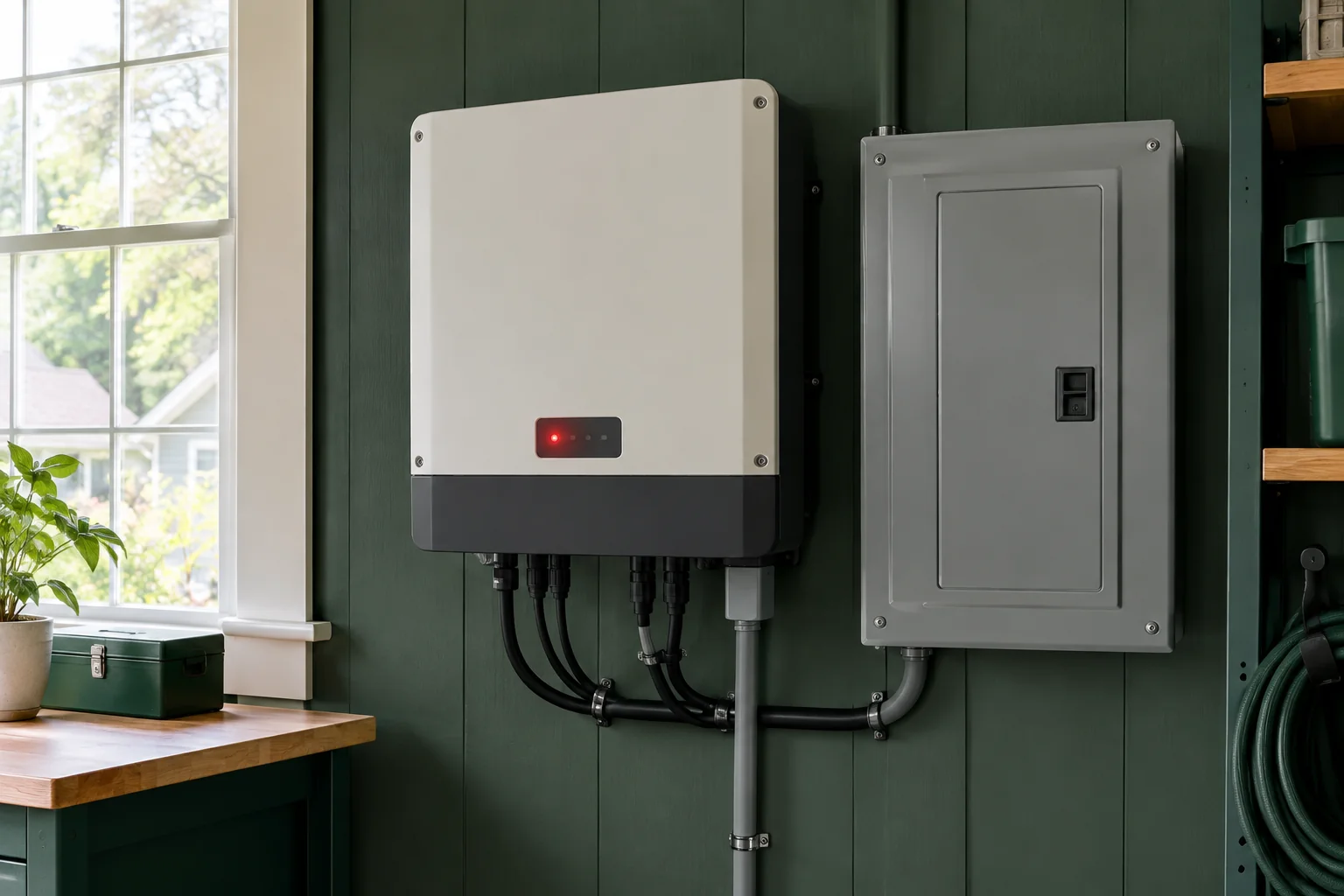
The clearest signs are a red or flashing status light, zero production in your monitoring app on a sunny day, and a fault code on the inverter screen. Other signs include loud buzzing, a unit that feels very hot, and output that falls well below the same month last year.
Most Connecticut, Massachusetts and Rhode Island homeowners learn about a dead inverter late. The panels still look fine on the roof, so nothing seems wrong until the electric bill jumps. That is why a quick monthly look at your app is worth the two minutes it takes.
Error lights and fault codes
Most string inverters show a green light when they work and a red or amber light when they do not. The meaning of each color differs by brand, so look up your model's manual. Write down any code on the screen before you touch anything, because a technician can often diagnose a fault from the code alone.
Zero production or a sudden drop
A flat line in the app on a bright day points to the inverter, the breaker or lost communication. Our guide on how to read your solar monitoring app data shows what a healthy daily curve looks like, so you can tell a real fault from a cloudy week.
Rule out the simple causes first
Before you call anyone, run through this short list:
- Check that the utility grid is up. The Rhode Island Office of Energy Resources notes that grid-tied solar systems without battery backup will not operate when the power grid is down, so a neighborhood outage can look like a failure.
- Look at the solar breaker in your main panel and the AC disconnect near the inverter. If either is tripped, reset it once only.
- Check your Wi-Fi. A lost connection can make the app show zero even when the system is producing.
- Look for snow or heavy debris on the array, which can cause low output but is not an inverter fault.
If the light stays red after a reset, or the breaker trips again, stop. Repeated tripping is a safety signal, not a nuisance, and it needs a licensed electrician or solar technician.
How Do You Check Your Inverter Warranty Before Paying for Anything?
Find the inverter's model and serial number on its label, then contact the manufacturer with your install date. Ask whether the unit is still covered and what the warranty pays for. Many warranties ship a free replacement part but do not cover the labor to install it.
This step can save you more than any other. A string inverter installed eight years ago may still have two to four years of coverage, and a microinverter may have decades.
Steps to confirm coverage
- Locate the label. Photograph the model number, serial number and any fault code.
- Find your install date. Use your permission-to-operate letter, your contract or your first utility bill with solar credits.
- Contact the manufacturer directly. Do not wait on an installer who is not answering. Ask for the warranty term, whether it transfers to you as the current owner, and whether the replacement is new or refurbished.
- Ask about labor. Get the answer in writing: does the manufacturer pay any labor allowance, or only ship the part?
- Check your installer's workmanship warranty. Some contracts cover labor for 10 years or more, though that promise is only as good as the company still standing behind it.
The Massachusetts state guidance on solar products says that when an installer goes out of business or is sold, customers should consult the contracts and warranties provided at installation. Keep those documents in one folder, paper or digital.
The covered part, uncovered labor trap
This is the most common surprise. The manufacturer sends a free inverter, then you learn that removing the old one, mounting the new one, commissioning it and handling any permit is a separate bill. For a microinverter on the roof, labor is often most of the cost. Ask any quoting company to price the labor on its own line so you can compare.
What Drives Solar Inverter Replacement Cost?
Five things drive solar inverter replacement cost: the inverter type, its size in kilowatts, labor and roof access, permit and utility paperwork, and any electrical work beyond a simple swap. Warranty status then decides how much of the equipment price you pay yourself.
Published 2026 estimates put a string inverter swap at roughly $1,000 to $3,500 installed. Larger systems at the top of that range need higher amperage handling. Microinverters run about $150 to $650 per unit, and hybrid units about $2,000 to $5,000.
Inverter type and size
| Type | Where it sits | If one fails | Cost pattern |
|---|---|---|---|
| String inverter | Wall near the panel or garage | Whole system stops | One larger purchase, easy to reach |
| Microinverter | Under each panel | Only that panel goes quiet | Smaller part cost, more roof labor |
| Hybrid inverter | Wall near the panel | Whole system stops | Highest equipment cost, battery-ready |
Size matters because the replacement must match your array's output. A 10 kW system needs a bigger unit than a 5 kW system, and the price follows.
Labor, access and season
A wall-mounted inverter in a garage is a quick job. A roof job is slower, and in New England it depends on weather. Snow, ice and short winter days can push a roof repair back by days or weeks. Interior swaps can go ahead in any weather.
Permits and electrical work
A like-for-like swap often needs a simple permit or a notice to your town and utility, depending on the town. Changing the inverter type can mean a new permit and updated utility paperwork. Connecticut's solar buyer guide says an E-1 Unlimited Electrical Contractor license is needed to connect a solar system to your home's wiring.
Extra electrical work adds cost. Common examples are a corroded disconnect, a breaker that no longer matches the new unit, or a main panel that needs an upgrade before a battery-ready inverter can be added.
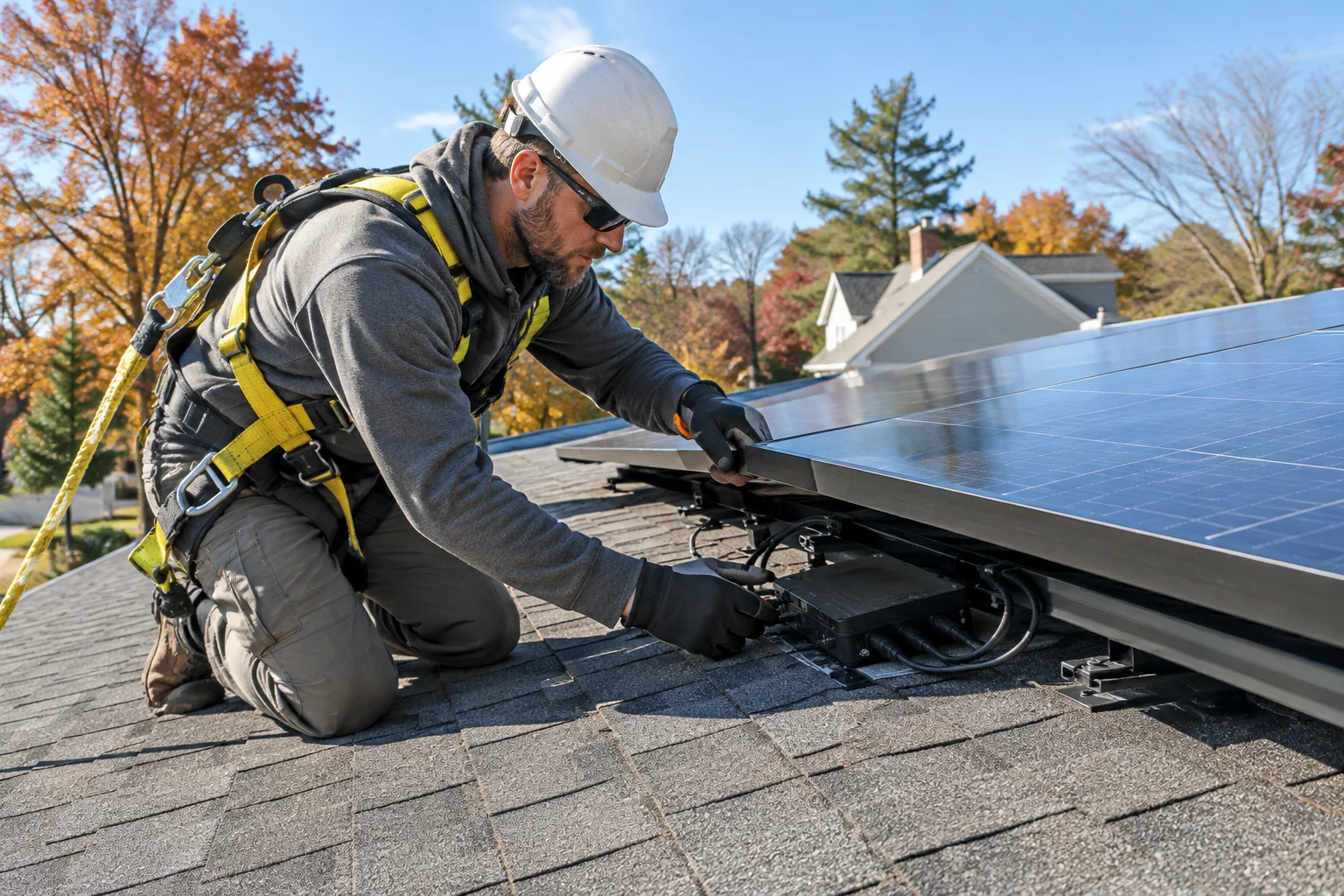
Replacing a microinverter on the roof
When one microinverter fails, the rest of the array keeps producing, so there is no rush in a technical sense. You still lose that panel's output every day, and a failing unit can sometimes be a sign of a bad trunk cable or connector.
The part is cheap, but a technician must lift the panel, swap the unit and test the circuit. Ask for a cost for one unit and a cost for several, because a crew already on the roof charges less per unit than for separate visits. Also confirm the new unit is compatible with the older ones. Mixed generations of the same brand usually work together, but your installer should verify that.
Should You Replace Like for Like or Move to a Battery-Ready Inverter?
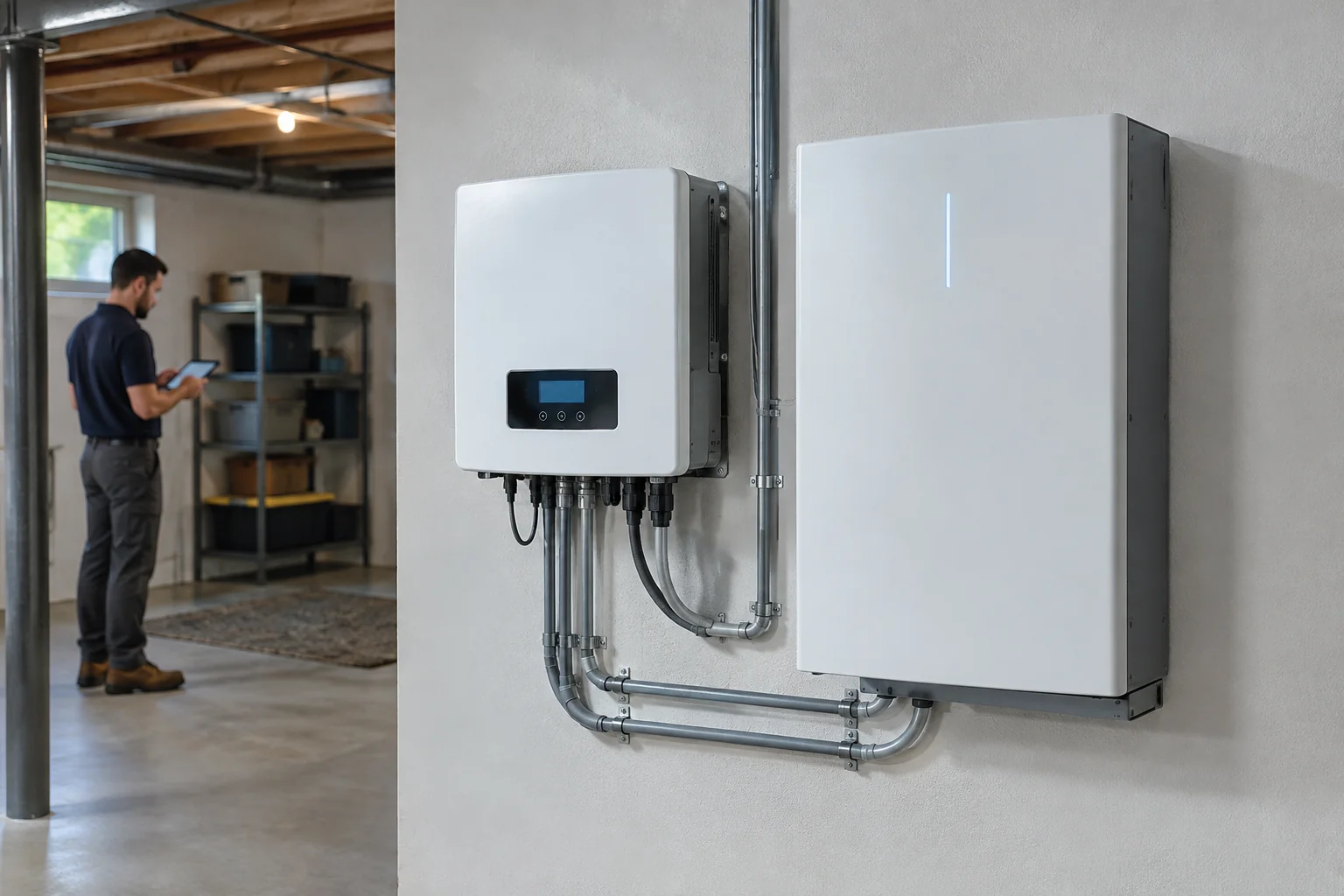
Replace like for like if you want the lowest cost and have no plan for a battery. Move to a hybrid or battery-ready inverter if you expect to add storage within a few years, because you will avoid paying for a second inverter project later.
The right choice comes down to one question: will you want backup power? Storms and outages in Connecticut, Massachusetts and Rhode Island make that a fair question. A solar system with no battery shuts down during a grid outage, which is the main reason homeowners add one.
| Factor | Like-for-like swap | Hybrid or battery-ready upgrade |
|---|---|---|
| Equipment cost | Lower | Higher, about $2,000 to $5,000 for the unit |
| Work involved | Same wiring, same permit type | May need new wiring, permit and utility update |
| Backup power | No | Yes, once a battery is added |
| Best for | Homeowners focused on bill savings | Homeowners planning storage soon |
| Risk | May pay twice if you add a battery later | Pay for capability you may never use |
A simple decision rule
Our advice is straightforward. If you want a battery within about three to five years, upgrade now. If you are unsure, and your inverter is under warranty, take the free like-for-like part and revisit storage later, since some batteries work with existing inverters through AC coupling.
If your system is more than 10 years old, think about the rest of it too. Our post on when to upgrade an older solar system covers panels, monitoring and wiring. If storage is the goal, read how a solar battery retrofit works before you choose an inverter.
A hypothetical worked example
Suppose a home has a 12-year-old string inverter that has died, and the owner wants a battery in two years. A like-for-like swap costs money now. Adding the battery later may then need a second visit, with new wiring and a second permit.
Choosing a hybrid unit now costs more up front, but pays for the capability once. If the owner never adds storage, they paid a premium for nothing. That is the honest tradeoff, and only you know which side you land on.
What Can You Do When the Original Installer Is Unresponsive or Gone?
Contact the inverter manufacturer for warranty support, then hire any licensed, insured solar company that services your brand. You do not need the original installer. Gather your contract, warranty papers and system photos, and ask for a written diagnosis and quote before work begins.
Solar companies merge, close or stop answering calls, and it happens often enough that the state publishes guidance on it. The Massachusetts guidance says your installer should identify the company available for maintenance, whether you own or lease the system. When that company is gone, individual components such as microinverters, batteries and panels keep their own manufacturer warranties, which is why the manufacturer is your first call.
How to choose a replacement company
- Verify the license. In Connecticut, Department of Consumer Protection license data is maintained by the state and treated as a primary source of verification. Check the electrical contractor and the home improvement or solar registration before you sign.
- Ask about brand experience. The company should have worked on your inverter brand, not only its own preferred equipment.
- Ask who does the work. A company using its own employees is easier to hold accountable than a chain of subcontractors. Teamsun uses in-house W-2 crews for repair and upgrade work on systems of any brand.
- Get itemized pricing. Equipment, labor, permit and any electrical work should each have a line.
- Look for a written warranty on the new work. Ask how long the labor is covered and who answers the phone after the job.
The Solar Energy Industries Association publishes a Solar Business Code aimed at promoting transparency and good faith in the U.S. solar industry. It is a reasonable benchmark for the questions you ask any company, though it does not replace checking licenses.
You can also explore Teamsun's service and repair options for systems installed by another company. We also keep a guide on finding a repair company that works on any brand, and the advice there applies directly to your situation.
A Step-by-Step Plan for Replacing Your Inverter
Work through the process in order. Skipping the early steps is how homeowners pay for work a warranty would have covered.
- Document the problem. Take photos of the lights and codes, and screenshot the app showing zero production.
- Rule out simple causes. Check the grid, breakers and Wi-Fi as described above.
- Call the manufacturer. Confirm warranty status, labor coverage and whether a replacement is available.
- Get two or three written quotes. Ask each company to price a like-for-like swap and a battery-ready option.
- Compare the lines, not the totals. A low total with no permit line may leave you with an unpermitted install.
- Confirm permits and utility notice. Ask who files the paperwork with your town and with your utility, whether Eversource, National Grid or Rhode Island Energy.
- Schedule the work. Expect a short outage of your solar production during the swap.
- Test and keep records. The Rhode Island guide says the installer should test the equipment after installation and provide you with copies of the paperwork. Save the new warranty and serial number.
A repair may be possible in place of a full replacement, with published estimates around $150 to $700 for some faults. Ask the technician whether the diagnosis points to a repairable part, and whether the unit's age makes repair worth it.
Frequently Asked Questions
How long does a solar inverter last?
String inverters often last about 10 to 15 years, which is well short of the 25 years or more that panels can run. Microinverters are built for longer life and carry longer warranties. Heat, moisture and electronic wear on capacitors are common reasons any inverter fails earlier than its panels.
Can I keep using my system with a failed inverter?
No. With a failed string inverter the system produces nothing, and you keep buying all your power from the utility. With a failed microinverter, the other panels keep working. Do not bypass a safety shutdown or reset a tripping breaker repeatedly, and call a licensed technician instead.
Is it worth repairing an old inverter instead of replacing it?
Repair makes sense when the fault is a single part and the unit is fairly young or still under warranty. Replacement makes more sense when the unit is past about 10 years, the fault repeats, or you plan to add a battery soon. Ask for a quote for both options.
Will replacing my inverter affect my utility agreement?
A like-for-like swap rarely changes your net metering arrangement, but your utility may need notice of the equipment change. Changing to a different inverter type or size can need updated paperwork. Ask your installer to confirm the steps with your utility before work starts. Our guide to how net metering works with your utility explains the basics.
Get a Second Opinion Before You Replace
A dead inverter is frustrating, but it is one of the more fixable problems in solar. Check the warranty, get itemized quotes, and decide whether a battery is in your future before you pick the unit. Open questions remain on any job, such as whether a roof repair will hit bad weather, so ask for a schedule and a plan for delays.
If your original installer is not answering, we can look at it. Request a free quote for your solar inverter replacement and we will diagnose the fault, check your warranty options and price a like-for-like swap alongside a battery-ready upgrade. You can also talk to a designer about your system, or call 203-903-4091. We serve homeowners across Connecticut, Massachusetts and Rhode Island, on systems of any brand.
Recommended Resources
Written by
Dan Katzman
Teamsun
Teamsun writes practical solar guidance to help property owners compare equipment, project scope, costs, and long-term service before making a decision.
Keep going.
5 Signs Your Roof Needs Replacing Before Solar Goes On
Five clear signs your roof needs replacing before solar goes on, from shingle age to flashing, plus a decision rule for Connecticut homeowners.
Dan Katzman
Teamsun
Battery retrofit cost for old solar system
Battery retrofit cost for old solar system owners in CT, MA & RI: real 2026 price ranges by inverter type, battery brand, and panel condition.
Dan Katzman
Teamsun
EV Charger Installation Cost for Massachusetts Homeowners
What EV charger installation costs Massachusetts homeowners in 2026: Level 2 hardwired pricing, panel upgrades, permits, rebates and solar bundling.
Dan Katzman
Teamsun