How to Pair an EV Charger With Solar Panels (2026)
Learn how to install an EV charger with solar panels, from panel sizing and electrical capacity to permitting and battery storage for CT, MA, and RI homes.
Dan Katzman
Teamsun
Charging an EV from solar power sounds simple until you realize a single overnight charge can pull more electricity than your entire house uses in a day. Learning how to install an EV charger with solar panels means solving three problems at once: sizing the array big enough, making sure your electrical panel can handle the added amperage, and deciding whether a battery is worth adding so you're not just shifting your charging habit onto the grid at 9pm.
Key Takeaways
- Extra panel count: A typical EV driven 1,000 miles a month adds roughly 3,000-4,000 kWh of annual demand, which usually means 6-10 more solar panels than a solar-only system.
- Panel capacity matters first: Homes with 100-amp electrical panels often need a 200-amp upgrade before a Level-2 charger and solar inverter can share the same panel safely.
- Battery sizing is about timing, not just size: A single 13.5-15 kWh home battery won't fully cover a 30 kWh overnight EV charge, so charging schedule matters as much as battery capacity.
- Permits stack up separately: Solar and EV chargers usually require distinct permits and inspections unless one crew coordinates both under a single project timeline.
- Combined installs move faster: Teamsun's in-house crews install solar and EV chargers on the same job, holding to a 47-day average timeline instead of running two separate contractor schedules back to back.
EV Charger + Solar Panel Install: Quick Facts
| Factor | Typical Requirement |
|---|---|
| Added solar panels for one EV | 6-10 panels (roughly 2.4-4kW extra capacity) |
| Charger circuit size | Dedicated 40-50 amp, 240V circuit |
| Minimum panel size for combined system | 200-amp main electrical panel recommended |
| Overnight EV charge draw | 20-40 kWh depending on battery size and daily miles |
| Battery needed to fully offset one overnight charge | 2 stacked units (26-30 kWh) in most cases |
| Permits required | Electrical permit for charger, updated interconnection for solar capacity change |
| Average combined install timeline (Teamsun) | 47 days, contract to power-on |
1. Size Your Solar Array for EV Charging Loads
Most solar quotes are built around a home's existing electric bill, using 12 months of utility data. Add an EV to the driveway and that math changes fast. A driver covering about 1,000 miles a month at average efficiency pulls somewhere between 3,000 and 4,000 additional kWh a year from the grid, or from your panels if you plan ahead.
That typically translates to 6 to 10 extra solar panels, depending on panel wattage and your roof's sun exposure. If you're still deciding between a Level-2 hardwired EV charger at home and a portable one, know that only a hardwired Level-2 unit draws enough power to matter for this sizing conversation.
A smart move is oversizing the array by around 20% beyond your current calculated need. That buffer covers a second EV down the road, a heat pump upgrade, or simply degradation in panel output over 15-20 years. It costs less to add capacity during the original install than to bolt on a second array later.
2. Check Your Electrical Panel Capacity First
Before any panel sizing conversation matters, your home's main electrical panel has to physically support the new load. A Level-2 charger needs a dedicated 40-50 amp, 240-volt circuit, and that's on top of whatever your solar inverter's backfeed breaker requires.
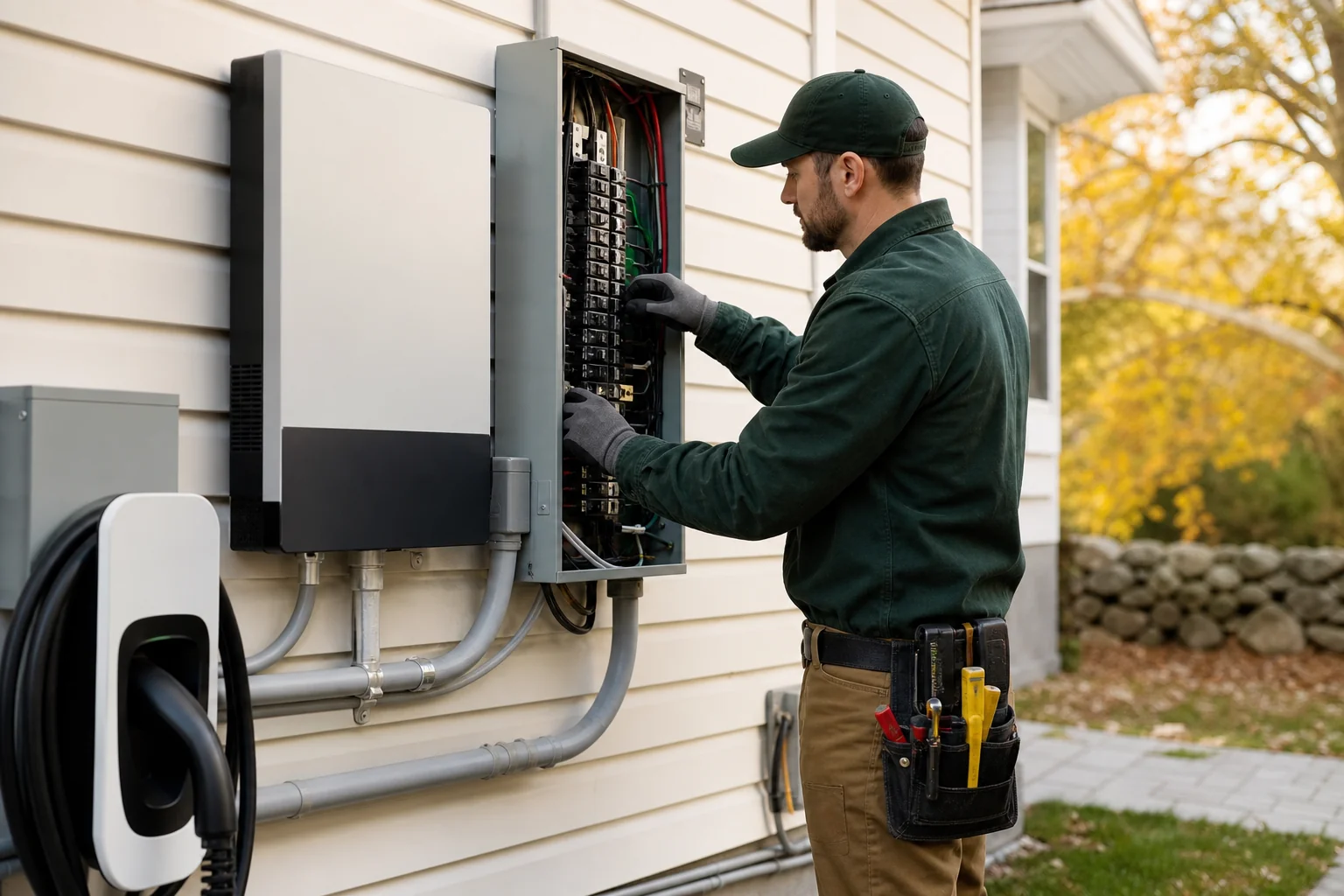
Homes built with a 100-amp panel frequently run out of room once solar and an EV charger are both added. The National Electrical Code (NEC 220) governs how installers calculate total home load, and that calculation, not a guess, determines whether you need a panel upgrade to 200 amps. Skipping this step is one of the most common reasons EV charger installs stall out mid-project.
If you're not sure where your home stands, a licensed electrician can run this load calculation in about an hour. It's worth doing before you commit to a specific panel count or charger model, since an undersized panel changes the entire project scope and budget.
3. Choose Where the Charger Ties Into the System
There are two common configurations. The charger can tap directly into your main electrical panel alongside your solar inverter's backfeed connection, or it can run off a dedicated subpanel fed by both solar and, if you have one, battery storage.
The main panel busbar has a rated amperage limit, and code restricts how much backfed power (from solar) plus main utility feed can combine on that busbar. Adding an EV charger circuit to an already-tight busbar can push you over that limit, forcing either a busbar upgrade or a load management device that throttles charging speed automatically.
A dedicated subpanel avoids that busbar math entirely by isolating the EV charger's circuit from the rest of the home's load calculation. It costs more upfront in materials but gives you cleaner room to add capacity later, whether that's a second EV or additional battery storage. This is exactly the kind of decision worth walking through with a designer before signing anything, since it affects both your permit application and your long-term flexibility.
4. Size Battery Storage So EV Charging Doesn't Spike Grid Usage
Here's the part most homeowners get wrong: they assume any home battery will cover an EV charge. It usually won't, at least not on its own. A single Tesla Powerwall 3 stores 13.5 kWh. A FranklinWH aPower 2 stores 15 kWh. A typical overnight EV charge, filling 20-40 kWh depending on your daily mileage and battery size, can exceed either unit by itself.
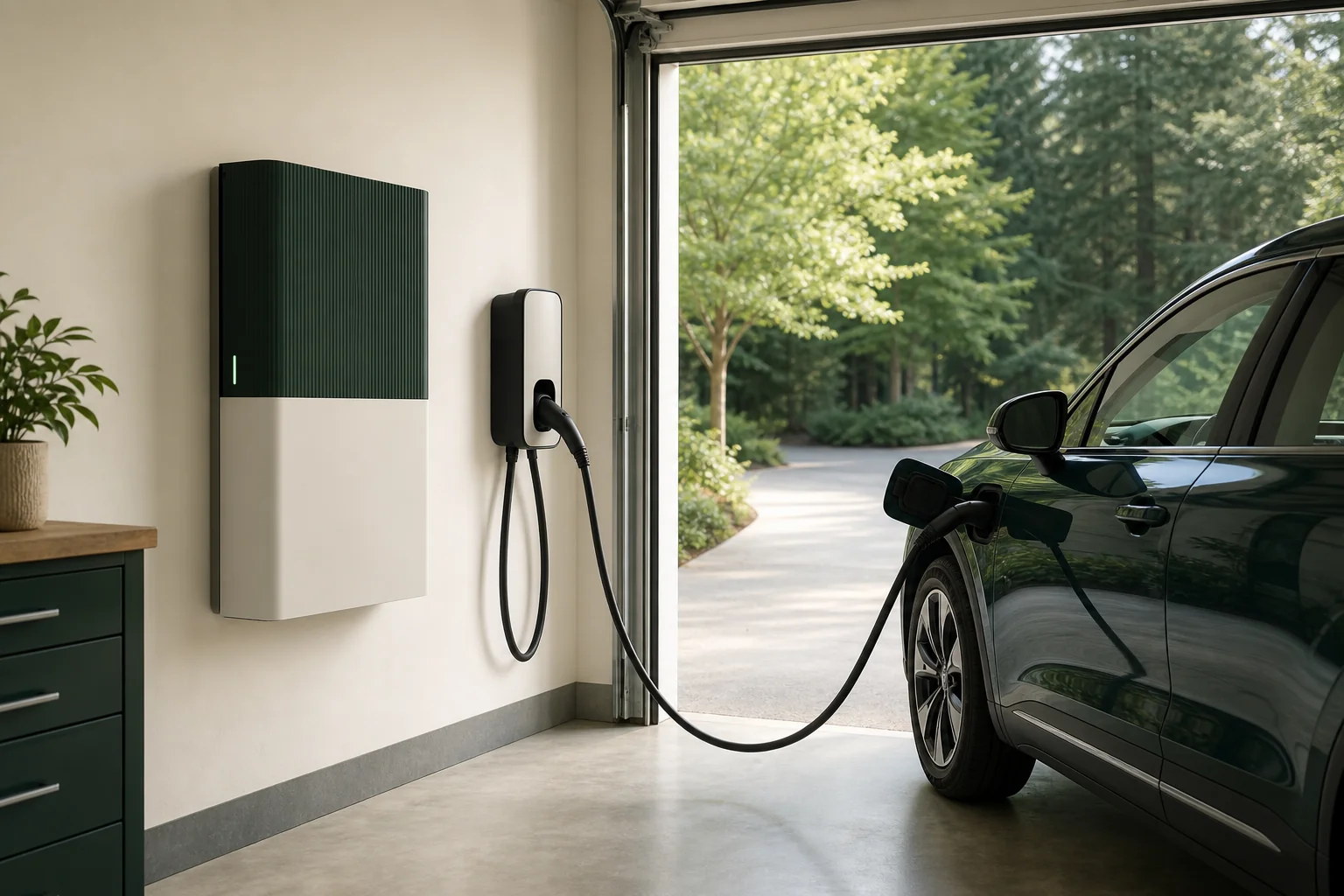
That doesn't mean skip the battery. It means think about timing. If your solar array produces its peak output midday while you're at work, and you charge your EV overnight, a battery bridges that gap by storing daytime solar production and releasing it after sunset. Stacking two battery units, landing around 26-30 kWh combined, covers most single-EV households through a full overnight charge without pulling from the grid.
Homeowners weighing which brand fits their situation should look at the tradeoffs directly. Our Tesla Powerwall vs FranklinWH comparison breaks down stackability, backup coverage, and pricing structure for exactly this kind of EV-plus-home-battery scenario. If you already have solar without a battery, adding one later is also possible; our guide on how a solar battery retrofit works covers what that process involves for systems of any age or brand.
Without a battery, an EV charging overnight simply draws directly from the grid at whatever your utility charges, even if your solar panels produced plenty of surplus that afternoon. Net metering credits can offset that cost depending on your utility's program; see our breakdown of how solar net metering works with your utility for the specifics in Connecticut, Massachusetts, and Rhode Island.
5. Permitting and Utility Interconnection Steps
Solar and EV chargers each carry their own regulatory paperwork, and skipping either one risks a failed inspection or a denied interconnection. Your town's building department typically requires an electrical permit specifically for the EV charger circuit, separate from the solar permit, unless your installer bundles the applications together.
Your utility also needs an updated interconnection agreement any time your solar system's total capacity changes, which applies if you're adding panels alongside the charger. This isn't a formality to skip. An outdated interconnection filing can delay your permission-to-operate approval by weeks, holding up both your solar production credits and your ability to legally use the new charger.
Homeowners who've already been through a solar-only install and now want to add federal tax credit paperwork or state rebate documentation for the EV charger portion should check our solar installation timeline breakdown for how permitting typically stacks against your overall project schedule.
6. Why Installing Solar and an EV Charger Together Saves Time
Hiring a solar installer and a separate electrician for the EV charger means two permit applications, two inspection schedules, and two crews that may never coordinate on wiring layout or panel capacity. That's where most delays creep in, not from the equipment itself but from scheduling conflicts between contractors who don't share a project calendar.
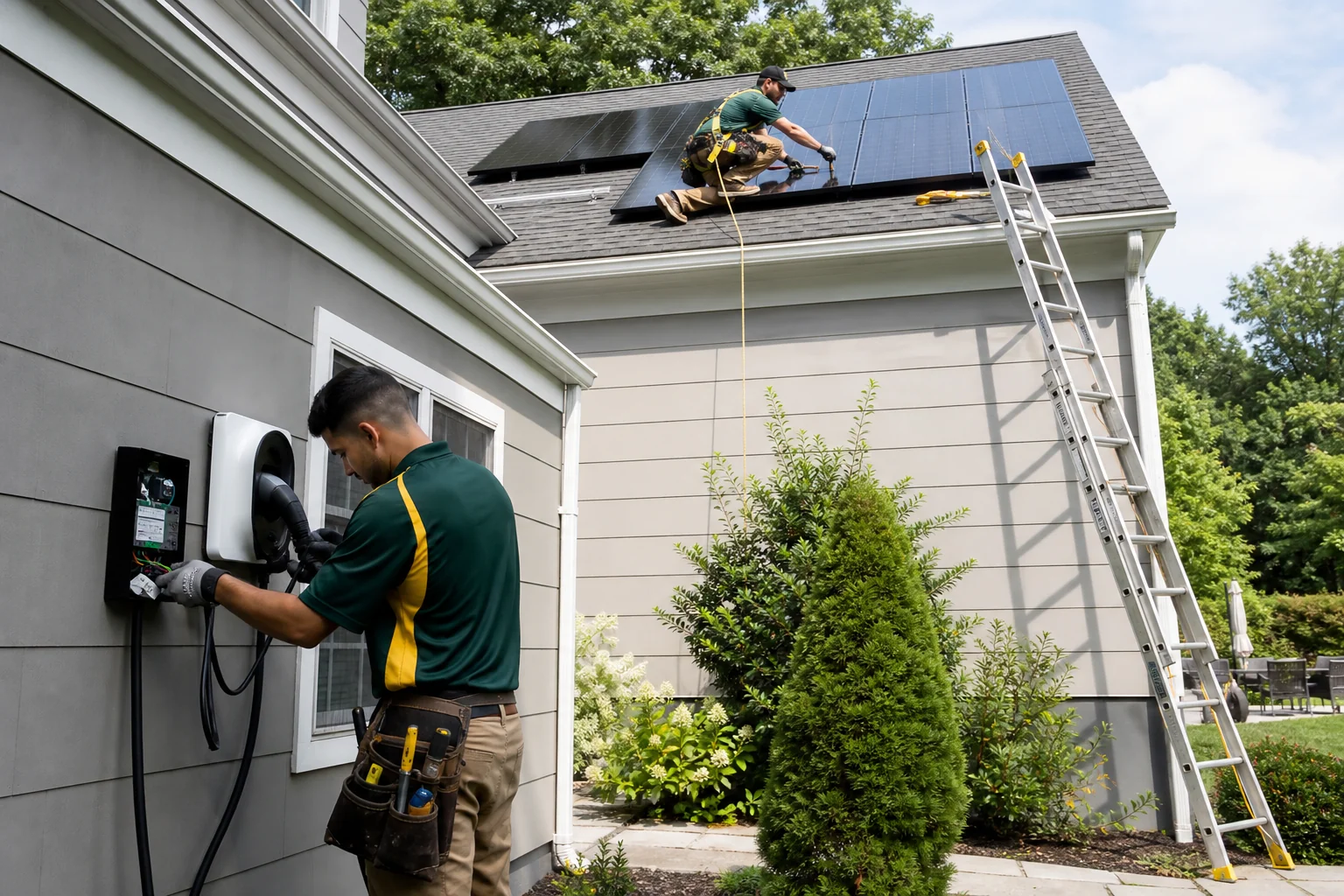
Teamsun runs one in-house crew, W-2 employees rather than subcontractors, for both the solar install and the EV charger wiring. That means one permit package covering both scopes, one inspection window, and one team accountable for the entire job from panel sizing through the charger's final circuit test. Homeowners comparing this approach against national installers who rely on subcontracted labor should read our piece on in-house crews vs subcontractors to see why that structure matters for accountability after the crew leaves.
Combined projects still land within Teamsun's average 47-day timeline, contract to power-on, because coordinating solar and EV charger work under one schedule removes the back-and-forth of hiring separate contractors. If you're also weighing a national provider, our Sunrun vs local solar installer comparison covers how that decision plays out for service after installation.
Solar Panels vs Solar + Battery vs Solar + Battery + EV Charger
Not every home needs the full setup right away. Here's how the three common configurations compare on grid dependence and typical use case.
| Setup | Grid Dependence | Main Cost Driver | Best For |
|---|---|---|---|
| Solar panels only | Moderate; still draws grid power at night or during outages | Panel count and roof size | Homes without an EV, focused on bill reduction |
| Solar + battery | Low; battery covers evening use and outages | Battery capacity (kWh) | Homes wanting backup power and lower grid reliance |
| Solar + battery + EV charger | Lowest achievable; battery timed to overnight charging | Battery stacking and charger circuit sizing | EV-owning households wanting to minimize grid draw from charging |
Small business owners exploring similar setups for fleet vehicles should also look at our guide on how many solar panels a small business needs, since commercial EV charging loads scale differently than a single residential vehicle.
Frequently Asked Questions
Can I add an EV charger to an existing solar system?
Yes. Most existing solar systems can support an added EV charger, but it requires a new electrical load calculation and possibly a panel upgrade if your current setup is near capacity. Your installer will also need to file an updated interconnection agreement with your utility if the added load changes your system's registered capacity.
Do I need a battery to charge an EV from solar?
No, but without one, EV charging that happens after sunset draws from the grid instead of stored solar production. A battery lets you store daytime solar output and release it overnight, which is when most EV charging actually happens.
How many solar panels does it take to charge an EV?
For a driver averaging 1,000 miles a month, expect to add 6-10 panels beyond what your household electric use alone requires, translating to roughly 2.4-4kW of additional capacity depending on panel wattage and roof orientation.
Does an EV charger installed with solar qualify for the same tax credit?
EV charger equipment and solar equipment are sometimes eligible for separate federal incentives; the paperwork differs by component. Check current program details through the U.S. Department of Energy's EV charging incentive resources and consult a tax professional for your specific situation.
Will adding an EV charger increase my electric bill even with solar?
It can, if your charging schedule outpaces your solar production and battery storage. Sizing the array and battery around your actual driving habits, not just your home's baseline electric use, is what prevents that spike. The National Renewable Energy Laboratory's transportation research division publishes data on typical EV charging load patterns if you want to dig into the numbers yourself.
Pairing an EV charger with solar panels isn't a project to piece together with two separate contractors and hope the timelines line up. Whether you're starting from scratch or adding a charger to a system you already own, get the panel sizing, electrical capacity, and battery math right the first time. Talk to a designer about your specific home, driving habits, and existing electrical panel, or request a free quote to see what a combined solar and EV charger install looks like on your property. You can also explore the full range of solar, battery, and EV charger services Teamsun offers across Connecticut, Massachusetts, and Rhode Island, or call 203-903-4091 to start the conversation.
Recommended Resources
Written by
Dan Katzman
Teamsun
Teamsun writes practical solar guidance to help property owners compare equipment, project scope, costs, and long-term service before making a decision.
Keep going.
How to Combine Solar Panels With Battery Backup (2026)
Learn how solar panel installation with home battery backup works, from wiring to outage performance to sizing a battery for true energy independence.
Dan Katzman
Teamsun
How to Install a Hardwired EV Charger at Home (2026)
Learn how to install a hardwired EV charger at home in 2026: panel capacity checks, permits, licensed installers, and pairing with solar or battery.
Dan Katzman
Teamsun
How to Read Your Solar Monitoring App Data (2026)
Learn how to read solar monitoring app data, spot underperformance early, and know when to call for a repair check on your CT, MA, or RI solar system.
Dan Katzman
Teamsun