Ground Mount vs Rooftop Solar: Best for Your Business?
Ground mount vs rooftop solar for commercial properties: compare costs, permitting, and ROI to find the right fit for your 25kW-500kW system.
Dan Katzman
Teamsun
A 500kW system fits comfortably on 3-4 acres of open land, but the same capacity can require a roof larger than a football field to accommodate. That single fact drives most of the ground mount vs rooftop solar for commercial decision more than price alone. The right choice depends on how much usable space you actually have, your roof's remaining life, and how fast you need the system generating power.
Key Takeaways
- Cost gap: Ground mount systems typically run $0.10-$0.25 more per watt than rooftop due to racking, trenching, and site work, but avoid roof repair costs down the road.
- Roof age matters: A roof with under 10 years of remaining life usually shouldn't carry a rooftop array without replacement first.
- Permitting timelines diverge: Ground mounts often need zoning approval and setback compliance; rooftop systems need a structural engineering review before a permit is issued.
- Property type drives ROI: Warehouses and distribution centers with large flat roofs usually favor rooftop, while properties with open land and older or complex roofs often see better returns going ground mount.
- Size range flexibility: Both options scale across the 25kW-500kW range Teamsun installs, but land availability becomes the limiting factor above roughly 300kW.
Ground Mount vs Rooftop Solar at a Glance
| Factor | Ground Mount | Rooftop |
|---|---|---|
| Typical cost per watt | $1.70-$2.10 | $1.50-$1.90 |
| Space required (per 100kW) | ~0.6-0.8 acres | ~10,000-12,000 sq ft |
| Permitting complexity | Zoning, setbacks, sometimes wetlands review | Structural report, building permit |
| Roof impact | None | Requires 10+ years remaining roof life |
| Maintenance access | Ground-level, easier | Requires roof access equipment |
| Best-fit property type | Land-rich sites, distribution yards, farms | Warehouses, retail, office buildings |
| Typical timeline to power-on | 3-5 months | 2-4 months |
How Ground Mount and Rooftop Systems Differ for Commercial Properties
A rooftop system bolts or ballasts racking directly onto an existing structure, using the roof itself as the mounting surface. A ground mount instead sinks steel posts into the earth or sets concrete ballast blocks on a graded lot, building an independent structure from the ground up. Both approaches produce the same electricity per panel, but the surrounding site work looks nothing alike.
Rooftop arrays lean on the building's structural bones. Engineers check rafter spacing, roof deck condition, and load capacity before a single panel goes up. Ground mounts skip that dependency entirely, which is why they're common on properties with older buildings that can't take the added weight, or on sites where the roof is already spoken for by HVAC equipment.
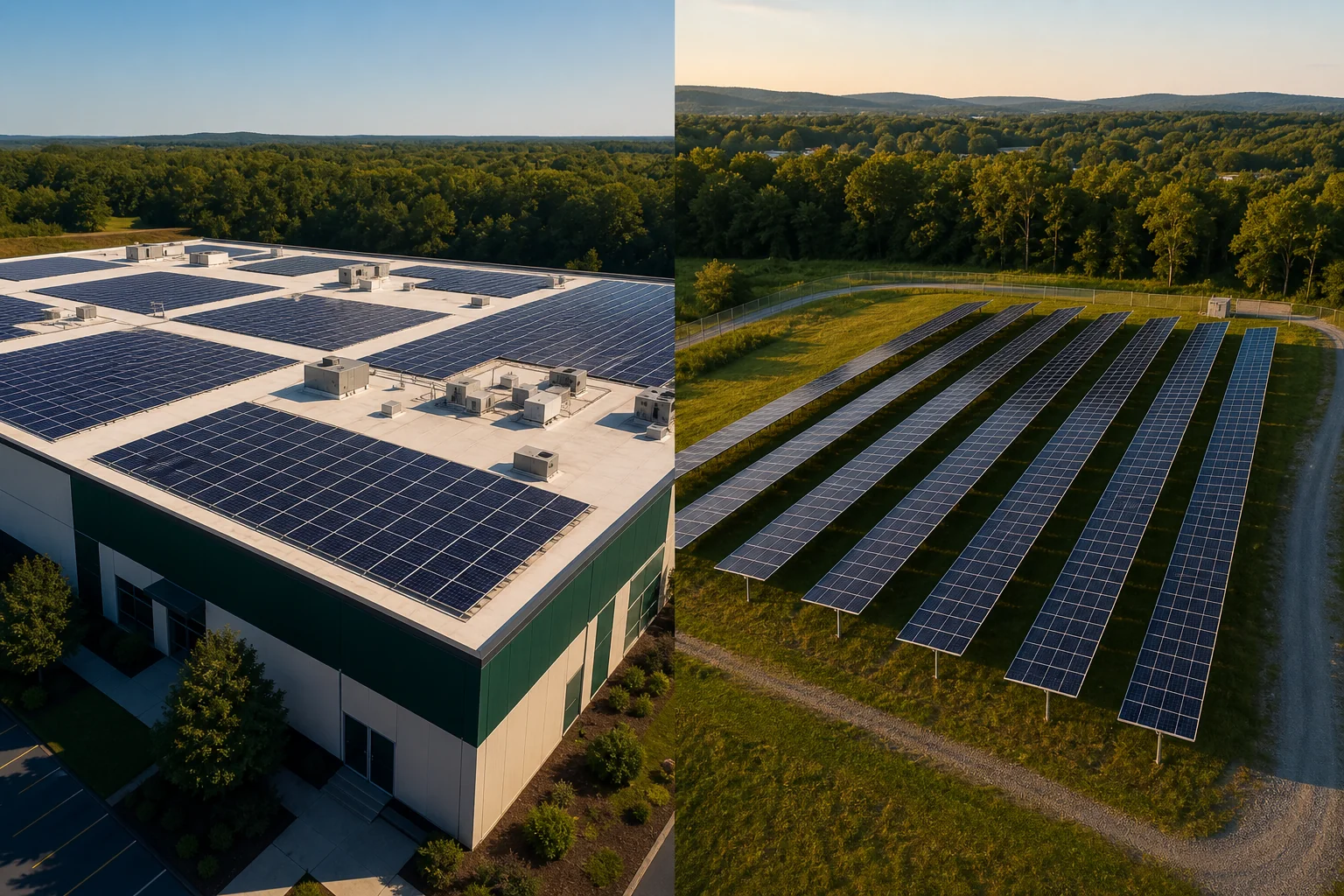
For businesses weighing commercial solar for small business roofs, the structural question usually comes first. If the roof passes inspection, rooftop tends to be the faster and cheaper path. If it doesn't, ground mount becomes the practical fallback rather than a second choice.
1. Cost Differences Between Ground Mount and Rooftop Solar
Rooftop systems generally cost less per watt installed. There's no trenching, no concrete footings, and no need to run new underground conduit back to the building's electrical service. For a straightforward flat commercial roof in good condition, a rooftop array often lands in the $1.50-$1.90 per watt range before incentives.
Ground mount systems add racking that has to stand on its own, plus site grading, fencing in some jurisdictions, and trenched electrical runs from the array to the building or utility interconnection point. That pushes typical ground mount pricing to $1.70-$2.10 per watt. On a 200kW system, that difference can mean a swing of $40,000 or more in upfront cost.
The math flips, though, when a roof needs work first. Reinforcing an aging deck or replacing membrane roofing before a rooftop install can cost as much as the ground mount premium, sometimes more. Anyone comparing options should read our solar panel installation cost breakdown for a fuller look at where commercial pricing lands relative to residential, alongside our guide on when to replace a roof before solar.
Financing structures apply to both installation types. Businesses exploring loans, PPAs, or leases for a commercial array can find current terms directly through Teamsun rather than guessing at national averages, since site conditions shift the numbers property by property.
2. Land vs Roof Space: What You're Actually Working With
Roof space sounds free until you measure what's already on it. Rooftop HVAC units, skylights, vents, and fire code setbacks routinely eat 20-30% of a commercial roof's usable area. A 40,000-square-foot roof might only offer 28,000 square feet that's actually mountable, which caps the system size regardless of your electric bill.
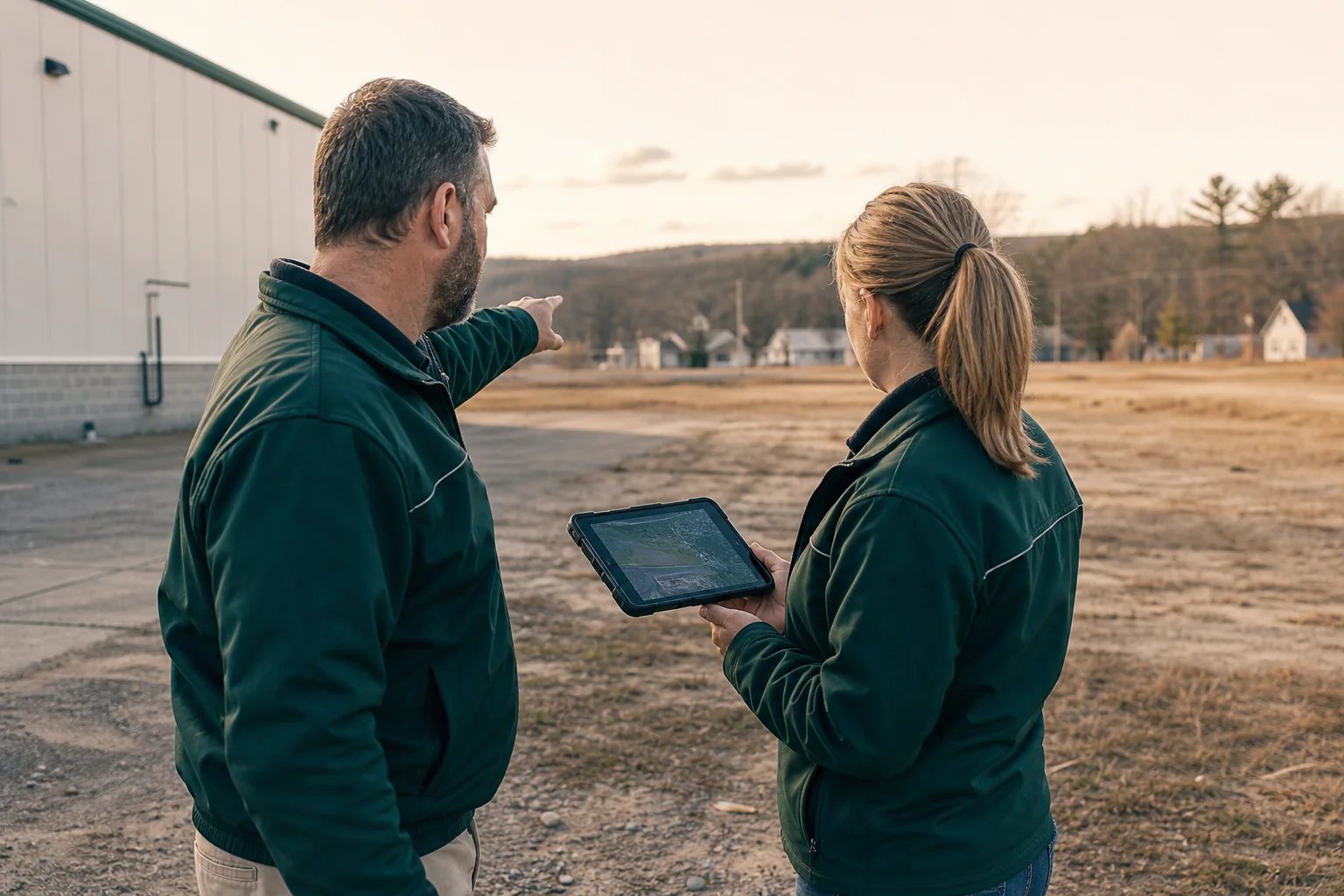
Land carries its own constraints. Zoning setbacks from property lines, wetlands buffers, and existing landscaping or drainage easements can shrink a seemingly large lot fast. Shading from trees along a property edge matters more for ground mounts too, since the array sits lower and catches shadows a rooftop system would clear entirely.
Properties with both options available should weigh long-term land use. A ground mount takes acreage out of future expansion plans, parking additions, or resale flexibility for the life of the system, typically 25-30 years. A rooftop system leaves the ground level untouched, which matters more to businesses planning to grow their footprint.
- Rooftop wins when: the roof is under 15 years old, structurally sound, and mostly unobstructed.
- Ground mount wins when: the roof is aging, heavily shaded, or too small for the system size the business needs.
- Neither wins when: the roof needs replacement and land isn't available, at which point a solar plus roofing bundle often becomes the more sensible path.
3. Permitting and Interconnection Complexity
Ground mount projects add a permitting layer that rooftop systems generally skip: zoning review. Many Connecticut, Massachusetts, and Rhode Island towns classify ground-mounted arrays above a certain size as an accessory structure, which triggers setback rules, sometimes a site plan review, and occasionally a public hearing if the parcel borders residential zoning. Wetlands proximity can add a separate review process on top of that.
Rooftop systems trade zoning headaches for structural ones. Before a building permit is issued, most jurisdictions require a stamped structural engineering letter confirming the roof and framing can handle the added dead load, plus wind and snow load calculations specific to New England climate conditions. On older buildings, this step can uncover the need for reinforcement that adds weeks to the timeline.
Utility interconnection runs on a similar clock for both types, since it depends on your local utility's queue and the size of your system relative to the existing service, not on whether panels sit on a roof or the ground. Larger commercial systems, particularly those approaching 500kW, sometimes require a supplemental interconnection study regardless of mounting type. For a full breakdown of typical timelines, see how long solar installation takes from contract.
Businesses often assume rooftop is always faster to permit. In practice, a rooftop project on an aging building can stall longer than a ground mount on clean, unrestricted land once structural findings come back.
4. Which Option Maximizes ROI for Your Property Type
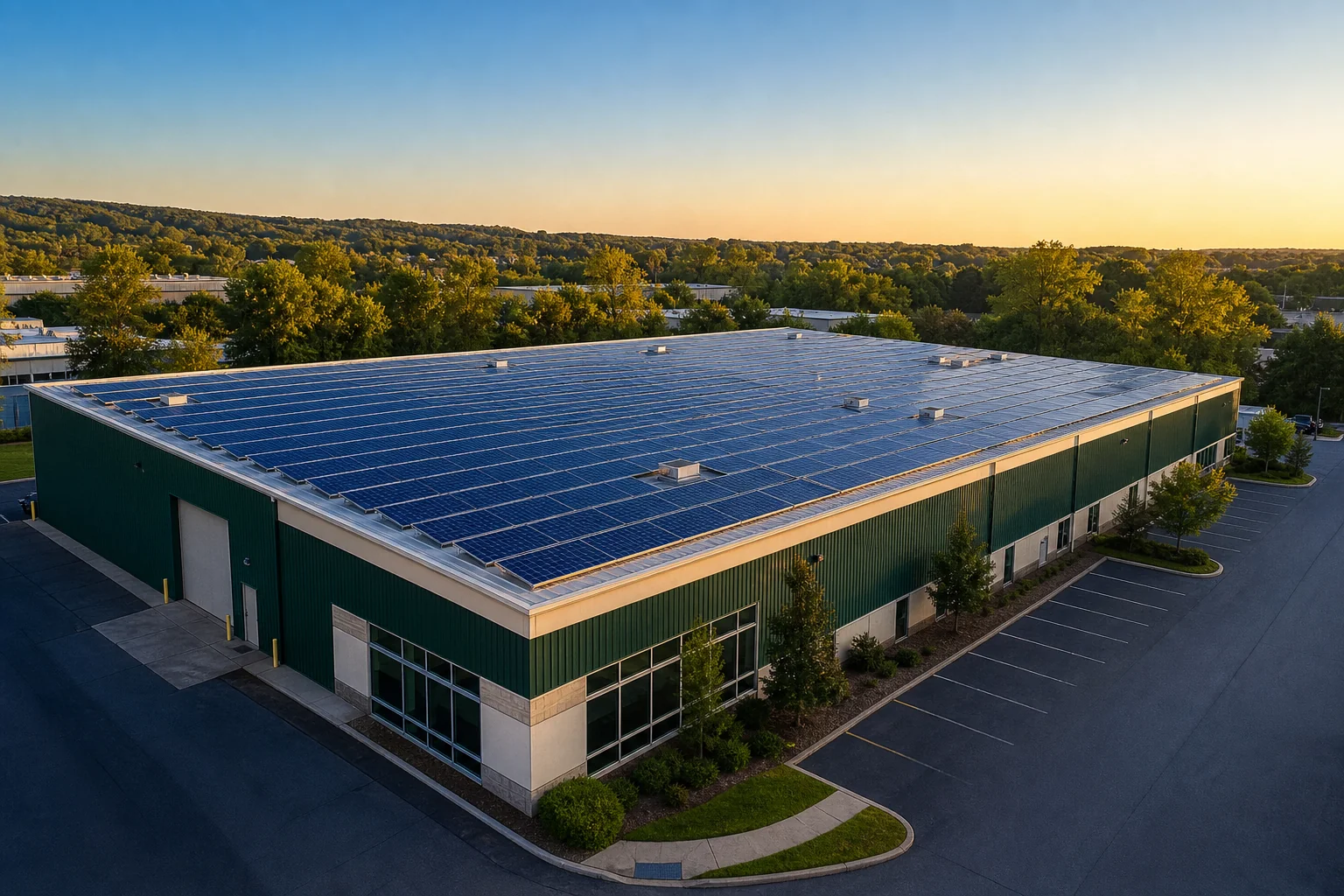
A distribution center or warehouse with a large, flat, recently-recoated roof is usually the clearest rooftop case. These buildings often have minimal shading, ample unobstructed roof area, and roof life that outlasts the solar system's payback period. Systems in the 100kW-300kW range fit naturally here without touching adjacent land.
Retail plazas and office buildings with smaller or more complex roofs (multiple HVAC units, parapet walls, shorter remaining roof life) often see stronger ROI from a ground mount if the property has adjoining land, a side lot, or an unused portion of a parking area that can be repurposed with a canopy-style or ground-fixed array. Manufacturing facilities and agribusiness properties with acreage tend to favor ground mount for the same reason, especially at the higher end of the 25kW-500kW range where roof space simply runs out.
Businesses that already know roughly how many panels they need should confirm that number against actual usable space before committing to either type. Our guide on how many solar panels a small business needs walks through the sizing math in more detail.
ROI also depends on how your utility credits excess generation. Understanding how net metering works with your utility changes whether oversizing a ground mount system for future growth makes financial sense, or whether matching current usage closely is the smarter play.
5. Maintenance, Longevity, and Roof Life Considerations
Ground-level access is the quiet advantage of ground mount systems. Panel washing, vegetation control, and inverter servicing happen without lift equipment or roof-access coordination, which keeps routine maintenance costs lower over a 25-30 year system life.
Rooftop systems tie your solar investment to your roof's condition for the full life of the array. A membrane failure ten years into a system's life means removing and reinstalling panels to make the repair, an added cost that catches many owners off guard. This is precisely why roof condition gets so much attention before installation, and why coordinating roof work upfront, rather than mid-lifecycle, protects the investment. If your existing system (any brand) is already installed and something isn't working right, Teamsun's repair service for any brand covers both mounting types.
Both system types share the same core equipment lifespan expectations, with Tier-1 panels rated for 25+ years of production and inverters typically warrantied for 10-25 years depending on the manufacturer. The mounting method affects access and repair cost, not the underlying equipment durability.
Frequently Asked Questions
Can a commercial property use both ground mount and rooftop solar together?
Yes. Properties with a smaller usable roof and available adjacent land sometimes split a system across both, using the roof for a base load and ground mount to reach a target capacity like 400kW or 500kW. This is common on manufacturing sites where the roof alone can't fit the required panel count.
Does ground mount always cost more than rooftop for commercial solar?
Usually, yes, per watt installed. But that comparison ignores roof repair or replacement costs that can apply to rooftop systems on older buildings. Once those are factored in, ground mount frequently comes out even or ahead on total project cost.
What size commercial system typically needs a ground mount instead of rooftop?
There's no fixed threshold, but systems above 250kW-300kW start running into roof space limits on many small-to-mid-size commercial buildings, making ground mount, or a hybrid of both, more common at that scale.
How long does permitting take for a commercial ground mount system in Connecticut?
Zoning and site plan review can add several weeks compared to a straightforward rooftop permit, particularly if the parcel requires a public hearing. Utility interconnection review typically runs on a separate, comparable timeline for both mounting types.
Every commercial property has different roof conditions, available land, and electricity usage patterns, which is exactly why this decision shouldn't be made from a generic comparison alone. Teamsun's in-house crews design and install both ground mount and rooftop systems across the 25kW-500kW range for businesses throughout Connecticut, Massachusetts, and Rhode Island, using site data specific to your property rather than assumptions. Talk to a designer about which mounting type fits your building and land, explore our commercial solar services, or request a free quote to see real numbers for your property. You can also reach our team directly at 203-903-4091 to start the conversation.
Recommended Resources
Written by
Dan Katzman
Teamsun
Teamsun writes practical solar guidance to help property owners compare equipment, project scope, costs, and long-term service before making a decision.
Keep going.
Commercial Solar Ground Mount Permitting Checklist for New
A commercial solar ground mount permitting checklist covering zoning, utility interconnection, and CT/MA town-specific permit steps for business owners.
Dan Katzman
Teamsun
Commercial Solar for Small Business Roofs: 2026 Guide
Commercial solar for small business roofs: roof suitability, permitting, interconnection, and financing options for 25kW-500kW rooftop systems in CT, MA, RI.
Dan Katzman
Teamsun
Commercial Solar for Warehouse Rooftop Owners
Commercial solar for warehouse rooftop owners: roof load limits, interconnection timelines, and financing for 25kW-500kW systems before you sign a contract.
Dan Katzman
Teamsun