Commercial Solar for Small Business Roofs: 2026 Guide
Commercial solar for small business roofs: roof suitability, permitting, interconnection, and financing options for 25kW-500kW rooftop systems in CT, MA, RI.
Dan Katzman
Teamsun
A 25,000-square-foot warehouse roof in Hartford can typically host a 200kW-plus solar array, enough to offset the majority of a mid-size operation's electric bill. Commercial solar for small business roofs works best on structures with 15+ years of remaining roof life, minimal shading, and at least 5,000 square feet of usable surface, but the real deciding factors are roof condition, utility interconnection rules, and which financing structure fits your balance sheet.
Key Takeaways
- Roof life threshold: If your commercial roof has less than 10-15 years of usable life left, replace it before installing panels rather than paying to remove and reinstall the array later.
- Sizing range: Most small-to-mid-size commercial rooftops in Connecticut, Massachusetts, and Rhode Island fall between 25kW and 500kW, requiring roughly 100-150 square feet of roof per kW installed.
- Financing without perfect credit: Power Purchase Agreements (PPAs) can be underwritten with credit scores as low as 620, opening commercial solar to businesses that a cash purchase or bank loan would exclude.
- Interconnection takes time: Utility interconnection review for commercial-scale systems often adds 4-10 weeks beyond the permitting timeline, so factor that into your project schedule.
- Federal tax incentive: Commercial solar projects generally qualify for the Section 48 Investment Tax Credit plus accelerated depreciation, which together can offset a significant share of installed cost, though eligibility depends on your specific tax situation.
At a Glance: Commercial Rooftop Solar Facts
| Factor | Typical Range or Requirement |
|---|---|
| System size for small business | 25kW to 500kW |
| Roof space needed | ~100-150 sq ft per kW |
| Minimum roof life recommended before install | 10-15 years remaining |
| Common roof types suited to solar | TPO, EPDM, standing-seam metal, built-up (BUR) |
| Permitting + interconnection timeline | 8-16 weeks combined, varies by utility |
| Financing options | Cash, commercial loan, PPA (620 FICO min.), prepaid lease |
| Federal incentive | Section 48 Investment Tax Credit + MACRS depreciation |
| Average install timeline (Teamsun) | 47 days average, contract to power-on |
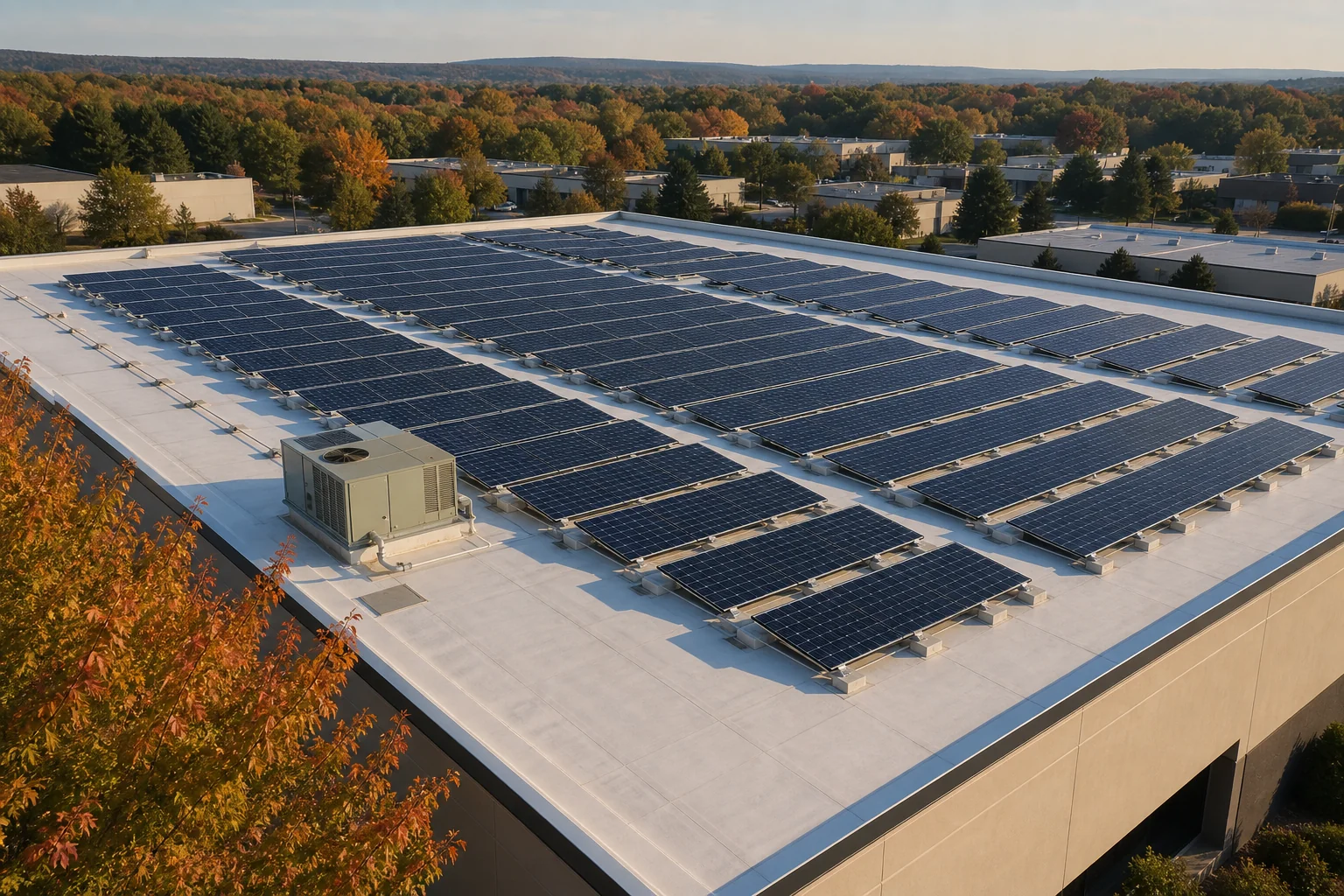
1. Is Your Commercial Roof a Good Fit for Solar?
Not every commercial roof carries panels well. Flat roofs on warehouses, office buildings, and retail plazas usually use TPO, EPDM rubber, or built-up roofing (BUR), and each membrane type interacts differently with racking systems. Ballasted racking works well on TPO and EPDM without penetrating the membrane, while metal roofs often use clamp-on mounts that avoid drilling entirely.
Structural load capacity matters just as much as membrane type. An engineer needs to confirm your roof deck can handle the added weight of panels, racking, and ballast, plus snow load in a New England winter. Older buildings, especially those built before modern commercial code updates, sometimes need reinforcement before an installer will sign off.
Shading and orientation come next. A roof with rooftop units, skylights, or a taller adjacent building casting shadows across half the array will underperform regardless of panel quality. South-facing and unobstructed sections generate the most consistent output across the year, though east-west split arrays can still work well for businesses with midday-heavy energy use.
2. How Many Panels and How Much Roof Space Do You Need?
A rough industry rule puts usable roof space at 100 to 150 square feet per kilowatt of installed capacity, depending on panel wattage and racking layout. That means a 100kW system, a common size for a mid-size retail building or light industrial facility, typically needs 10,000 to 15,000 square feet of clear roof area.
The right system size depends on your actual electric usage, not just available roof space. Pulling 12 months of utility bills and matching that against your roof's solar capacity is the only reliable way to size a system correctly. For a deeper breakdown of sizing math, see our guide on how many solar panels a small business needs, which walks through the calculation step by step.
If your roof can't fit the full system your usage would justify, a ground-mount array on adjacent land, or a combination of roof and ground mount, is often the fallback plan.
3. Roof Condition: Replace First or Install Now?
Here's where a lot of commercial solar projects go sideways. A business installs panels on a roof with five years of life left, then has to pay a crew to remove the entire array, replace the membrane, and reinstall everything, sometimes at a cost of several thousand dollars in extra labor alone.
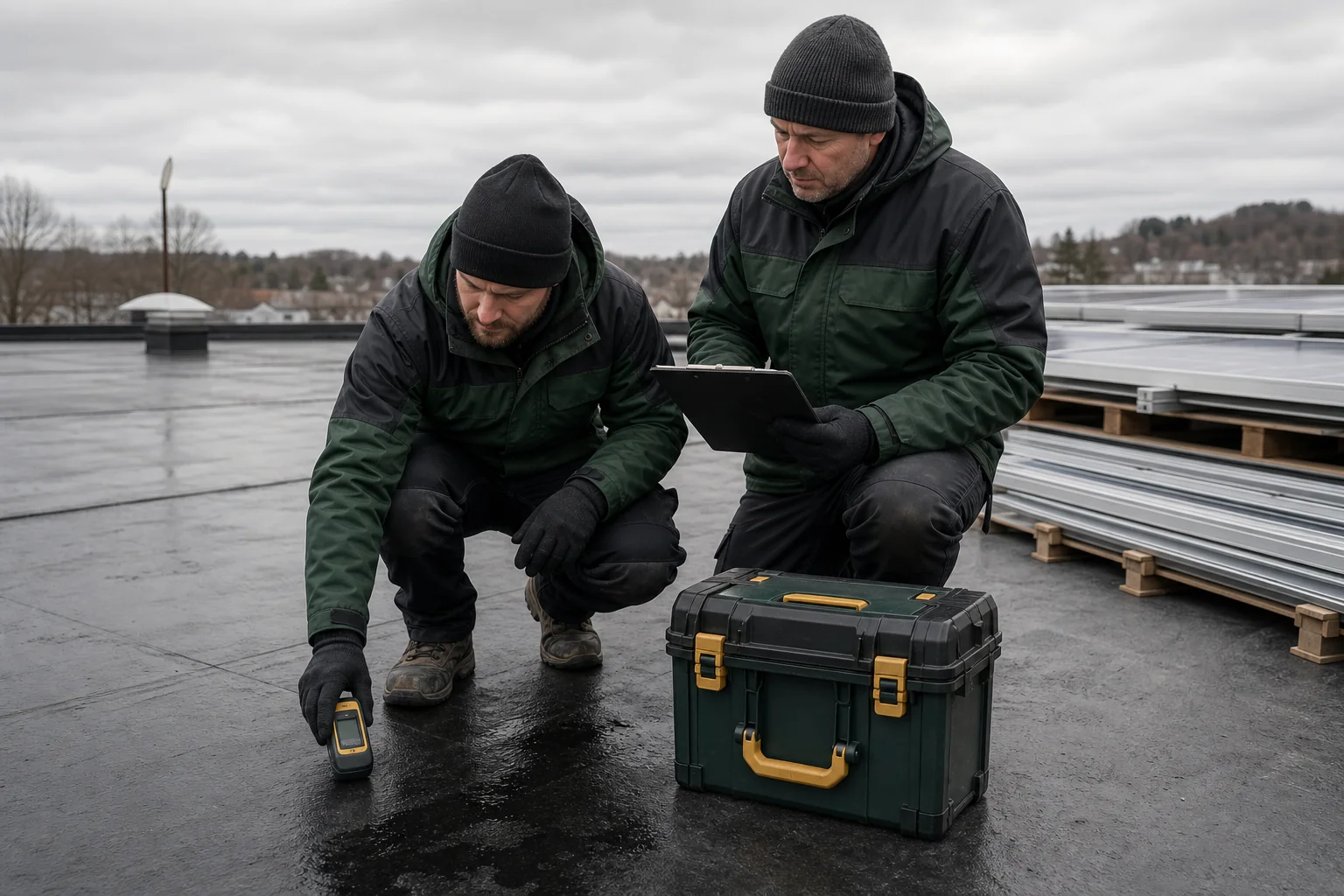
If your roof inspection turns up less than 10-15 years of remaining usable life, replace it before the array goes up. This applies to residential roofs too, and we cover the underlying logic in more detail in Need a New Roof? When to Do It Before Solar. Coordinating roofing and solar with separate contractors often creates gaps in accountability, so bundling both scopes with one company that handles both trades keeps warranty coverage and scheduling in one place.
Teamsun offers solar plus roofing as a bundled scope for exactly this reason. It avoids the finger-pointing that happens when a roofer blames the solar installer for a leak, and vice versa.
4. Permitting and Utility Interconnection for Commercial Systems
Commercial installations move through two separate approval tracks that run partly in parallel. The first is your local building and electrical permit, which covers structural review, electrical code compliance, and fire access setbacks required for rooftop arrays under most state fire codes. The second, often the longer of the two, is utility interconnection.
Utility interconnection applications for systems over 25kW typically go through a more detailed technical review than residential net metering applications, sometimes including a supplemental review study if the array's capacity is high relative to the local circuit. Eversource and National Grid, the two largest utilities across Connecticut, Massachusetts, and Rhode Island, publish their own interconnection queues and standards, and timelines vary based on how loaded the local distribution circuit already is.
Net metering, or a state-specific equivalent tariff, determines how your business gets credited for excess power sent back to the grid. If you're unfamiliar with how the credit mechanics actually work, our post on how solar net metering works with your utility breaks down the billing cycle in plain terms. Massachusetts' SMART program and Connecticut's non-residential renewable energy solutions program are two examples of state-level incentive structures that layer on top of standard net metering, and eligibility rules shift periodically, so check current program status before finalizing your financial model.
5. Financing a Commercial Solar Roof: Cash, Loan, or PPA
Most small business owners land on one of three paths: pay cash, take a commercial loan, or sign a Power Purchase Agreement (PPA). Each shifts risk, tax benefit, and monthly cash flow differently.

| Financing Option | Upfront Cost | Who Claims Tax Credit | Credit Requirement | Best Fit |
|---|---|---|---|---|
| Cash purchase | Full system cost | Business (Section 48 ITC + depreciation) | N/A | Businesses with capital and tax appetite |
| Commercial loan | Little to none | Business | Higher, lender-dependent | Businesses wanting ownership without full upfront cost |
| PPA | None | Third-party owner | 620 FICO minimum (Teamsun) | Businesses without strong credit or tax liability |
| Prepaid lease | Partial upfront | Third-party owner | Moderate | Businesses wanting lower rate without ownership |
A PPA lets a business get solar with no upfront capital and no ownership burden, paying instead for the power the system produces at a rate typically below the utility's. Because a third party owns the system, the credit bar is lower; Teamsun underwrites commercial PPAs with a 620 FICO minimum, which opens the door to businesses that a bank loan application would reject outright. Our post on how solar PPA financing works goes deeper into the mechanics if you want the full picture before deciding.
Cash purchases and loans let the business claim the federal Section 48 Investment Tax Credit directly, along with accelerated depreciation under MACRS, which can materially improve the payback timeline for a business with sufficient tax liability to use those benefits. If your business already went through the paperwork maze for the residential version of this credit, the commercial process shares some of the same documentation logic covered in our solar tax credit and rebate paperwork guide.
6. In-House Crews vs Subcontractors: Why It Matters for Commercial Jobs
Commercial rooftop work carries higher stakes than a residential install. A poorly executed penetration or a rushed racking job on a 100,000-square-foot warehouse roof can mean a leak affecting inventory, tenants, or equipment below. Who actually shows up to do the work matters.
Many national solar companies sell the project, then hand the physical install to a subcontracted crew paid a flat fee per job, with limited incentive to slow down for quality control. Teamsun uses in-house W-2 crews for every install, meaning the same company that designed your system is accountable for how it's built and how it performs afterward. We cover this distinction in detail in In-House Crew vs Subcontractors: Who Installs Your Solar?, and it applies just as directly to commercial projects as residential ones.
That accountability also shows up in timeline. Teamsun's average project runs 47 days from signed contract to power-on, a benchmark that's harder to hit when a company is coordinating outside crews with their own scheduling conflicts.
7. Steps to Get Started With Commercial Solar
- Site assessment: A technician evaluates roof condition, structural capacity, shading, and available space, and reviews 12 months of utility bills.
- System design and proposal: You receive a proposed system size, estimated production, and a financial comparison across cash, loan, and PPA structures.
- Financing decision: Choose the structure that fits your tax position and cash flow, whether that's ownership or a PPA with no upfront cost.
- Permitting and interconnection filing: Your installer submits local permit applications and the utility interconnection request in parallel where possible.
- Installation and commissioning: Panels, racking, and inverters go in, followed by inspection, utility approval, and system activation.
Because roof condition and available space determine so much of the downstream plan, starting with an honest roof assessment saves time later. If your business is also weighing whether to install solar before or after fixing up an aging roof, that decision should happen at step one, not after a proposal is already signed.
FAQ
Can I add battery storage to a commercial rooftop system later?
Yes. Battery retrofits are common on both residential and commercial systems, and the process follows similar wiring and permitting logic regardless of scale. See our guide on how a solar battery retrofit works for the general process, which your installer can adapt to a commercial electrical panel.
What if my roof needs replacement within the next five years?
Replace it first. The labor cost of removing and reinstalling an array to redo roofing later almost always exceeds the cost of replacing the roof upfront, and a solar-plus-roofing bundle keeps both scopes under one warranty.
How long does commercial utility interconnection actually take?
It varies by utility and system size, but plan for 4-10 weeks beyond your local permitting timeline for systems in the 25kW-500kW range, longer if a supplemental review study is triggered by circuit capacity.
Do I need a new roof structure to support solar racking?
Not usually, but an engineer needs to confirm your existing roof deck can handle the added dead load plus local snow load requirements before any racking goes on.
If you're weighing whether your building's roof, usage, and budget line up for a 25kW-500kW system, the fastest way to know is a real site assessment rather than guesswork. Request a free quote to get a roof suitability review, system sizing estimate, and financing comparison specific to your property. You can also talk to a designer directly, call 203-903-4091, or explore our full range of commercial solar services before deciding what's next for your roof.
Written by
Dan Katzman
Teamsun
Teamsun writes practical solar guidance to help property owners compare equipment, project scope, costs, and long-term service before making a decision.
Keep going.
When Should You Upgrade an Older Solar System?
Signs it's time for a solar system upgrade for older panels, from declining output to inverter age. Learn what Teamsun checks before recommending changes.
Dan Katzman
Teamsun
Tesla Powerwall vs FranklinWH: Which Battery Wins in 2026?
Tesla Powerwall vs FranklinWH battery: compare capacity, backup power, warranty, and cost to find the right storage system for your CT, MA, or RI home.
Dan Katzman
Teamsun