Does Solar Make Sense for Homes With Oil Heat?
Solar panels for homes with oil heat still cut electric bills in CT, MA and RI. See which loads panels offset, where savings stop, and when a battery helps.
Dan Katzman
Teamsun
Yes, solar panels for homes with oil heat still pay off for most Connecticut, Massachusetts and Rhode Island households, because panels offset the electric bill and your oil delivery is a separate cost. Panels cannot reduce what you spend on heating oil, so your savings ceiling is your electric bill minus the utility's fixed charges. High electric use, cooling, a well pump or an EV raises that ceiling.
Key Takeaways
- Oil heat is not a dealbreaker: solar offsets kilowatt-hours you buy from the utility, and every oil-heated home still buys plenty of them.
- The ceiling is your electric bill: panels cannot touch oil spending, and fixed utility charges stay on the bill no matter how much you produce.
- Size to your real usage: use 12 months of bills, not a neighbor's system, and do not count on future heat pump load until you have signed for one.
- Batteries are about outages here: an oil burner stops when the power does, so a battery that carries the burner and circulators is the main reason to add one.
- Walk away from oil-inclusive claims: any savings estimate that counts oil you will keep burning is wrong.
Solar for Oil-Heated Homes: Quick Facts
| Question | Short answer | What decides it |
|---|---|---|
| Does solar reduce my oil bill? | No, not directly | Panels make electricity, not heat |
| Does solar reduce my electric bill? | Yes, the usage portion | Annual kWh use and roof production |
| What cannot be offset? | Oil, fixed utility fees, minimum bills | Your utility's rate structure |
| Which loads help most? | Cooling, well pump, electric hot water, dryer, EV | How much electricity each uses |
| Does a battery add savings? | Rarely on its own; it adds backup | Outage risk and export rate |
| Should I wait for a heat pump? | Not required | Plan the system around likely future load |
| Federal credit for a purchased system? | Ended for property placed in service after Dec. 31, 2025 | Financing structure; ask about it before signing |
Why Does Oil Heat Not Rule Out Solar Savings?
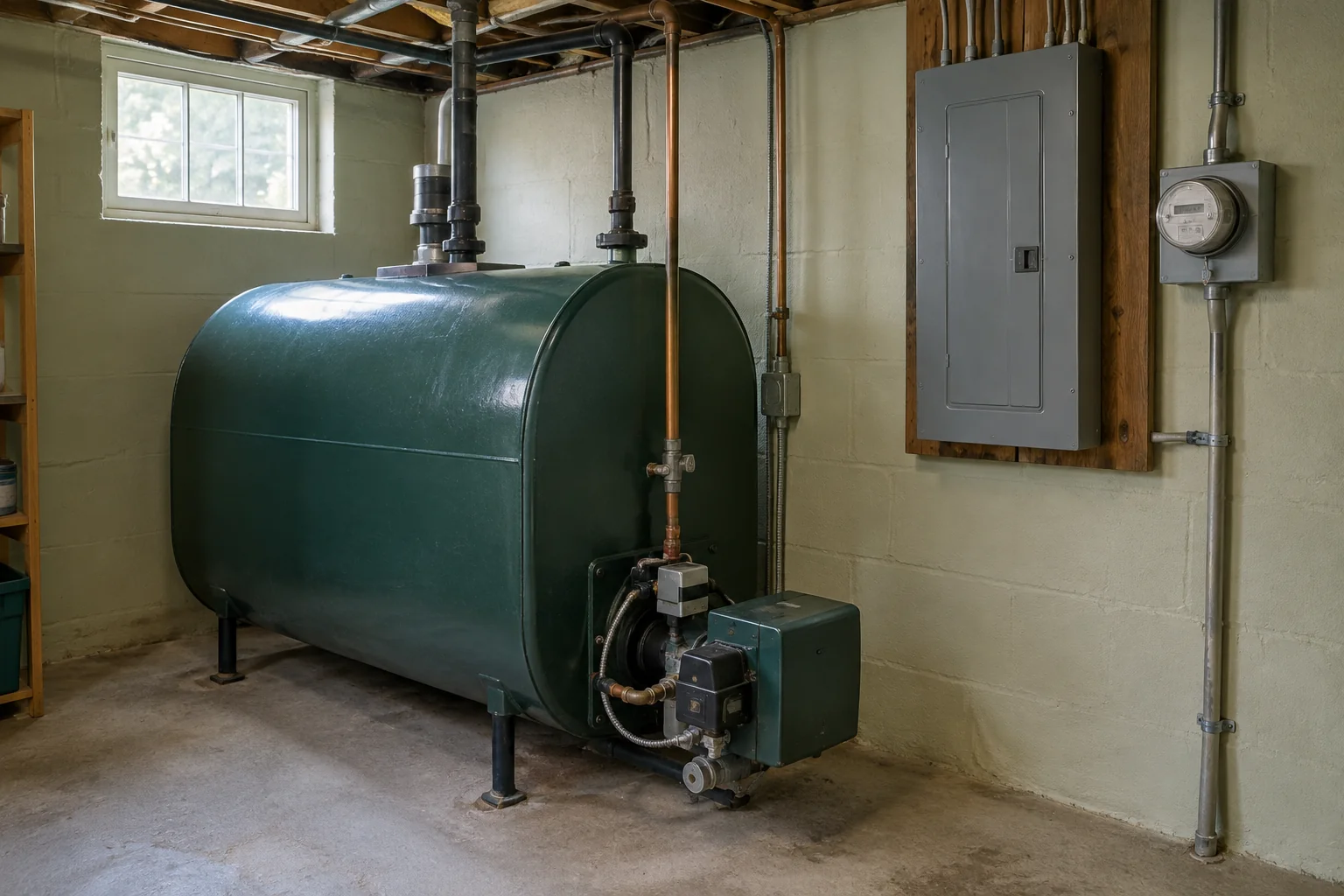
Oil heat does not rule out solar because your oil and your electricity are two separate bills. Panels make electricity, so they reduce what you buy from the utility. Your oil delivery stays the same. If your electric bill is meaningful on its own, solar has something to offset.
The assumption we hear most from oil-heated homeowners is that solar only works after a switch to heat pumps. It does not. A heat pump adds a large new electric load, which makes solar more valuable, but the panels were never tied to your heating fuel. They are tied to how many kilowatt-hours you buy.
Think of it as two ledgers. One holds fuel oil, which solar leaves alone. The other holds the electric bill, which solar can shrink a lot. The question for your home is how big the second ledger is.
Oil-heated homes also use more electricity than people expect. The burner blower, circulator pumps, thermostat controls and boiler all run on household power. They are small loads on their own, but they add to a house that already runs a fridge, lighting, laundry and, in many New England homes, a well pump and summer cooling.
Which Electric Loads Can Solar Still Offset in an Oil-Heated Home?
Solar can offset any electric load in an oil-heated home: lighting, appliances, cooling, a well pump, electric water heating, laundry, EV charging and the small motors on your oil boiler. It cannot offset the oil itself. The more electricity you use, the more of your total energy spending panels can cover.
Here is how the usual loads line up. The table shows where solar fits and where it does not.
| Household load | Runs on electricity? | Solar fit |
|---|---|---|
| Lighting, fridge, TV, laundry, cooking | Yes | Strong; year-round baseline |
| Central air or window units | Yes | Strong; summer sun matches summer demand |
| Well pump | Yes | Good; steady daily use |
| Electric or heat pump water heater | Yes | Good; can be timed to daytime |
| EV charging | Yes | Strong if you can charge by day |
| Oil burner blower and circulator pumps | Yes, small | Minor; they run mostly in the dark, cold months |
| Heating oil itself | No | None; panels cannot offset fuel |
| Mini-split or heat pump (if added) | Yes | Strong, but winter output is lower |
The winter timing problem
Winter is where oil homes feel the limit most. Burner loads peak when days are short and panels produce least. Output in a cloudy climate is lower than on a clear day, which we cover in our look at solar production in cloudy New England weather.
That is why summer cooling, pumps and EV charging do most of the work for an oil-heated house. Their demand lines up with strong sun. Over a full year, extra summer production can offset part of what you draw in winter, depending on how your utility credits exported power.
Electric loads people forget
Walk the house with the electric bill in hand. Many homes have a basement dehumidifier running all summer, a sump pump, a workshop, a pool pump, a second fridge or a hot tub. Each one adds kilowatt-hours that panels can cover. List them before a designer sizes your system.

Where Is the Savings Ceiling for Oil-Heated Homes?
The savings ceiling for an oil-heated home is the variable part of its electric bill: the charges for kilowatt-hours used. Fixed monthly fees, minimum bills and your heating oil stay put. A system sized to your annual use can approach that ceiling, but it rarely reaches it because of timing, shade and seasonal output.
Research on rooftop solar and household energy burden makes the same point. A study in the National Library of Medicine's PubMed Central notes that solar alone only affects the volumetric cost of electricity, so in utility territories with high fixed costs or minimum bills it will not fully offset electricity bills. It also notes that rooftop solar alone cannot offset non-electric loads such as natural gas, and the same logic applies to heating oil.
A worked example with hypothetical numbers
These figures are an illustration, not a quote and not a real customer. Suppose a colonial in Connecticut uses 8,000 kWh a year and pays $2,400 in total electric charges, of which $240 is fixed monthly fees. Suppose it also burns 700 gallons of oil a year at $3.50 per gallon, or $2,450.
- Total energy spending: $2,400 electric plus $2,450 oil equals $4,850.
- Most solar can ever remove: $2,400 minus $240 in fixed fees equals $2,160.
- Share of total spending: $2,160 divided by $4,850 is about 45%.
So in this home, even a perfect system tops out near 45% of all energy spending, and about 90% of the electric bill. Real results land below that. A proposal that promises to eliminate "your energy bills" for this house is counting oil that panels cannot touch.
How the utility pays for what you export
The second driver is how your utility credits power you send to the grid. The U.S. Department of Energy points out that your solar savings also depend on how much the utility compensates you for excess electricity. For a plain-language rundown of the rules in our three states, read our guide to how solar net metering works with your utility.
Connecticut works differently from most places. Under its residential program, owners pick between netting and a buy-all tariff. The state's utility regulator FAQ lists a buy-all incentive rate of $0.3189 per kWh for both Eversource and United Illuminating customers. The terms you pick stay fixed for the length of the contract, so confirm the current rate and your choice with your installer before you sign.
Which option wins depends on your own use. A home with high daytime use tends to favor netting. A home that is empty by day or produces far more than it uses may favor buy-all. An oil-heated house with modest summer load is often a closer call than the sales deck suggests.
How Do You Size a Solar System for an Oil-Heated Home?
Size the system to your last 12 months of electric kilowatt-hours, not to your total energy spending. Pull a year of utility bills, add up the kWh, then adjust for known changes such as an EV, a new well pump or a planned heat pump. Oil deliveries should not enter the calculation.
The Rhode Island Office of Energy Resources makes the same starting point in its Residential Guide to Going Solar: understand your electricity usage first, because system size is the first factor in cost. Use this order.
- Collect 12 months of electric bills. Add the kWh figures. Pass mark: a full year with no estimated reads. If any months are estimated, ask the utility for actual usage data.
- Separate fixed from variable charges. Fixed fees are your floor. If fixed fees are most of a typical bill, solar has little to offset and you should walk away or shrink the project.
- List new loads you will add within two or three years. That means an EV, a heat pump water heater, a pool or a workshop. Count only loads you have decided on.
- Check roof capacity. Compare roof area, shade and orientation with the kWh you need. If the roof cannot make your annual usage, a smaller system is fine.
- Ask for production in kWh per year, with assumptions written down. Compare it to your usage. A system sized far above your use, with no plan for the extra, is a red flag.
A decision rule for borderline homes
If your annual electric spend is low and mostly fixed fees, wait. If you have meaningful kWh use plus a pump, cooling or an EV, go ahead and size for it. If you are undecided about a heat pump, choose a roof layout that can take more panels later, rather than oversizing now.
When Does a Battery Change the Math for Oil Homes?
A battery changes the math for an oil-heated home when outages matter more than bill savings. An oil burner, its circulator pumps and the thermostat all stop when the grid goes down, and solar panels alone shut off with it. A battery can keep those loads running. It rarely adds much bill savings by itself.
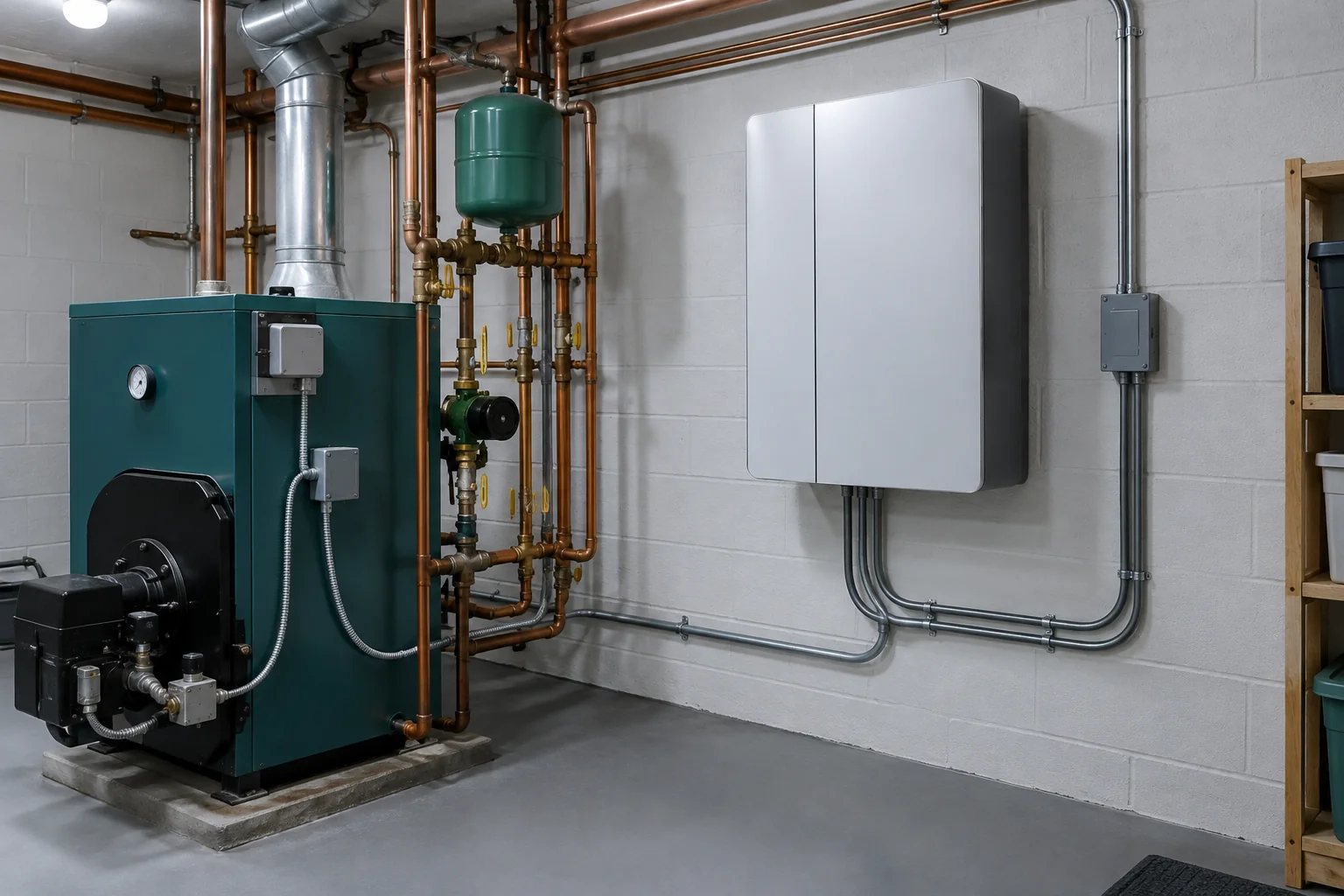
Here is the practical point for New England winters. A house with oil heat and no backup can get cold in a few hours of a winter outage, because the burner cannot fire without electricity. Add a well pump and the home loses water too. A battery on a backed-up circuit with the burner, circulators, fridge and well pump keeps the basics going.
When a battery is worth it
- You lose power often. Rural lines and tree-lined streets mean repeated outages.
- You have a well pump or medical equipment. Loss of power means loss of water or health risk.
- Your utility pays little for exports. Storing midday power for evening use beats selling it cheaply.
- You work from home. Outages cost you income, not just comfort.
When a battery does not pay
If outages are rare, your utility credits exports fairly and you have a small generator already, a battery adds cost with little return. In that case, install solar now and leave room in the electrical panel and wiring for a battery later. We install FranklinWH, Tesla Powerwall and Enphase IQ batteries, and we can add one to an existing system of any brand.
For the full process, see our guides on combining solar panels with battery backup and on how a retrofit works. The point to hold onto: for oil homes, the battery is mostly insurance for the burner, not a way to lift the savings ceiling.
Should You Wait for a Heat Pump Before Going Solar?
No, you do not need to wait for a heat pump before going solar. Panels cut your current electric bill today. If you later add a heat pump, your electric use rises and the same panels offset more of it. The better move is sizing the system with that future load in mind.
Waiting has a cost. Each year without panels is a year of full-price electricity, and your roof may need work later regardless. Going solar first also lets you see real production data before you commit to a heating change.
The honest unknown is how much a future heat pump will add to your electricity use. That depends on your house, your insulation and the equipment you choose, and no proposal can know it today. Get a heat load estimate from an HVAC contractor first, then ask your solar designer whether the layout can grow.
If you plan to replace the roof in the next few years, do that first or combine the work. Our guide on when to replace the roof before solar explains the timing.
Checklist Before You Sign a Solar Contract With Oil Heat
Use these checks on every proposal. Each has a pass and a walk-away answer.
- What does the savings claim include? Pass: it states electric savings only, with kWh and rate assumptions. Walk away: it mentions "total energy" or "heating" savings for an oil-heated home with no heat pump in the plan.
- What future utility rates does it assume? The Massachusetts attorney general's office advises asking about the assumptions behind any savings claims, including estimates of future utility rates, in its solar FAQ for customers. Pass: the rate growth is written down and modest. Walk away: it will not say.
- Is the installer licensed? Connecticut licenses solar trades through its Department of Consumer Protection. Pass: you can look up the license number. Walk away: no number, or "our subcontractor handles that."
- Who installs the system? Pass: employees of the company you signed with, who stand behind the work. Our crews are in-house W-2 employees, and our average install is 47 days from contract.
- How are fixed charges handled? Pass: the proposal shows a post-solar bill that still includes the fixed fees. Walk away: a projected bill of zero.
- What is the backup plan for the burner? Pass: the proposal says whether a battery or other backup would run your oil boiler and pumps. Walk away: it assumes solar panels alone will keep the house warm in an outage.
Financing changes the math too. Our guides on solar tax credit and rebate paperwork and loan, PPA and lease options explain what each route does to your net cost. We underwrite PPAs at a 620 FICO minimum, so credit that other installers turn away can still work with us.
Frequently Asked Questions
Is the solar tax credit still available in 2026?
The federal homeowner credit for purchased systems ended for property placed in service after December 31, 2025. Some third-party-owned arrangements such as leases and PPAs may still pass through a business credit. Whether it applies depends on your contract, so ask your installer to explain in writing and confirm with a tax professional.
Do solar panels reduce how much oil I burn?
Not directly. Panels make electricity and your burner runs on oil. Oil use only drops if you replace or supplement the boiler with something electric, such as a mini-split or heat pump. Until then, solar lowers your electric bill and leaves your oil deliveries unchanged.
Do I need to remove snow from solar panels in winter?
Usually not. Tilted panels shed snow within a day or two of sun, and winter output is a small share of the year. If you want to clear them, use a soft roof rake from the ground. Our guide to solar panel snow removal covers when to clear and when to leave them.
What if I need the panels removed and reinstalled for a new roof?
A licensed crew can detach, store and remount the panels while your roofer works. The system is shut down during the job and recommissioned afterward. Cost and timing depend on array size and roof schedule, so plan the roof and the panels together.
Get a Straight Number for Your House
If you heat with oil, the useful question is not whether solar works, but how big your electric bill really is. Send us 12 months of bills and we will show you what panels can offset, where the ceiling sits and whether a battery is worth it for your burner and well pump.
Request a free quote for your oil-heated home, or talk to a designer about sizing around a future heat pump. You can also explore our services for solar, batteries, roofing bundles and EV chargers, or call 203-903-4091. We serve homeowners across Connecticut, Massachusetts and Rhode Island.
Recommended Resources
Written by
Dan Katzman
Teamsun
Teamsun writes practical solar guidance to help property owners compare equipment, project scope, costs, and long-term service before making a decision.
Keep going.
Do Solar Panels Make Sense for Rental Properties?
Solar panels for rental property owners: how tenant savings, added property value, and financing stack up for landlords in CT, MA, and RI.
Dan Katzman
Teamsun
5 Mistakes Homeowners Make Choosing an EV Charger Installer
Avoid these 5 mistakes homeowners make choosing an EV charger installer, from skipped permits to unlicensed electricians, before you sign a contract.
Dan Katzman
Teamsun
How Does a Solar Battery Retrofit Work? 2026 Guide
Learn how does a solar battery retrofit work, from compatibility checks to activation. See equipment options, permitting steps, and install-day timelines.
Dan Katzman
Teamsun