Commercial Solar Depreciation (MACRS)
Commercial solar depreciation under MACRS explained: how 5-year recovery stacks with the federal tax credit, and what to ask your accountant before filing.
Dan Katzman
Teamsun
Commercial solar depreciation lets a business deduct most of a system's cost over roughly five years under MACRS, and it works alongside the 30% federal tax credit when a project qualifies. For a Connecticut, Massachusetts or Rhode Island owner of a 25kW to 500kW system, the two benefits together can return close to half the installed cost in tax value. Your accountant confirms the exact numbers.
What Is Commercial Solar?
Commercial solar means a solar electric system owned or hosted by a business, on a roof, a ground mount or a carport. This guide covers systems from 25kW to 500kW. The cost and savings depend on the system size, the building and the ownership structure, so get an itemized proposal. The tax side is where much of the value sits, and it is what the rest of this guide explains.
Key Takeaways
- Two benefits, one system: the federal tax credit cuts your tax bill directly, and depreciation deducts the system's cost from taxable income over time.
- The credit shrinks the depreciable base: when you claim the credit, the basis you depreciate is generally reduced by half of the credit amount.
- Rules moved in 2025 and 2026: construction start dates and placed-in-service dates now decide which credit and which recovery class apply, so check dates before you sign.
- Ownership matters: the business that owns the system claims the tax benefits. A PPA or lease usually passes them to the third-party owner.
- This is not tax advice: bring the questions at the end of this guide to your accountant before you file.
Commercial Solar Depreciation at a Glance
| Item | What to know |
|---|---|
| Federal tax credit | Generally 30% of eligible installed cost for qualifying projects |
| Depreciable basis | Cost minus half of the credit claimed |
| Recovery period | 5-year MACRS, if your project is classified that way |
| Bonus depreciation | 100% first-year deduction for qualified property acquired after January 19, 2025, if elected and eligible |
| IRS form | Form 4562, with elections attached |
| Who claims it | The tax owner of the system, not a PPA customer |
| Hypothetical $250,000 system | About $119,625 in combined tax value at a 21% rate (worked example below) |
| Key date | The placed-in-service date, when the system is ready for use |
Here at Teamsun, our in-house W-2 crews build commercial systems across Connecticut, Massachusetts and Rhode Island. We are installers, not tax preparers. What follows is what we see owners miss, so you can have a sharper conversation with your CPA.
What Is MACRS Depreciation for a Commercial Solar System?
MACRS, the Modified Accelerated Cost Recovery System, is the IRS method for writing off business equipment over a set number of years. Under it, a commercial solar system that qualifies as 5-year property is deducted over six tax years, with the largest deductions up front.
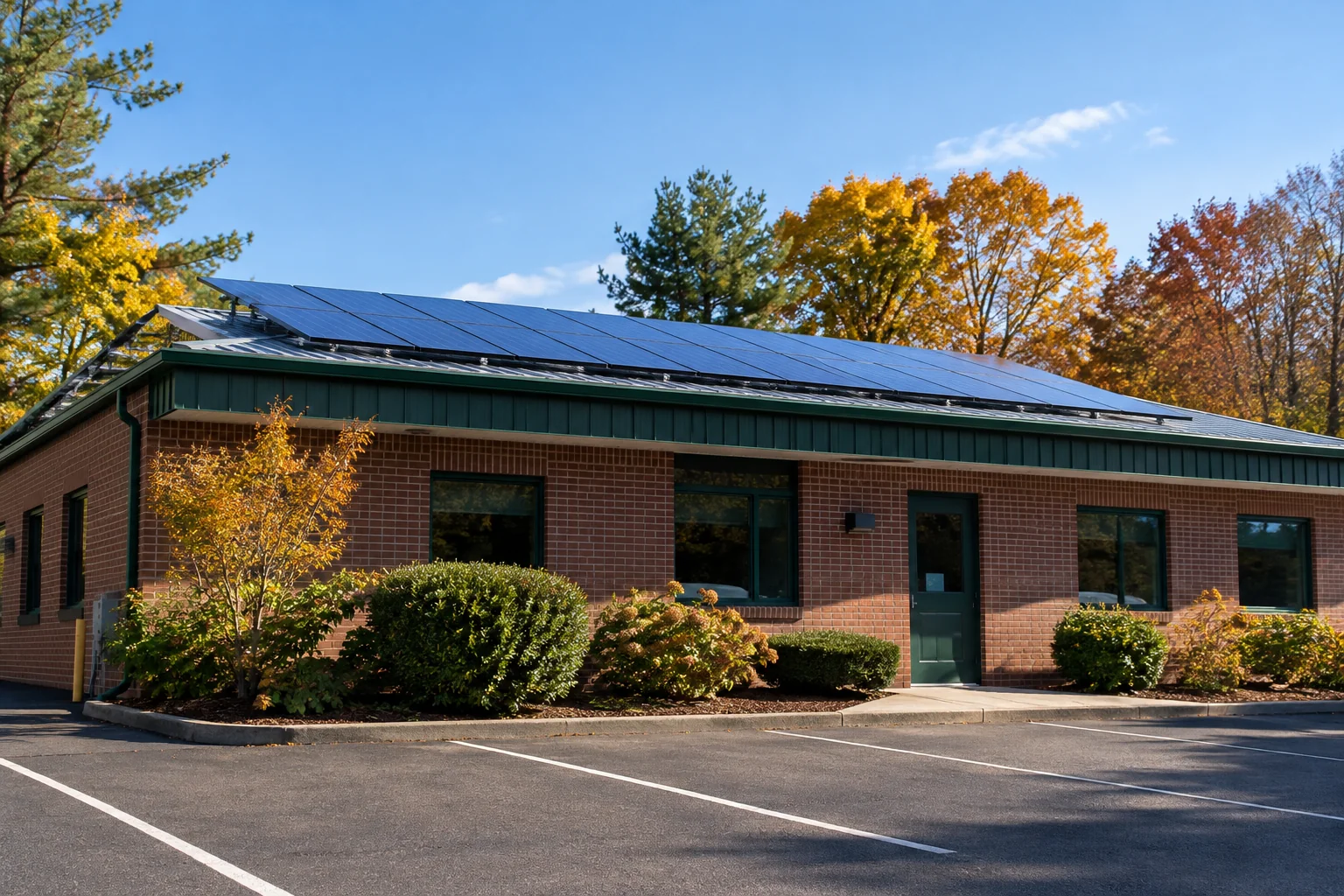
The IRS explains that property placed in service after 1986 generally falls under MACRS, which sorts assets into classes that set the number of years over which cost is recovered. Solar is not special here. It is business equipment that earns deductions the way a delivery van or a CNC machine does.
Why 5 years, and why six tax years?
The IRS says certain qualified clean energy property placed in service after 2024 may be classified as 5-year property under MACRS. The half-year convention treats the asset as in service mid-year, so a 5-year class spreads over six tax years.
The standard half-year table for 5-year property runs 20%, 32%, 19.2%, 11.52%, 11.52% and 5.76%. You report the deduction on Form 4562, the IRS form for depreciation and amortization.
The part that is not settled
Here is where owners get tripped up. The IRS page describes 5-year treatment for property placed in service after 2024. Tax commentary written since the 2025 federal budget law says the 5-year class was eliminated for solar property where construction began after December 31, 2024, while systems that began construction earlier keep it.
We cannot resolve that for you, and we would not guess. If your project started construction after 2024, ask your accountant which recovery class applies and whether bonus depreciation covers the gap. The worked example below assumes 5-year treatment because it is the most common planning case.
How Does Depreciation Stack With the Federal Solar Tax Credit?
The credit and depreciation stack because they do different jobs. The credit, generally 30% of eligible cost, reduces your tax bill dollar for dollar. Depreciation then deducts the remaining basis from taxable income.
The catch is that claiming the credit cuts your depreciable basis by half of the credit amount, as the IRS Form 3468 instructions describe for the basis rules. Larger systems may also face prevailing wage and apprenticeship requirements to earn the full credit, so ask your accountant whether they apply to your project.
A federal laboratory presentation hosted by the EPA lists two primary federal tax benefits for solar: the investment tax credit and accelerated depreciation. Used together, that presentation says, they can cover a large share of a project's cost. The rates in that older document have changed, so use it for the structure, not the numbers.
The basis reduction in plain terms
Say eligible cost is $100. A 30% credit is $30. Basis drops by half of that, $15, so you depreciate $85. You get $30 of credit plus deductions on $85. You do not depreciate the full $100.
Owners often assume the full cost is deductible and then find their accountant's number is lower. That is not an error. It is how the rule works, and it should already be in the proposal's tax assumptions.
Credit timing in 2026
The federal credit rules for solar changed under 2025 legislation, adding start-of-construction and placed-in-service deadlines. Commentary from a tax advisory firm notes that facilities may establish a construction start before July 5, 2026 under the IRS tests, such as the physical work test.
That date has passed. If your project did not begin construction by then, ask your accountant what placed-in-service deadline applies to you, and compare it to your installer's realistic schedule. For the differences between business and residential credits, our guide on the small business solar tax credit versus the residential credit covers the basics.
A Worked Example: 100kW System, Hypothetical Numbers
This example is hypothetical. The figures are round numbers chosen to show the mechanics, not a quote and not a Teamsun price. It assumes a taxable C-corporation paying 21% federal tax, a 30% credit, 5-year MACRS, and enough tax liability to use every deduction.

| Step | Calculation | Result |
|---|---|---|
| Installed cost | Hypothetical | $250,000 |
| Federal credit | 30% of $250,000 | $75,000 |
| Basis reduction | Half of $75,000 | $37,500 |
| Depreciable basis | $250,000 minus $37,500 | $212,500 |
| Tax value of depreciation | $212,500 times 21% | $44,625 |
| Total tax value | $75,000 plus $44,625 | $119,625 |
| Net cost after tax | $250,000 minus $119,625 | $130,375 |
How the $44,625 arrives year by year
Using the half-year table, the deductions and tax savings land like this:
- Year 1 (20%): $42,500 deducted, about $8,925 saved
- Year 2 (32%): $68,000 deducted, about $14,280 saved
- Year 3 (19.2%): $40,800 deducted, about $8,568 saved
- Years 4 and 5 (11.52% each): $24,480 deducted, about $5,141 saved each year
- Year 6 (5.76%): $12,240 deducted, about $2,570 saved
If your accountant elects 100% bonus depreciation instead, the whole $212,500 is deducted in year one, which puts the full $44,625 in the first return. The IRS guidance on the 2025 budget act describes bonus depreciation as a permanent 100% first-year deduction for qualified property acquired after January 19, 2025. Whether it fits your situation, and whether you want a large first-year loss, is a call for your CPA.
What the example leaves out
It ignores state income tax, state incentives, the interest on any loan, and the fact that lower utility bills raise taxable income slightly. It also assumes a profitable business. A company with little federal tax liability cannot use deductions or credits as fast, and unused credits generally carry forward rather than vanish.
PPA, Lease or Ownership: Who Gets the Depreciation
Only the tax owner of the system claims the credit and depreciation. If your business buys the system with cash or a loan, that is you. In a PPA or lease, the third-party owner usually claims them and prices the benefit into your rate.
That is not automatically worse. A tax-exempt owner such as a nonprofit cannot use deductions, so a PPA can make sense there. A profitable small manufacturer, on the other hand, often gives up significant value by letting someone else claim the benefits. Our guide to commercial solar financing for 25kW to 500kW systems compares the four structures side by side.
Pass-through entities and landlords
If your business is an LLC or S-corporation, the tax benefits flow to the owners' personal returns, and the owners' own tax situations decide how fast they can be used. If you lease your building, ask whether you or the landlord should own the system. The owner of the system is the one who needs the tax appetite.
Payback Impact for 25kW to 500kW Systems
Depreciation and the credit shorten payback by cutting your net cost, and the effect scales with system size. A 25kW system might cost five figures after incentives, while a 500kW system runs well into six. The percentages stay similar. What changes is how much tax liability you have to absorb the deductions.
Using our hypothetical numbers, a $250,000 system with $20,000 a year in utility savings pays back in about 12.5 years with no incentives. After $119,625 of tax value, net cost is $130,375, and payback is about 6.5 years. The savings figure is invented for illustration. For ranges and drivers, see our commercial solar ROI and payback guide.
Size bands and what changes
- 25kW to 75kW: typically a small roof or a modest ground mount. Tax liability is often the limit, so the schedule you choose matters more than the size.
- 75kW to 250kW: the sweet spot for many small manufacturers, warehouses and retail buildings. Year-one deductions can be large relative to income.
- 250kW to 500kW: big deductions in year one. Check whether your income can absorb them, or whether spreading them out serves you better.
Massachusetts owners should also factor in SMART production payments, and Connecticut and Rhode Island have their own programs. Those payments are taxable income, which interacts with depreciation. Ask your accountant to model them together.
Records Our Crews Hand Over for Your Accountant
Depreciation depends on documents, and installers create most of them. The most important is the placed-in-service date, which is generally when the system is ready and available for use, usually after the utility gives permission to operate. A date off by a few weeks can push a deduction into the wrong year.
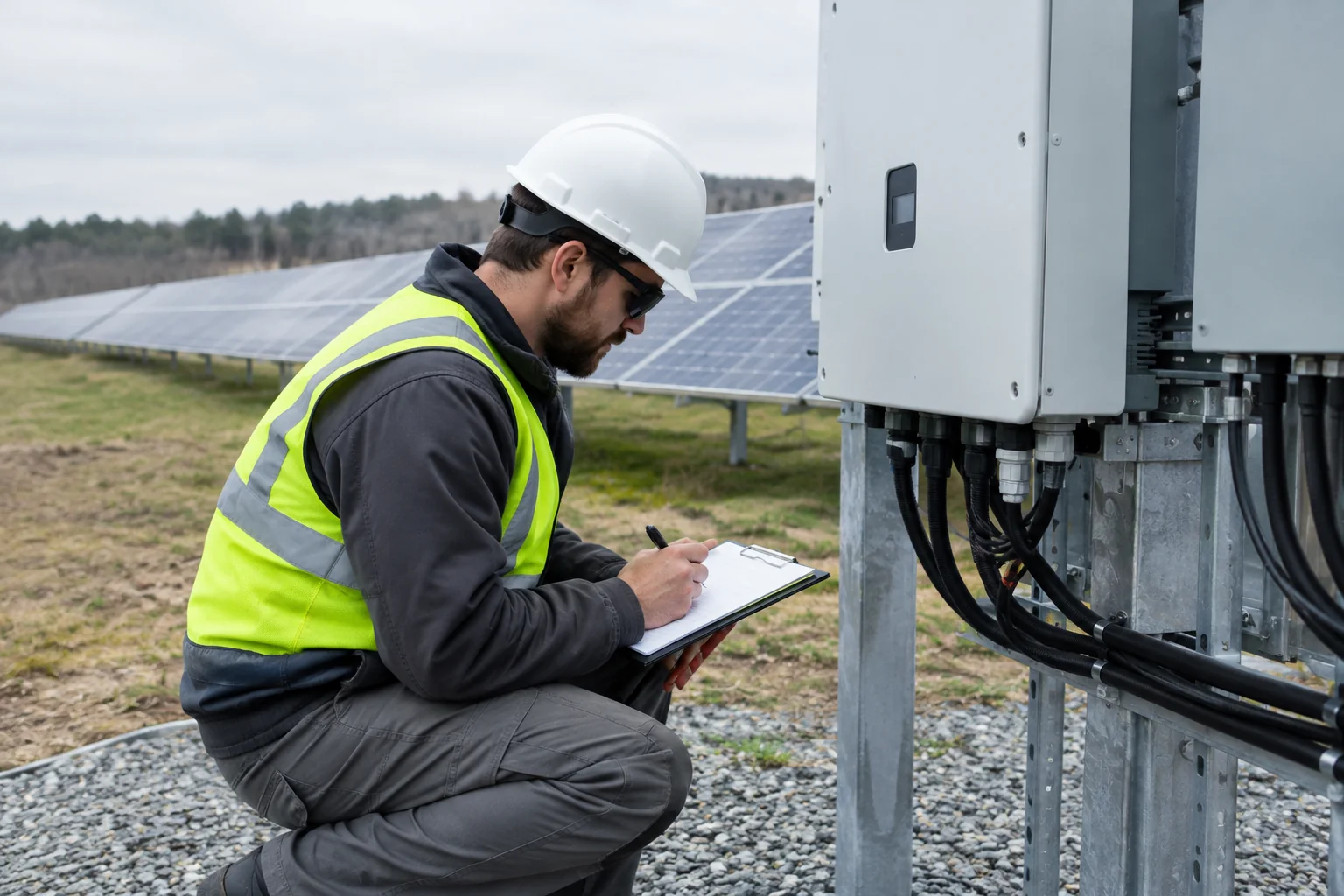
On every commercial job, our in-house crews keep a record set you can hand to your CPA:
- the signed contract and itemized invoice, split between equipment, labor, permits, interconnection and any electrical upgrades
- the utility's permission-to-operate letter and the date the system was energized
- equipment model and serial numbers for panels, inverters and any battery
- the inspection sign-off from the town
- records of when construction physically began, since that date now affects the credit
Ask for the itemized split early. Some costs, such as certain roof repairs or unrelated building work, may not qualify as part of the solar basis. Your accountant needs the line items to separate them. Our guide to commercial solar for small business roofs covers the roof questions that affect this.
Questions to Bring to Your Accountant Before Filing
Take these to your CPA before the system is energized, not after the return is due. Each has a pass mark so you know whether the answer is good.
- When did construction begin, and which credit rules apply to us? Pass: a specific date tied to a physical work or cost test. Walk away from a vague answer and get a second opinion.
- Which MACRS class applies to this project? Pass: the CPA cites the classification and your construction start date. Not a pass: "solar is always 5-year."
- Should we elect bonus depreciation or use the regular schedule? Pass: a side-by-side projection of tax owed for the next six years under both.
- Do we have enough tax liability to use the credit and deductions? Pass: a number for expected liability. If liability is low, ask about carryforwards.
- How does the 50% basis reduction change our deduction? Pass: the CPA shows your depreciable basis in dollars.
- How do state taxes and incentives interact with this? Pass: Connecticut, Massachusetts or Rhode Island treatment is addressed explicitly.
- Should we own the system, or use a PPA or lease? Pass: a comparison using your own tax rate, not a generic one.
- What records do you need, and by when? Pass: a short list. Give it to your installer so the paperwork matches.
If your accountant has never handled energy property, that is not a reason to skip the benefits. It is a reason to ask whether they want a specialist consulted, which is normal for a project of this size.
Common Mistakes We See Business Owners Make
- Treating the proposal's savings as a tax opinion. Installers show estimates. Your CPA files the return.
- Ignoring the construction start date. It now affects both the credit and, according to recent tax commentary, the depreciation class.
- Signing a PPA without pricing the lost tax benefits. Compare it against ownership with your real tax rate.
- Waiting until filing season. By then the placed-in-service date and invoices are fixed, and options are gone.
- Not planning for taxable incentive income. Production payments count as income in most cases.
Frequently Asked Questions
Is there still a federal solar tax credit for businesses in 2026?
Yes, a federal business solar credit generally still exists in 2026 for qualifying projects, usually at 30% of eligible cost. Legislation passed in 2025 added construction-start and placed-in-service deadlines, so eligibility now depends on your project's dates. Confirm your specific timeline with an accountant before signing a contract.
Can I depreciate the full cost of a commercial solar system?
Generally no. When you claim the federal credit, the depreciable basis is reduced by half of the credit amount. On a $250,000 system with a 30% credit, that removes $37,500 and leaves $212,500 to depreciate. Your accountant calculates the exact basis for your project.
What is the placed-in-service date for solar?
It is generally the date the system is complete and ready for its intended use, which usually follows the utility's permission to operate. Installation finishing is not always the same date. Ask your installer for the permission-to-operate letter and give it to your accountant.
Does depreciation help if my business pays little tax?
Less, in the short term. Deductions and credits only reduce tax you actually owe. Unused credits generally carry forward and unused losses may too, depending on the entity. A low-liability business should model a slower schedule or a different ownership structure with its accountant.
Do I need a Connecticut-licensed installer to claim these benefits?
The tax benefits depend on the system and its dates, not on who built it, but a properly licensed and permitted installation is what gets inspected, energized and documented. Verify your installer's license with the state before signing, and ask for the records listed above.
Next Steps for Your Commercial Solar Project
Depreciation is easiest to use when the numbers are lined up before construction, not after. If you are weighing a 25kW to 500kW system in Connecticut, Massachusetts or Rhode Island, request a free quote and we will give you an itemized proposal your accountant can work from.
Want to talk through system size and roof or ground-mount options first? Talk to a designer, call us at 203-903-4091, or explore our services to see what we install and maintain. Then take the question list above to your accountant, because the tax return is theirs to sign.
This article is general information, not tax or legal advice. Tax rules for solar changed in 2025 and may change again; confirm current rules with a qualified accountant.
Recommended Resources
Written by
Dan Katzman
Teamsun
Teamsun writes practical solar guidance to help property owners compare equipment, project scope, costs, and long-term service before making a decision.
Keep going.
Commercial Solar for Warehouse Rooftop Owners
Commercial solar for warehouse rooftop owners: roof load limits, interconnection timelines, and financing for 25kW-500kW systems before you sign a contract.
Dan Katzman
Teamsun
Commercial Solar for Small Business Roofs: 2026 Guide
Commercial solar for small business roofs: roof suitability, permitting, interconnection, and financing options for 25kW-500kW rooftop systems in CT, MA, RI.
Dan Katzman
Teamsun
Commercial Solar Ground Mount Permitting Checklist for New
A commercial solar ground mount permitting checklist covering zoning, utility interconnection, and CT/MA town-specific permit steps for business owners.
Dan Katzman
Teamsun