Commercial EV Charger Installation
Commercial EV charger installation checklist for CT, MA and RI businesses: charger level, load calcs, permits, parking, networking and solar pairing.
Dan Katzman
Teamsun
Commercial EV charger installation starts with five decisions made in order: who will charge and for how long, which charger level fits, whether your electrical service has spare capacity, what permits apply, and how drivers will pay or gain access. For most small businesses in Connecticut, Massachusetts and Rhode Island, hardwired Level 2 chargers cover the need.
Key Takeaways
- Dwell time picks the charger: If cars sit for four hours or more (staff, overnight fleet), Level 2 is usually enough. DC fast charging only makes sense when vehicles must turn around in under an hour.
- Capacity comes before hardware: Your main service, panel space and distance to the parking area decide the budget more than the charger model does.
- EV charging counts as a continuous load: Breakers and wire are sized at 125% of the charger's rated current, so four chargers add up faster than most owners expect.
- Load management can avoid a service upgrade: Software that shares power between chargers often costs less than new utility service.
- Solar fits daytime charging: Staff and customer chargers run when the sun is up, which suits a commercial rooftop array.
Commercial EV Charger Installation at a Glance
| Checklist step | What to decide | Who usually owns it |
|---|---|---|
| 1. Use case | Staff, customers or fleet; how long cars stay parked | Owner or property manager |
| 2. Charger level | Level 2 (240V) for long stays; DC fast for short turnarounds | Owner with electrician |
| 3. Site assessment | Service size, panel space, conduit run, trenching | Licensed electrician |
| 4. Load calculation | Continuous load at 125%, need for load management | Electrician or engineer |
| 5. Permits and utility | Local electrical permit, inspection, utility programs | Installer and owner |
| 6. Parking layout | Cable reach, accessible spaces, bollards, snow plan | Owner and installer |
| 7. Networking | Networked or standalone; free, paid or restricted access | Owner |
| 8. Solar pairing | Size array and chargers together | Solar designer |
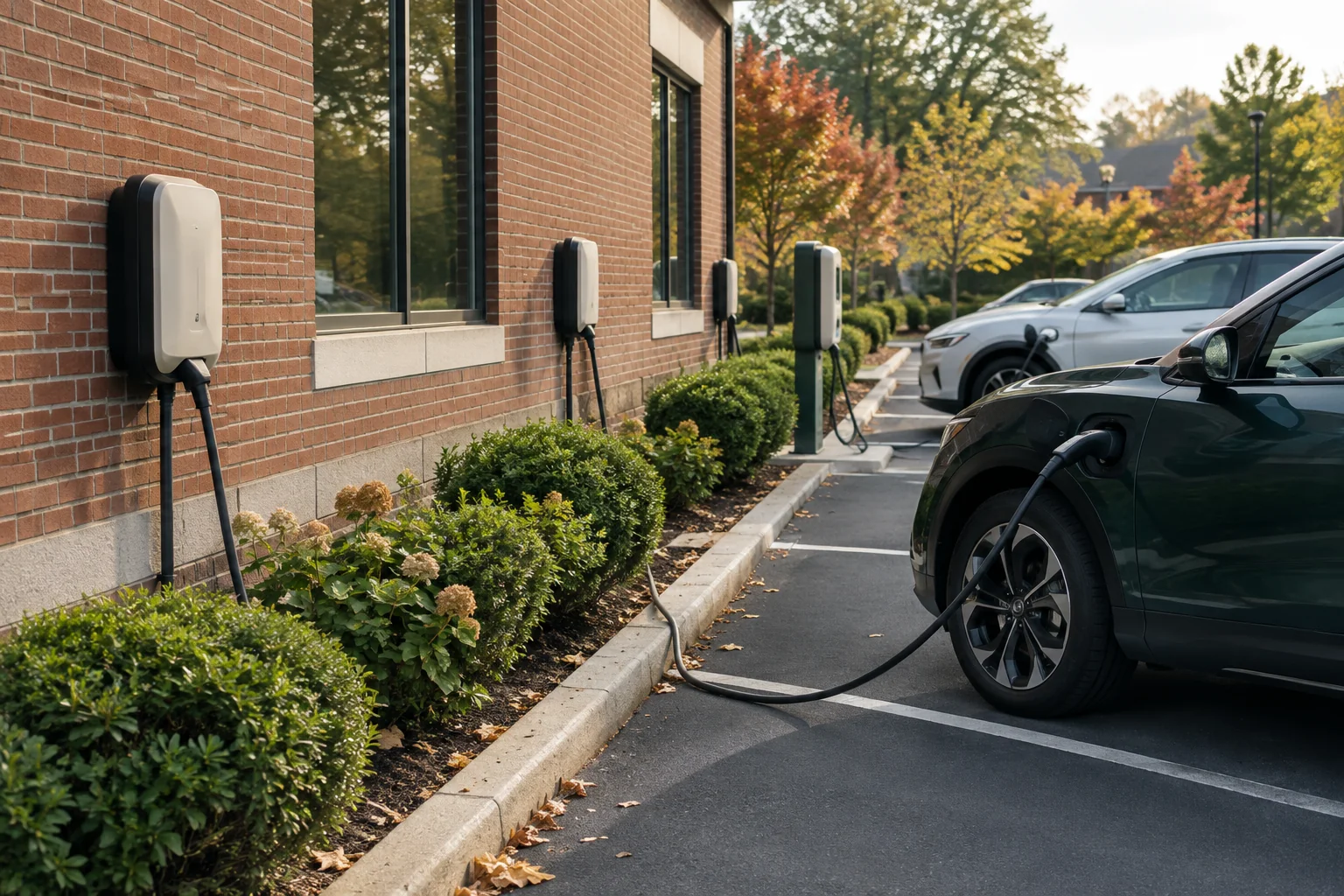
1. Define Who Will Charge: Staff, Customers or a Fleet
Every charger decision traces back to one question: how long does a car sit in that space? The answer separates a staff lot, a retail storefront and a service-van yard, and it sets the power you need.
Employees park for six to ten hours. Even a modest Level 2 charger can refill a commuter car in that window, so you can often install more chargers at lower power each. That keeps electrical demand manageable.
Customers stay for twenty minutes to two hours, depending on your business. A café, a medical office and a hardware store have very different dwell times. Charging here is an amenity, so pricing and access rules matter as much as speed.
Fleet vehicles usually return at night and leave in the morning. Overnight dwell favors Level 2 again, but the count is higher and every vehicle needs a full charge by a set time. Count the vehicles, note when they return and leave, and write down daily mileage before talking to any installer.
Many sites mix groups. A plumbing contractor with six vans and a small customer lot might want fleet chargers in the back and one or two public-facing ones out front. Treat those as separate zones with separate rules.
2. Choose Between Level 2 and DC Fast Charging
For most small businesses, Level 2 is the right choice. It runs on 240-volt power, costs far less to install, and matches the hours that employees, customers and overnight fleets are parked. DC fast charging suits high-turnover sites and needs much heavier electrical service.
| Factor | Level 2 (AC) | DC fast charging |
|---|---|---|
| Power supply | 240V, commonly 32A to 48A per charger | Typically three-phase, high-capacity service |
| Best dwell time | Two hours or more | Under an hour |
| Best fit | Staff lots, overnight fleets, offices, multifamily | Highway-adjacent sites, high-turnover retail, mixed fleets on tight schedules |
| Electrical impact | Moderate, scalable one charger at a time | Often needs new transformer or service |
| Teamsun installs | Yes, hardwired Level 2 | No |
The math is simple. A 40-amp Level 2 charger delivers about 9.6 kW on a 240-volt circuit, and a 48-amp unit about 11.5 kW. That is enough to add a full day's commute to most cars in a couple of hours.
A higher amp rating only helps if the vehicle's onboard charger can accept it. Many cars top out near 7.2 kW. Specifying 48-amp chargers for a staff lot full of those cars buys you a bigger breaker and thicker wire for no gain.
A decision rule you can use
If a vehicle sits for four hours or longer, choose Level 2. If it needs a meaningful charge in under an hour and you have the service capacity and budget, look at DC fast charging through a specialist. We install hardwired Level 2 chargers and do not install DC fast chargers, so we will tell you plainly when your use case belongs with another contractor.
3. Assess Your Site and Electrical Service Capacity
Site assessment answers one question: can your building's electrical service support the chargers you want, and how far is the power from the parking? Capacity and conduit distance usually drive the cost more than the chargers themselves.

Have an electrician walk the site and record these items:
- Main service size (amps and voltage, single or three-phase) from the nameplate on the main disconnect.
- Existing demand. Your utility bills show peak demand for the past year. This is better evidence than a guess.
- Open breaker spaces in the main panel or a nearby subpanel.
- Distance from the panel to each planned charger location.
- Route for conduit: wall surface, ceiling, or trench under asphalt or concrete.
- Future growth. Plan conduit for more chargers than you install today, because pulling wire later is cheaper than trenching twice.
Trenching across a paved lot is often the biggest line item on a quote. Placing chargers on a wall near the electrical room, or on the parking row closest to the panel, can cut cost considerably. Ask installers to price two layouts side by side.
Older New England buildings add wrinkles: crowded panels, shared meters in multi-tenant properties, and parking lots with ledge or old utilities underneath. A property manager should confirm who controls the electrical room and what the lease says about tenant-installed equipment.
4. How Do You Run a Load Calculation for EV Chargers?
Add up the continuous current of every charger, multiply by 125%, and compare that total with the spare capacity on your service. If it does not fit, you either upgrade service, install fewer chargers, or use load management to cap combined draw. A licensed electrician must perform the final calculation.
The reason for the 125% is that EV charging counts as a continuous load under the National Electrical Code, meaning current that runs for three hours or more. Breakers and conductors for each charger circuit must be rated at least 125% of the charger's maximum current. A 40-amp charger therefore needs a 50-amp breaker.
A hypothetical worked example
This example uses assumed numbers to show the method, not a real project or a quote. Suppose a small office has a 400-amp, 240-volt service and a measured peak demand of 310 amps. It wants four 40-amp Level 2 chargers.
- Four chargers at 40A each is 160A of charging current (about 38.4 kW).
- Multiply by 125% and you need about 200A of capacity if all four run together.
- Spare capacity is 400A minus 310A, or 90A.
The shortfall is real, but the answer is not automatically a bigger service. If staff cars sit all day, a load management system can cap the four chargers at a combined 90A or less, and each car still gets a full charge by afternoon. That is often far cheaper than a utility upgrade.
The reverse also happens. A fleet that needs every van full by 6 a.m. may have no slack to share, and then service capacity is the real project. Your electrician should model both cases before you commit.
When a panel or service upgrade is likely
Expect an upgrade conversation when the panel is full, when peak demand already sits near the service rating, or when you plan more than a handful of chargers. Upgrades involve the utility, can add lead time, and should be known before you promise chargers to tenants or staff. We cannot quote timelines for utility work, because they vary by utility and location.
5. Permits, Inspection and Utility Coordination
A commercial EV charger installation needs a local electrical permit and an inspection by the town or city. Some sites also need building, zoning or fire department sign-off. Your installer should pull the permit; you should confirm who is responsible in writing before work begins.
Rules differ by municipality across Connecticut, Massachusetts and Rhode Island, and each applies the electrical code edition its local authority enforces. Plans for chargers usually show the one-line diagram, the load calculation, charger specifications and mounting locations. If the work touches a main service, the utility may need to approve it as well.
Zoning is worth a quick call. Towns are actively updating how they treat energy equipment; Bethany, Connecticut, for example, approved new solar array regulations in October 2026. A charger canopy or a charger-plus-solar plan may fall under rules that changed recently.
Utility make-ready and rebate programs
Your electric utility may offer incentives, make-ready support, or special rates for commercial charging. Eversource serves customers in Connecticut and Massachusetts, National Grid serves parts of Massachusetts, and Rhode Island Energy serves Rhode Island. Program terms and funding change, so we do not quote amounts here.
Check your utility's current commercial EV program before you sign a contract. Some programs require approval before purchase or installation, and starting early can cost you the incentive. Ask your installer whether they handle the application.
Also ask about your electric rate. Demand charges can make a few chargers running at once more expensive than their kilowatt-hours suggest, which is another reason to consider load management.
6. Parking Layout and Accessible Spaces
Good layout puts each charger within cable reach of two spaces, keeps walking paths clear, protects equipment from plows and vehicles, and includes accessible charging. Plan it on paper with your electrician before trenching, because moving a charger afterward means redoing conduit.
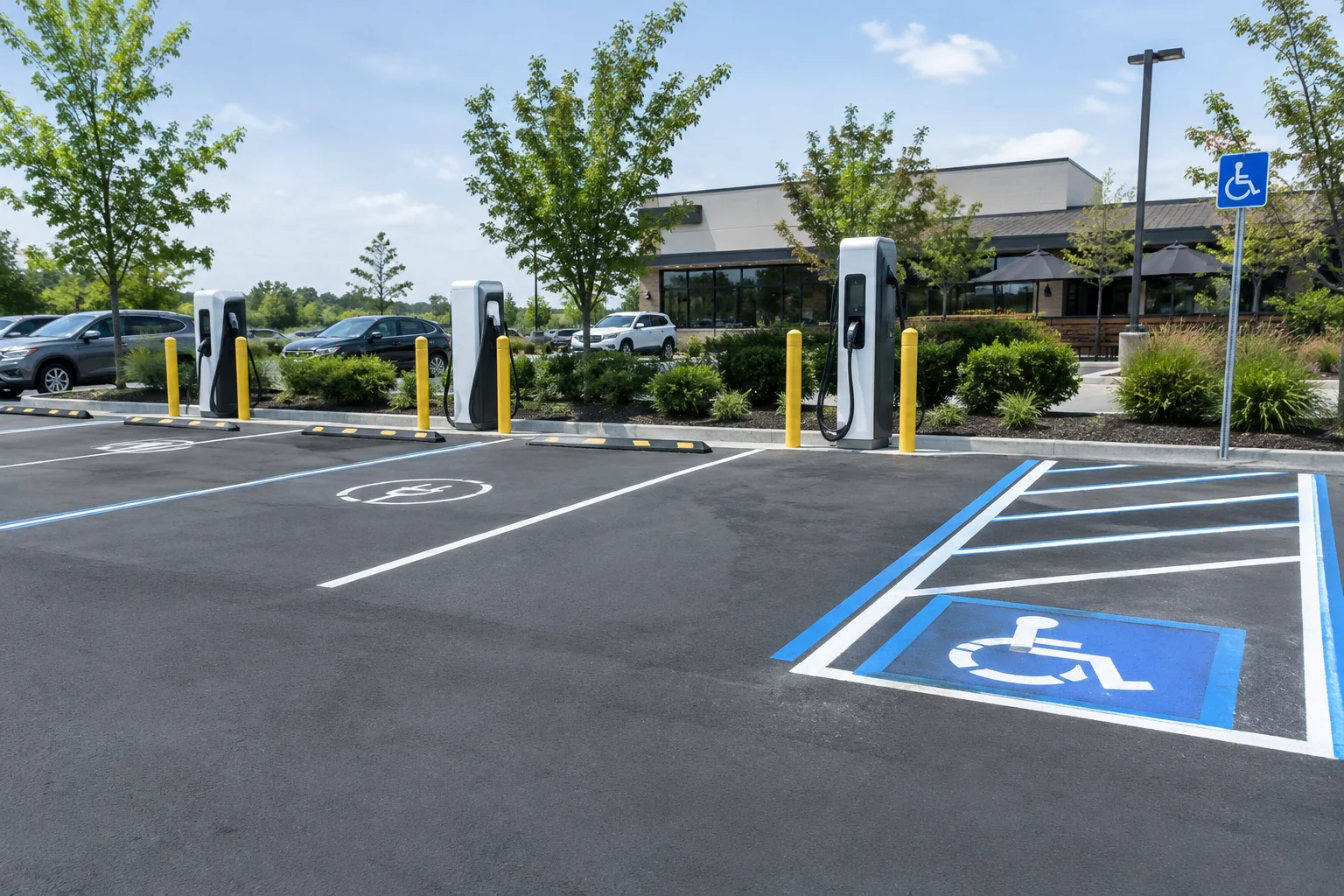
Practical layout points for New England sites:
- Share one charger between two spaces where cable length allows. A pedestal between two stalls cuts hardware and trenching.
- Protect with bollards or wheel stops so bumpers and plows do not strike the unit.
- Plan for snow. Mount high enough to clear a plowed bank, and tell your plow contractor where the equipment sits.
- Light the area. Evening and winter shifts mean drivers arrive in the dark.
- Manage cables. Holsters or retractors keep cords out of ice and slush.
Accessible charging spaces
Accessible spaces are a design item, not an afterthought. The Americans with Disabilities Act and state building codes affect parking, routes and reach heights, and federal guidance on EV charging specifically is still developing. Massachusetts, Connecticut and Rhode Island may each layer on their own accessibility rules.
The safest approach is to ask your designer or building official which standard applies to your site before you mark stalls. If you restripe an existing lot, accessible parking requirements can apply to the restriped layout. Our position: include at least one accessible-reachable charger from the start, because retrofitting one later costs more than designing it in.
7. Networked vs Non-Networked Chargers and Payment
Choose networked chargers if you want to bill drivers, restrict access, report usage or manage load remotely. Choose standalone chargers if you offer free charging to a small, known group and want the lowest upfront and ongoing cost. Many sites start networked because it keeps options open.
| Feature | Networked | Non-networked (standalone) |
|---|---|---|
| Payment collection | Yes, card or app billing | No; free or billed manually |
| Access control | Staff-only, public or scheduled | Anyone who can reach the plug |
| Load management | Typically supported | Limited or none |
| Usage reporting | Per charger, per driver | None |
| Ongoing fees | Network or software subscription | None |
| Needs connectivity | Wi-Fi or cellular | No |
Ask three questions. Will you charge drivers, and if so, will you recover electricity cost or run a profit? Do you need to keep strangers off staff or fleet chargers? Do you want to see usage data for reporting or tenant billing?
Two cautions. First, check that a networked charger still works at a basic level if the subscription lapses or connectivity drops. Second, confirm what happens to the hardware if the network provider changes. Open-standard chargers give you more room to switch providers later.
8. Pairing Chargers With Commercial Solar
Chargers and commercial solar pair well because workplace and customer charging happens in daylight, when a rooftop or ground-mount array produces. The solar offsets part of the electricity the chargers use, though it will not cover evening or overnight fleet charging without storage or net metering credits.
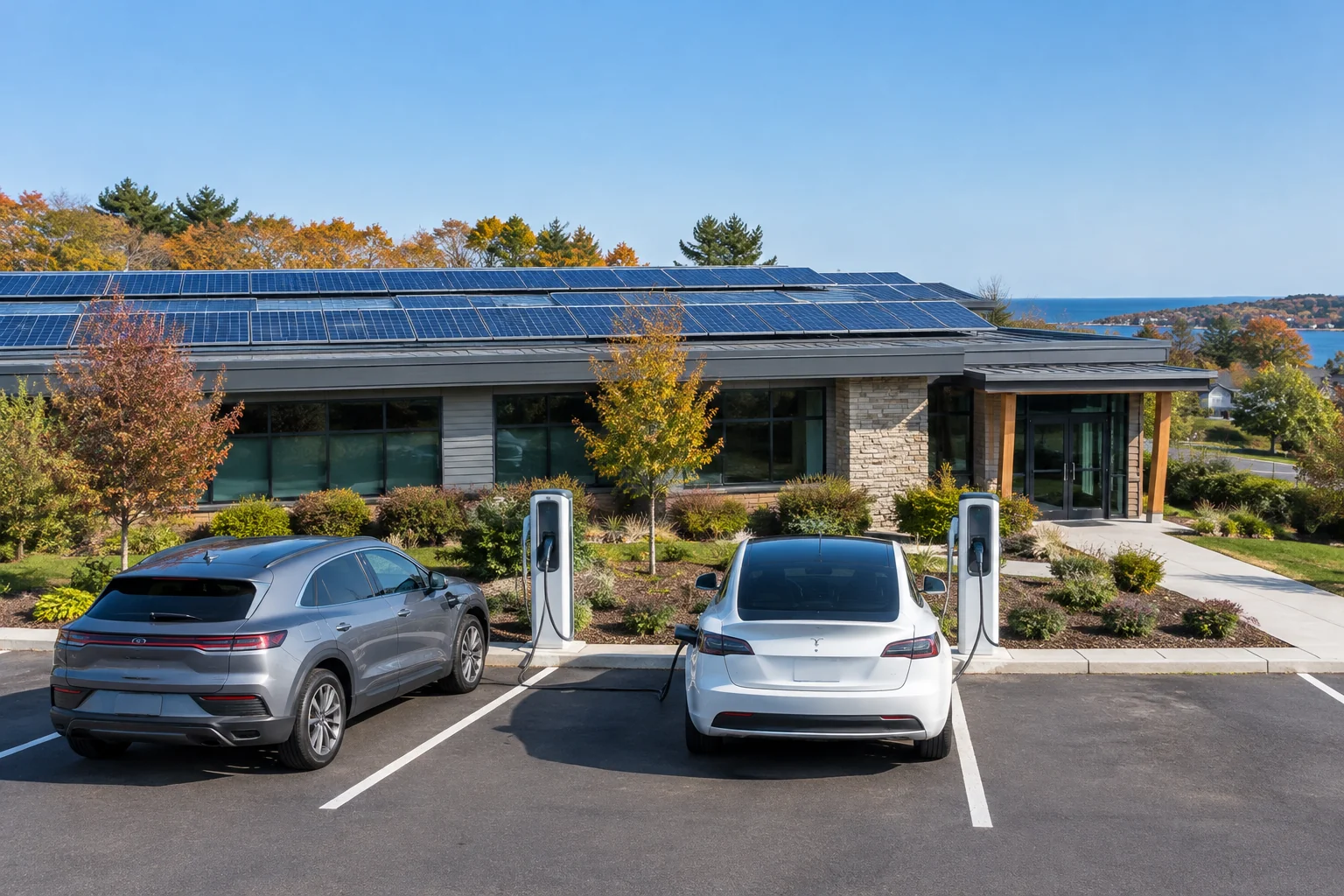
We design commercial solar from 25kW to 500kW, on roofs and ground mounts. Sizing the array and the chargers in one plan avoids two common mistakes: undersizing the array for the new load, and paying twice for electrical work that could have been done together.
Here is how the pieces interact:
- Daytime staff and customer charging uses solar power directly, as it is produced.
- Overnight fleet charging draws from the grid, with daytime solar export earning credits under your utility's net metering rules. Rules differ by state and utility, so confirm yours.
- Battery storage can shift daytime solar into evening charging and may help cap peak demand, though it adds cost and design complexity.
- Shared electrical upgrades (new panel, conduit, interconnection) can serve both projects.
If you are weighing the solar side first, our guide to commercial solar for small business roofs covers roof suitability and sizing. For the technical pairing details, see how to pair an EV charger with solar panels.
One open question: how much solar value an EV charger adds depends on your utility's rate design and how net metering evolves in your state. We would not promise a payback figure without your bills and your charging schedule in hand.
9. Choosing an Installer: A Pre-Contract Checklist
Pick an installer who will walk your site, do a real load calculation, pull permits and stand behind the work. Prefer a firm that uses its own licensed crews rather than passing the job to subcontractors, so one company answers for the wiring, the permit and the warranty.
Our crews are in-house W-2 employees, not subcontractors, and we install hardwired Level 2 EV chargers alongside commercial solar. That means one team can handle the charger circuits and the array in a single project. For a homeowner-side view of the basics, our hardwired home charger guide explains the circuit and wiring steps we apply at commercial scale.
Before signing, ask every bidder:
- Who performs the load calculation, and will I receive it in writing?
- Does the quote include permits, inspection and utility paperwork?
- Is trenching, restoration and any panel work itemized separately?
- What happens if the inspection fails?
- Which chargers are specified, and what are the warranty terms?
- Can the system add chargers or load management later?
- Who services the equipment after installation, and how do I reach them?
Compare quotes line by line. A low price that leaves out trenching or utility coordination is not a low price.
Frequently Asked Questions
Do I need a separate meter for my EV chargers?
Not always. Many sites run chargers off the existing service. A separate meter or submeter helps if you want to bill tenants or track charging cost precisely, and some utility rates or programs may require one. Confirm with your utility and electrician before design is finalized.
Can I install chargers if I lease my space?
Often yes, but you need the landlord's written approval and clarity on who owns the equipment, who pays for electrical work and who restores the site at lease end. Property managers should also decide how tenants share capacity and who pays for the electricity.
How many chargers should a small business install first?
Start with the number your current drivers will actually use, then run conduit and reserve panel space for more. One charger shared between two stalls often serves a small staff lot. We do not assign counts without knowing your vehicles, dwell times and electrical capacity.
Does Teamsun install DC fast chargers?
No. We install hardwired Level 2 chargers and commercial solar. If your site needs DC fast charging, we can still help you assess capacity and plan a solar system, but a specialist contractor would handle the fast-charging equipment.
Next Step: Plan Your Chargers and Your Power Together
A commercial EV charger installation goes smoothly when you settle the use case, the load and the permit path before buying hardware. If you want a second set of eyes on your site, request a free quote and tell us how many vehicles, how long they park and whether solar is on your list.
You can also talk to a designer about sizing chargers and a 25kW to 500kW solar system together, or explore our services to see what our in-house crews install. Prefer to talk it through? Call 203-903-4091.
Recommended Resources
Written by
Dan Katzman
Teamsun
Teamsun writes practical solar guidance to help property owners compare equipment, project scope, costs, and long-term service before making a decision.
Keep going.
Commercial Solar for Small Business Roofs: 2026 Guide
Commercial solar for small business roofs: roof suitability, permitting, interconnection, and financing options for 25kW-500kW rooftop systems in CT, MA, RI.
Dan Katzman
Teamsun
Commercial Solar Ground Mount Permitting Checklist for New
A commercial solar ground mount permitting checklist covering zoning, utility interconnection, and CT/MA town-specific permit steps for business owners.
Dan Katzman
Teamsun
EV Charger Installation Cost for Massachusetts Homeowners
What EV charger installation costs Massachusetts homeowners in 2026: Level 2 hardwired pricing, panel upgrades, permits, rebates and solar bundling.
Dan Katzman
Teamsun