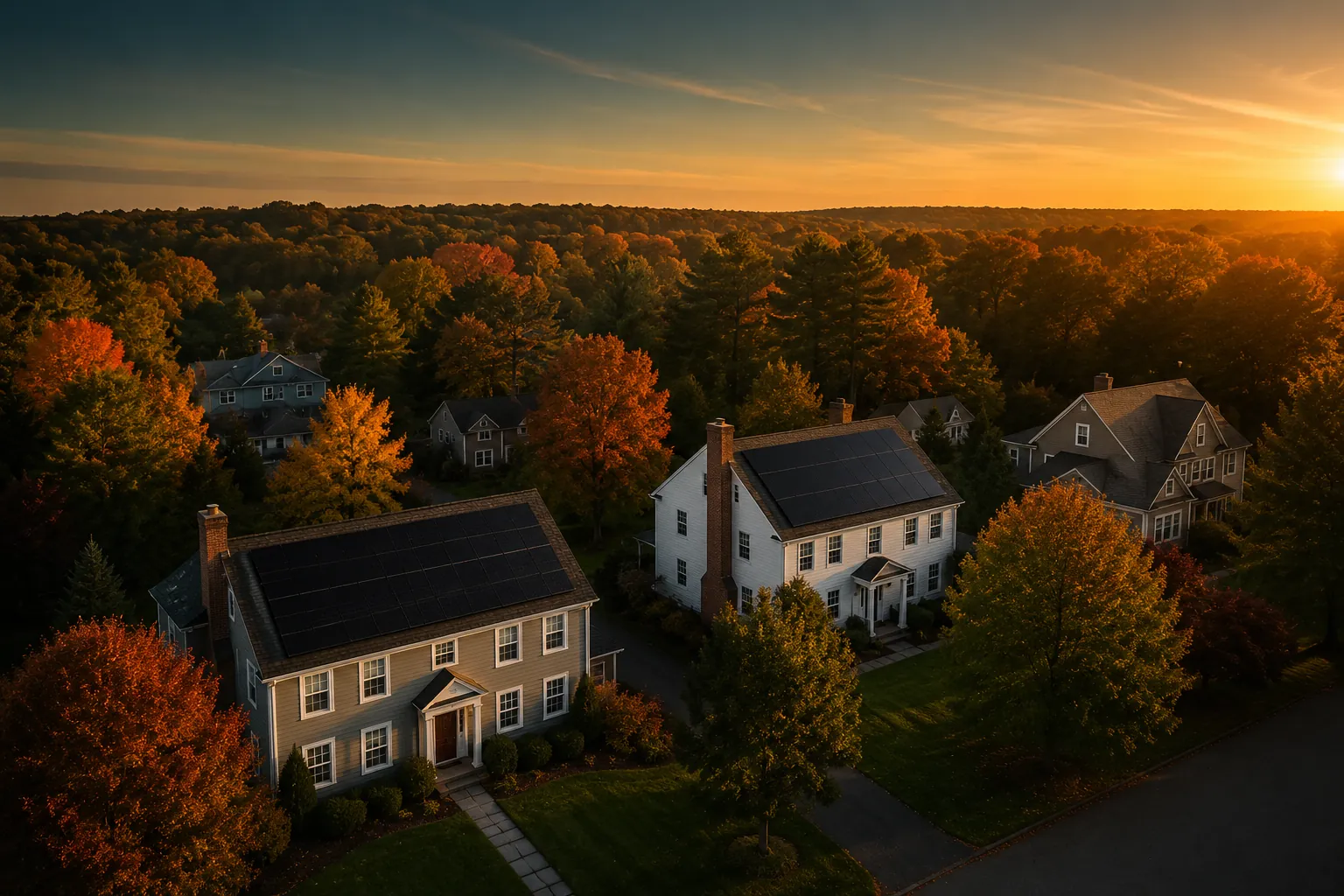
Can You Get Solar Panels That Match Your Roof Color?
Solar panels that match roof color: your real options in CT, MA and RI, from all-black panels to low-profile racking, plus HOA and historic district rules.
Dan Katzman
Teamsun
Yes. Solar panels that match roof color are available in practice as all-black panels with black frames, which blend into dark asphalt shingles in Connecticut, Massachusetts and Rhode Island. Fully color-matched panels for red, gray or tile roofs exist but are rare and cost output and money. Low-profile racking and tidy wiring do as much for curb appeal as panel color.
Key Takeaways
- Dark roof, easy match: an all-black panel (black cells, black backsheet, black frame) on charcoal or black shingles is the best blend most homes can get.
- Hardware shows more than you expect: silver rails, loose wiring and uneven gaps draw the eye faster than panel color does.
- Custom colors are a niche: skinned or tinted panels can imitate a roof, but they trade output and price for looks, and few installers stock them.
- Rules come first: HOAs and historic districts set the limits, so get the written rule and submit your layout before you sign a contract.
Solar Panel Color Options at a Glance
| Option | Best on | How it looks | Tradeoff |
|---|---|---|---|
| Standard blue-cell panel, silver frame | Any roof where looks are not a concern | Blue grid and bright frame stand out | Lowest visual blend; widest equipment choice |
| All-black panel, black frame | Dark gray, black or dark brown shingles | Uniform dark surface, thin black edge | Often a modest price step up; limited model choice per wattage |
| Black panel with silver frame | Roofs where a thin outline is acceptable | Dark cells, visible metal border | Cheaper than full black; outline stays visible |
| Low-profile racking, matched hardware | Any roof, any panel | Flush look, small shadow lines | Needs careful layout; adds planning time |
| Colored or skinned panel | Historic or highly visible roofs | Can imitate roof color or pattern | Lower output, higher cost, few suppliers |
| Array placed on rear slope | Homes with a back-facing roof plane | Little or no street view | May reduce production if the slope faces away from the sun |
What Does It Mean for Solar Panels to Match Your Roof Color?
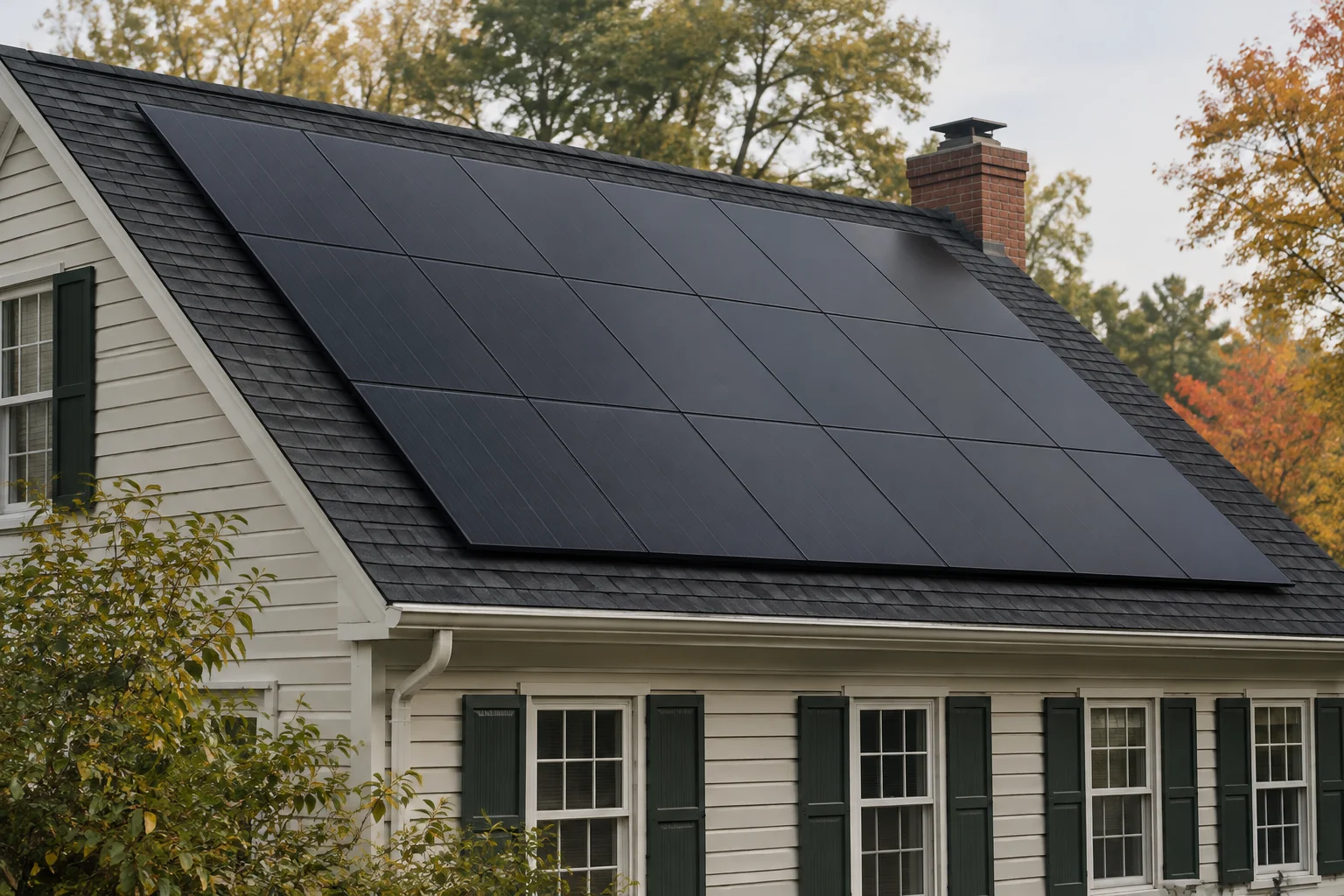
It means the array reads as one dark, even surface instead of a grid of contrasting parts. Matching rarely means identical color. It means black cells, a black backsheet, a black frame, and hardware and wiring that disappear against the shingles.
Most people picture the cell color first, but there are five things the eye picks up on a roof:
- Cell color: older style panels have blue cells with visible silver grid lines; newer all-black models have uniform dark cells.
- Backsheet: white backsheet shows as thin white lines between cells; black backsheet does not.
- Frame: silver aluminum outlines every panel; black anodized frames fade into the roof.
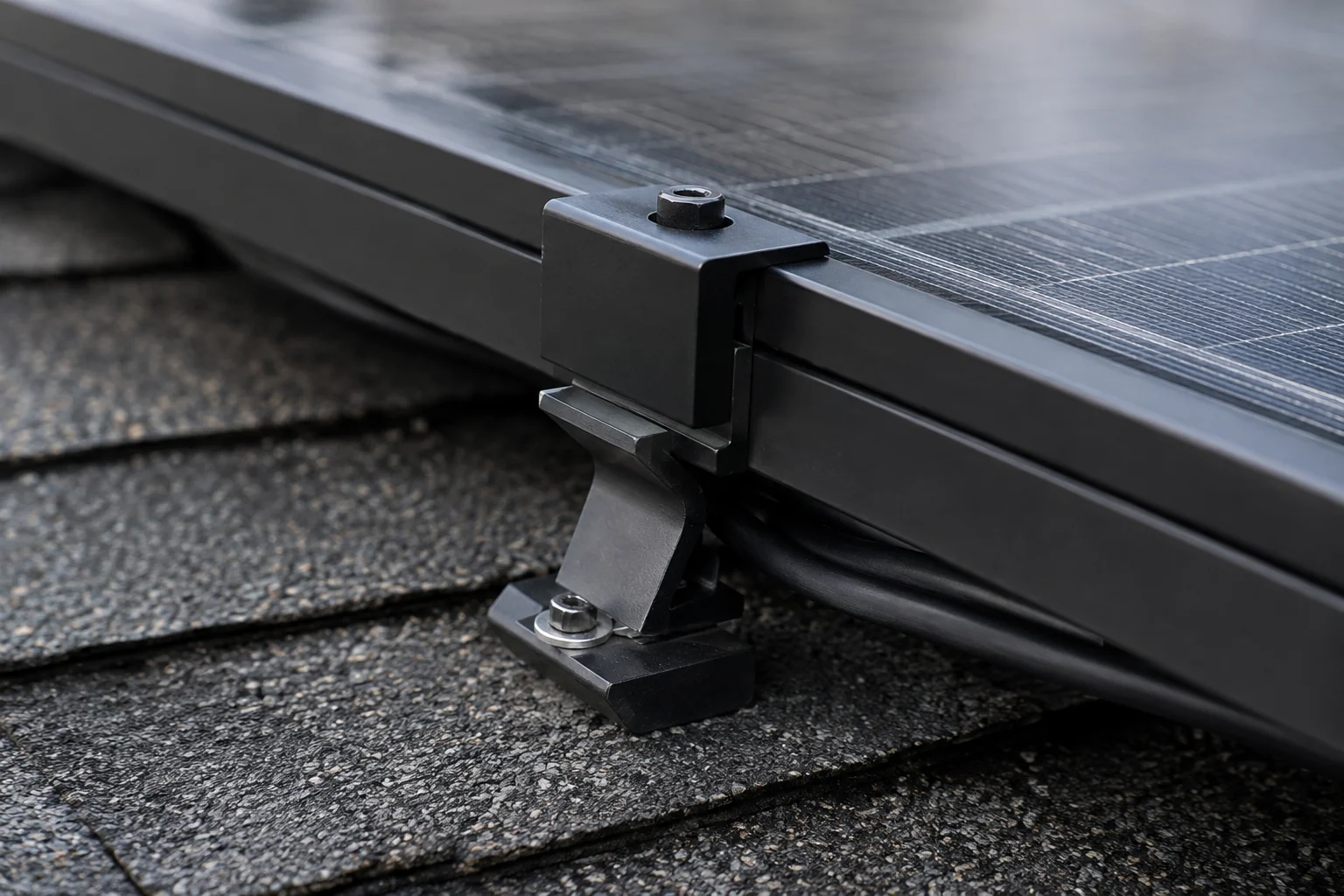
- Racking and clamps: exposed silver rail ends and tall standoffs stand out from the street.
- Wiring and conduit: loose cable and bright conduit look unfinished from the ground.
Our view at Teamsun is blunt: a homeowner who fixes all five gets 90% of the visual benefit, even when the panel itself is a standard model. A homeowner who buys an all-black panel and leaves silver rail ends and sagging wire still ends up with a roof that looks busy.
1. Start With Your Roof Color and Material
Your shingle color decides how well any panel can blend, so look at the roof before you look at equipment. Dark roofs give you the most freedom. Light, red or textured roofs limit how well an off-the-shelf panel can disappear.
Dark asphalt shingles: the easy case
Charcoal, black and dark brown asphalt shingles are the best match for all-black panels. The panel surface and the roof sit close in tone, so the array looks like part of the roof plane. Most of our residential work in Connecticut, Massachusetts and Rhode Island sits on asphalt shingle, so this is the setup we install most often.
Gray, weathered and mid-tone roofs
Weathered gray shingles are lighter than a new black panel, so you will see a darker rectangle. It usually still looks clean, because the panels are even and flush. The goal is to keep the array to one tidy block instead of scattering small groups across the roof.
Red, tan, tile, slate and cedar
Here a black panel will not blend, and no honest installer should tell you otherwise. You get contrast. The best answer is a clean rectangle on the least visible roof plane, with black hardware, so it reads as a deliberate dark element. For slate or cedar on older homes, expect a design review, covered below.
Metal roofs
Standing seam and corrugated metal come in many colors, and mounting methods differ from shingle. If you have metal, our guide to solar panels on a metal roof covers the clamps and rails that keep the look clean.
2. Choose All-Black Panels With Black Frames
For most homeowners, an all-black panel with a black frame is the answer to the question this article asks. It is the closest thing to a roof-matched panel that mainstream manufacturers sell, and it is available in the residential sizes we install.
What to confirm on the spec sheet
Do not accept "black panel" in a quote without checking the exact model. Ask for the model number and look for these four items:
- Cells are monocrystalline with uniform dark color.
- The backsheet is black, not white.
- The frame is black anodized, not silver.
- The wattage and warranty match the standard version of the same product line.
If a quote lists a "black frame" but a white backsheet, you will see thin white lines across the array. That is a half measure, and it is common enough that you should ask directly.
What the black look costs
All-black models often carry a modest price step over the standard version of a similar wattage, and some product lines offer fewer wattage choices. We will not quote you a number here, because it moves with the model and the year. Ask for both versions priced on the same line of the quote, then decide if the visual gain is worth the difference to you.
Heat and output
Dark panels run warm on a sunny day, and heat lowers output slightly. Compare the temperature coefficient on the spec sheet between models, and judge the real result by the production estimate for your address, not by color. For most homes the output gap between black and blue panels of the same wattage is small next to shade, roof direction and tilt.
3. Pick Low-Profile Racking and Hide the Hardware
Racking is the part of the array most people never think about, and it shapes the view from the street. Low-profile, flush mounting keeps the panels close to the shingles, shrinks shadow lines and keeps the array looking like part of the roof.
Things we ask for on a clean install
- Low standoff height: the closer the panel sits to the roof, the less shadow and gap you see from the ground.
- Black rails, clamps and trim: silver rail ends are the first thing a neighbor notices.
- Skirt or trim along the edge: hides the underside and the wiring from the street.
- Wires clipped under the frame: no cable loops hanging between panels or at the array edge.
- Conduit painted or run out of sight: where it must show, color it to match the siding or roof.
- Even gaps and straight lines: one tight rectangle looks planned; staggered rows look cluttered.
Plan around roof obstacles
Vent pipes, skylights, chimneys and plumbing stacks break up a roof layout. The panels need to avoid them, and an array that dodges five obstacles looks like a patchwork. Tell your designer early which roof planes matter most for appearance, so the layout does not put panels on the street-facing slope just to hit a target size.
It also pays to keep all panels on the same plane. If the roof has several slopes, one well-placed block usually looks better than two smaller groups on different planes, even if the second group adds a little production.
4. Can Fully Colored or Custom-Skinned Panels Work?
Yes, but they are a special-order niche. Some products add a printed or tinted layer so a panel can imitate roof color or pattern, and the U.S. Department of Energy has described one that copies tile, log or other looks. Expect lower output and higher cost than a standard panel.
The Department of Energy described in 2016 a product called SolarSkin that can mimic the color and pattern of a rooftop and can add a customizable graphic layer. That shows the idea is real, but availability, pricing and local installer support change over time. We would not promise a homeowner this route without confirming a current supplier, warranty and production figure first.
When a custom look is worth chasing
Consider it when your roof is highly visible, historic or unusual, and your review board will not accept a standard dark panel. Ask for these in writing before you commit:
- Rated wattage per panel and expected production for your roof.
- Product and workmanship warranty terms.
- Whether the manufacturer certifies it for your mounting method.
- Who services it if a panel fails in year eight.
If the answers are vague, walk away. A good-looking array that underperforms for 25 years is a poor trade for most homeowners.
5. How Do You Check HOA and Historic District Rules?
Get the written rules from your HOA or local historic commission, then submit a roof layout, panel model and hardware finish for approval before you sign a solar contract. Ask what is visible from the street, what colors are allowed and how long review takes.
What local rules actually say
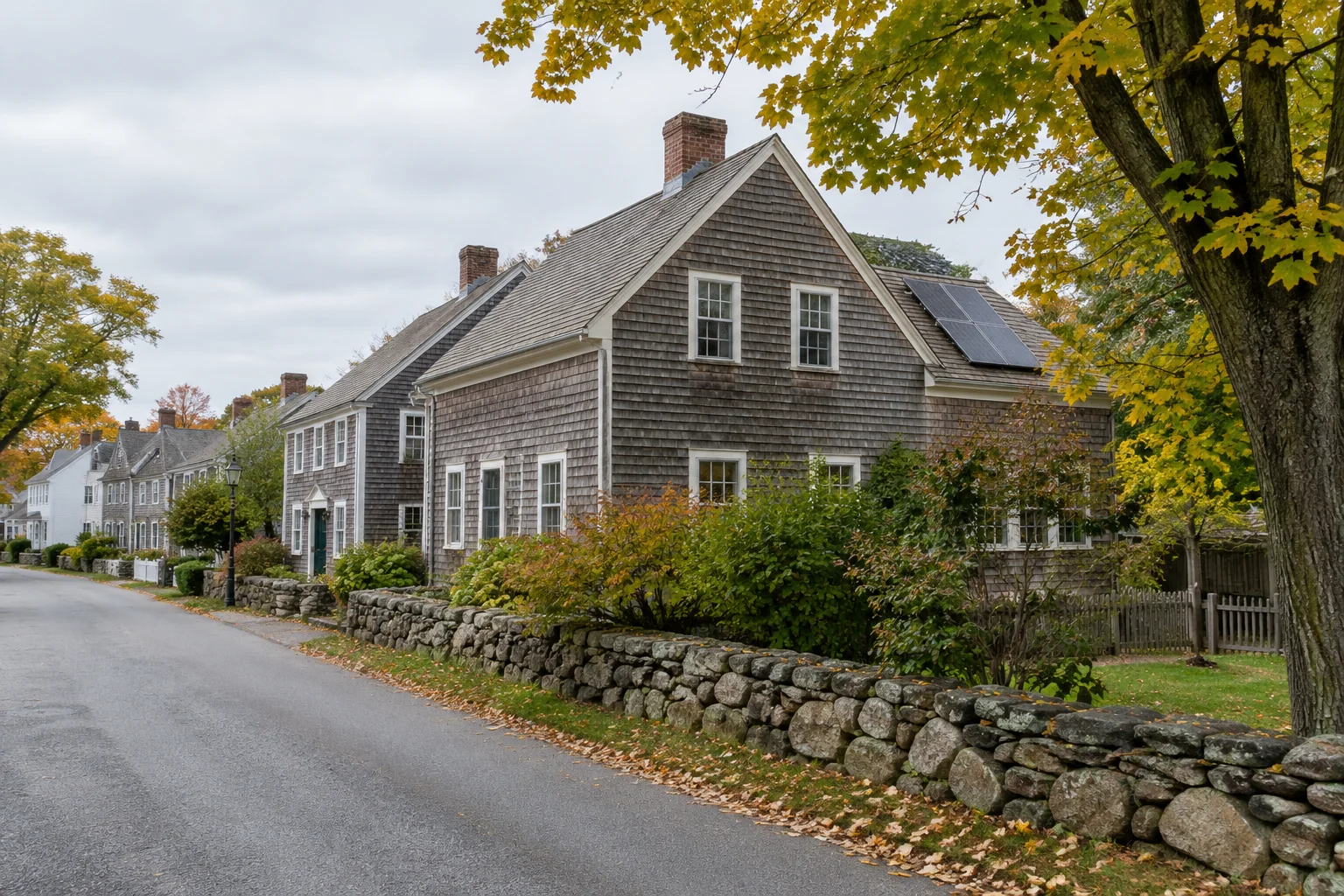
Rules vary a lot by town, and some give specific color guidance. On Cape Cod, the Old King's Highway Regional Historic District Commission publishes an exemption for flush-mounted, non-glossy, all-black rooftop arrays on single-family homes, and its criteria call for the array to be affixed to a dark shingled roof. That is an example of a district that has told homeowners exactly what blends.
Nantucket takes a design approach. Its solar guidelines say to keep PV and solar thermal collectors on the same plane, with panel color in keeping with the surrounding roofing materials. Outside New England, New York City's Landmarks Preservation Commission treats solar panels as "mechanical equipment" under its published rules, which shows how some preservation bodies classify them.
Your town may be stricter, looser or silent. Do not assume. Ask.
Questions to ask before you sign
- Who approves it? HOA architectural board, town historic commission, or both.
- Is the rule in writing? Get the current covenant or guideline document, not a verbal answer.
- What is regulated? Panel color, frame color, visibility from the street, roof plane, conduit and racking finish.
- What is the review timeline? A board that meets once a month can add weeks to your schedule.
- What does the application need? Usually a roof layout, a panel spec sheet and photos of the elevation.
- What happens on denial? Ask if you can revise and resubmit, and whether the board offers a pre-approved option.
HOAs commonly accept requirements such as hidden or painted conduit and panel frames or racking in a color that blends with the roof, because those rules do not meaningfully affect system performance. Rules that force panels onto a poor roof plane are harder to accept, because they cut production. That is where you may need to push back or ask for a variance.
Send your designer the written rule before the layout is drawn. We would rather redraw a plan once than submit three versions to a board. For a longer checklist on contracts and vetting, see our 15 questions to ask a solar installer before you sign.
Where Do Color Choices Limit Output or Raise Cost?
Color choices raise cost or lower output in three places: premium all-black or custom models can cost more per watt, restricted roof planes can reduce sun exposure, and fewer product choices can limit wattage. A plain dark panel on the best roof plane usually keeps both in check.
Panel model
The narrower the product line, the fewer wattage and price options you get. An all-black panel at the same wattage may cost more than a standard one, and a specialty colored panel can cost more again with lower output. Ask your installer to price three versions side by side: standard, all-black, and any special-order option you are considering.
Roof plane and roof area
This is where looks cost real money. If a rule or a preference puts the array on a rear slope that faces east or west instead of south, you give up some production. A panel with lower wattage also needs more roof area to reach the same system size. If the roof is small, that can cap the system.
How to judge the tradeoff
Compare the production estimate, not the panel color, across each layout. Ask your designer for the yearly kilowatt-hours of each option and the price of each. Then divide the extra cost by the production difference to see what the better look really costs you per year.
Our guide to remove and reinstall solar panels for a new roof is useful here too, because a roof change later is another moment to rethink layout and hardware color.
Decision Rules: Which Setup for Which Roof
These are the calls we would make, and the cases where we would make a different one.
- Dark shingle roof, no strict board: choose all-black panels, black frames, black rails and clipped wiring. This is what we recommend for most homes.
- Dark shingle roof, strict board: use the same setup, put the array on the least visible plane that still produces well, and attach the spec sheet to your application.
- Light, red or tile roof, no rules: go with all-black on a single clean block. Do not pay extra for a custom look unless you really want it.
- Historic home with a design review: start with the board's guidelines, ask for a pre-application meeting, and treat a custom-skinned panel as a last resort.
- Tight budget: a standard panel with black hardware and tidy wiring often looks better than people expect, and costs less than a full all-black upgrade.
One thing remains unsettled for us: how far skinned or tinted panels will come down in price and up in output. If that changes, the advice for historic roofs changes with it.
A hypothetical example
Suppose a homeowner in a Connecticut HOA has a charcoal shingle roof with a south-facing rear slope and a west-facing front slope. The HOA asks for no visible silver.
The best plan is all-black panels with black frames and rails, placed on the rear slope, with wiring tucked under the frame. If the rear slope cannot hold enough panels, add a small block on the front slope only after asking the board if it is allowed.
Frequently Asked Questions
Does panel color change how much power I get?
Slightly, but not as much as roof direction, tilt or shade. Dark all-black panels run warmer in summer, which can trim output a little. Compare the production estimate for your address across models rather than choosing by color alone, and check each panel's temperature coefficient on the spec sheet.
Do I need to match my roof color if I plan to replace the roof?
If a re-roof is coming, pick shingle color with the array in mind. A charcoal or black shingle blends best with all-black panels. Our guide to solar on an old roof explains the order of work, so you do not pay to move panels later.
Will my HOA let me install solar at all?
Many HOAs allow it, but they may set limits on placement, color and hardware. Rules vary by town and by association, so read your covenants and get the review process in writing. Ask your installer to prepare the layout and spec sheet in the format your board requires.
Is an all-black panel worth it on a light-colored roof?
Usually only if you prefer the cleaner look. On a light or red roof, black panels contrast with the roof either way, so the main gain is uniformity. If budget is tight, a standard panel with black racking and neat wiring is a fair compromise.
Next Step: Get a Layout You Can Show Your Board
If you want solar panels that match your roof color as closely as the roof and your local rules allow, start with a site visit and a layout that shows the panel model, frame color and racking finish. We are a local installer with in-house crews across Connecticut, Massachusetts and Rhode Island, so the people who design your array also install it.
Request a free quote and ask for an all-black option and a standard option priced side by side. You can also talk to a designer about your HOA or historic district rules, call 203-903-4091, or explore our services to see how panels, batteries and roofing fit together.
Recommended Resources
Written by
Dan Katzman
Teamsun
Teamsun writes practical solar guidance to help property owners compare equipment, project scope, costs, and long-term service before making a decision.
Keep going.
Can I Add Solar Panels Without Replacing My Whole Roof?
Can I add solar panels without replacing my whole roof? Learn what inspectors check — shingle age, decking, flashing — to avoid costly mistakes.
Dan Katzman
Teamsun
Can Solar Panels Be Installed During a New England Winter?
Solar panel installation during winter is possible in CT, MA and RI. See how crews handle snow and ice, and how a winter start affects your time to power-on.
Dan Katzman
Teamsun
Can Solar Panels Work With Your Home Generator?
Learn how a solar panel system with existing home generator setups can work together, what transfer switch changes are needed, and when a battery skips the generator.
Dan Katzman
Teamsun