Battery Backup vs Generator
Battery backup vs generator for Connecticut, Massachusetts and Rhode Island homes: cost factors, fuel vs recharging, noise, upkeep and when to run both.
Dan Katzman
Teamsun
In the battery backup vs generator decision for Connecticut, Massachusetts and Rhode Island homes, a battery fits short to medium outages, quiet operation and homes with solar, while a standby generator fits multi-day outages and whole-house loads. A portable generator is the cheapest stopgap. Many homeowners start with a battery and add a generator only if outages run long.
Key takeaways
- Battery first for most homes: It switches on silently when the grid drops, needs almost no upkeep and, with solar, saves money every day, not just during storms.
- Generator wins on duration: As long as you can keep it fueled, a standby generator can run the whole house through a multi-day outage.
- Winter limits solar recharging: Short days and snow-covered panels mean a battery may not refill fully in a long January outage. Plan for that gap.
- Only batteries have incentives: Programs for batteries exist in these states and change often. Generators have none, so check current program sites before you budget.
- Both together suit long or critical outages: Large loads, medical needs and rural homes on well pumps are the clearest cases for a battery plus generator.
Battery backup vs generator at a glance
| Factor | Home battery | Standby generator | Portable generator |
|---|---|---|---|
| Energy source | Stored electricity, recharged by solar or grid | Natural gas or propane, plumbed in | Gasoline or propane, refilled by hand |
| Start-up | Automatic, no gap you will notice | Automatic, a short delay while it starts | Manual: roll out, fuel, start, connect |
| Limit on run time | Stored energy plus solar recharge | Fuel supply | Fuel on hand and your patience |
| Typical coverage | Essential circuits, or more with extra units | Often the whole house | A few items or chosen circuits |
| Noise and fumes | Silent, no exhaust | Audible engine, outdoor exhaust | Loudest, outdoor use only |
| Upkeep | Minimal; monitor through an app | Scheduled service, exercise cycles | Fuel care, oil, start checks |
| Daily value | Yes, with solar or time-of-use rates | None until an outage | None until an outage |
| Incentives | State and utility programs have existed | None | None |
What is the real difference between a home battery and a generator?
A home battery stores electricity in advance and releases it silently the moment the grid drops. A generator makes electricity on demand by burning fuel, so it runs only as long as fuel lasts. Standby generators start automatically; portable ones need a person, a fuel can and extension cords or a transfer switch.
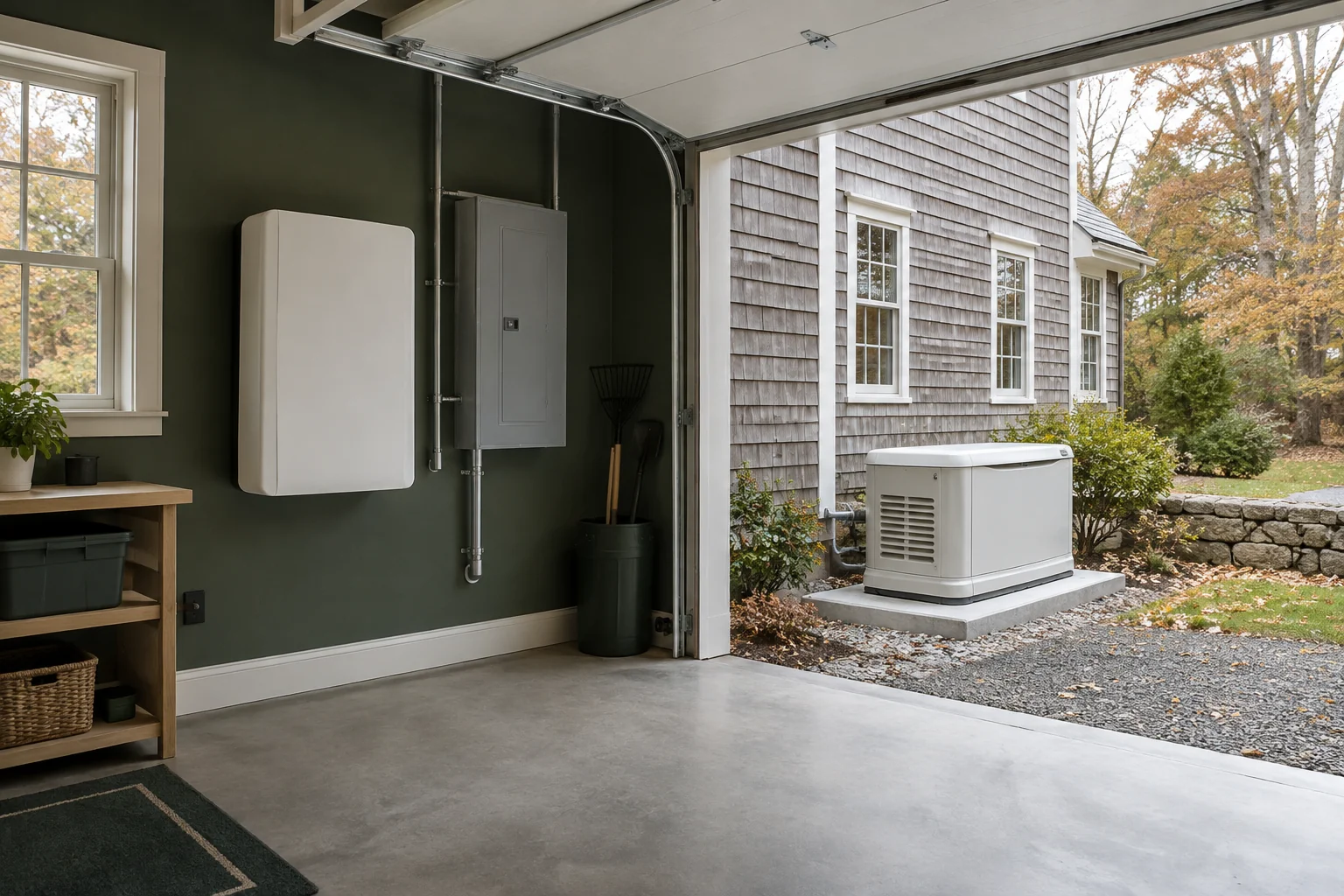
That one difference drives everything else in this guide. The Rhode Island Office of Energy Resources lists the main tradeoffs between a generator and a battery as fuel type, noise, cost and duration. A generator burns fossil fuel and emits greenhouse gases and particulates while it runs. A battery does neither.
Duration is where the generator pushes back. A battery is a fixed tank of energy. A generator is a faucet connected to whatever fuel you can find. Both facts matter in a region where the longest outages tend to follow nor'easters, ice storms and summer thunderstorm lines.
Where standby and portable generators differ
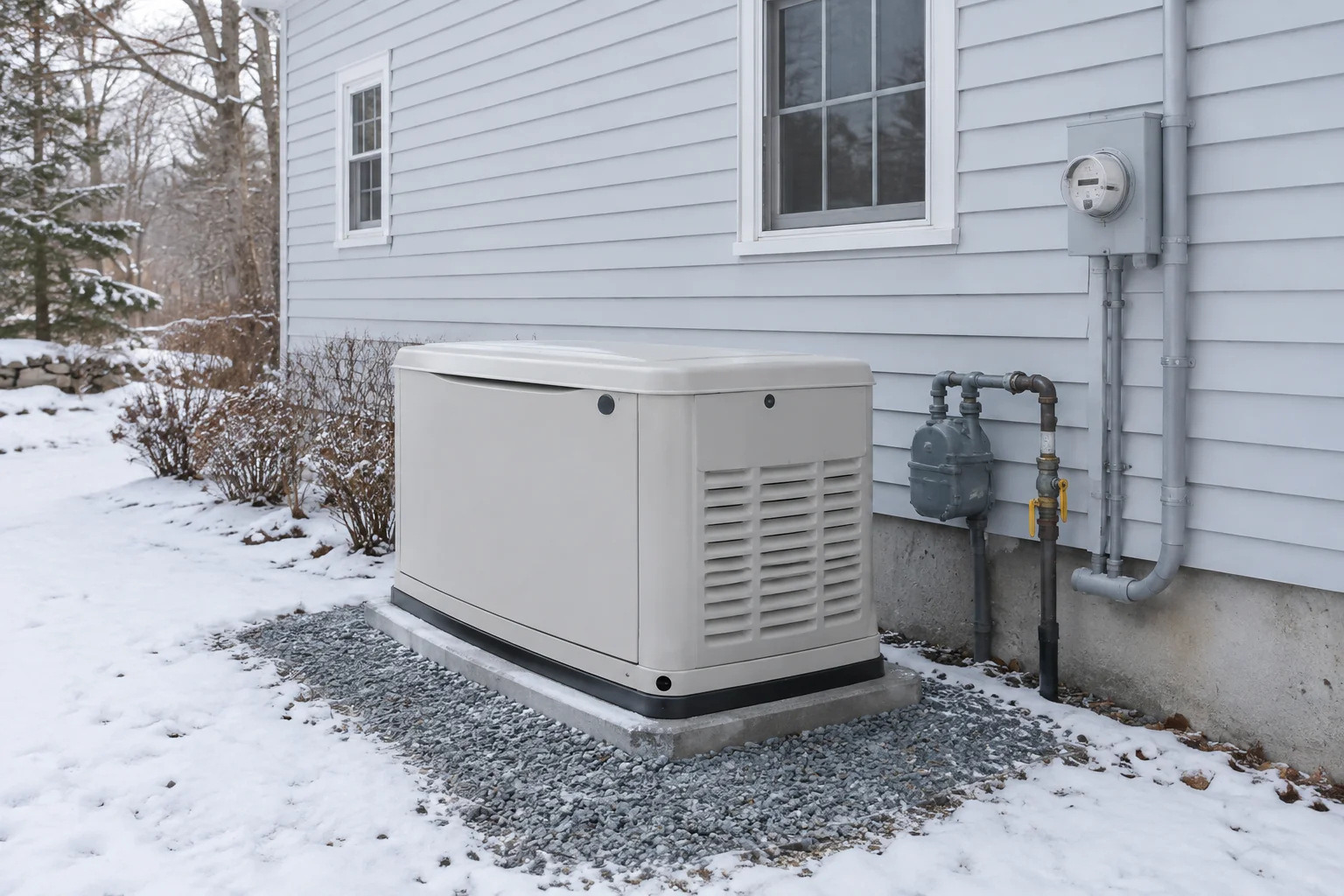
A standby generator is permanently installed outside, wired through an automatic transfer switch and fed by a natural gas line or a propane tank. It starts itself. A portable unit lives in a shed or garage and has to be set up outdoors, fueled and started by hand every time.
Portable units cost less and need no gas line, but they demand attention in the worst weather. Standby units cost more and need permits and professional installation. They also tie you to a fuel supply that can be disrupted during a regional event.
Battery backup vs generator side by side
The table above gives the quick view. The lists below show where each option earns its place and where it falls short for a typical New England home.
Home battery
- Strengths: instant, silent switchover; no fuel to buy or store; safe to place in a garage or basement per manufacturer rules; saves money daily when paired with solar.
- Weaknesses: finite stored energy; limited winter recharging; higher upfront cost for the same coverage; most single units back up chosen circuits, not every load.
Standby generator
- Strengths: can run the whole house for as long as fuel is available; large output for heavy loads; automatic start.
- Weaknesses: noise and exhaust; scheduled maintenance; fuel dependence; zero value on a normal day; no incentive programs.
Portable generator
- Strengths: lowest upfront cost; can be moved; useful as a backup to a battery.
- Weaknesses: manual setup in storm conditions; fuel storage and refilling; must run outdoors; covers only a few items unless wired to a transfer switch.
If you want to compare specific battery models, our guide to having both solar and a home backup generator covers how the two can coexist on one property.
How long can each one run during an outage?
A generator runs as long as you can keep it fueled, so its limit is your fuel supply. A battery runs until its stored energy is used, then needs recharging from solar or the grid. Run time for either depends on what you power, so calculate it from your own loads rather than trusting a headline number.
We are not going to give you a run-time figure here, because it would be wrong for your house. The method is simple. Take the battery's usable capacity in kilowatt-hours and divide it by the average kilowatts your backed-up loads draw. The answer is hours before the battery is empty, with no solar help.
Fuel refills versus solar recharging
Refueling a generator means gasoline, propane or natural gas. Natural gas comes through the pipe, which is convenient until a line or compressor fails. Propane and gasoline mean trips, storage limits and, in widespread storms, lines at stations that may also be without power.
Solar recharging is free and quiet, but weather-dependent. The Rhode Island Office of Energy Resources notes that pairing storage with solar lets you recharge your battery during extended outages, and that storage can also be installed without panels. Without solar, though, a battery cannot be refilled once the grid is gone.
The winter limit
New England winters are the hard case. Days are short, the sun sits low and snow can cover panels after a storm, which is exactly when the outage begins. On a clear day after a storm, solar can refill a good share of what the house used. On a gray multi-day stretch, it may not keep up.
That is why we tell homeowners the truth: a battery is excellent for the first night and the next morning, and good for several days with sun. Past that, a generator or a plan to shed heavy loads is the safeguard. Our ranking of battery storage options for New England winters goes deeper on how specific batteries perform in the cold.
What can each one power?
A standby generator can usually power the whole house if sized for it, while a battery typically backs up a chosen set of essential circuits unless several units are installed. A portable generator powers whatever you plug in or connect through a transfer switch, within its wattage. Sizing always starts with your loads.
The Building America Solution Center points out that homes increasingly depend on electricity for cooking, water heating and space conditioning, which makes a blackout more disruptive, especially in storms and extreme temperatures. In New England, heat is the load that matters most.
Make a load list before you shop
Walk through the house and write down what you must keep running. For each item, record its running watts and whether it has a large start-up surge. The nameplate or manual lists both.
- Heat: furnace or boiler controls and circulator pumps; a heat pump is a bigger draw.
- Water: a well pump, sump pump and water heater, if electric.
- Food and safety: refrigerator, freezer, lights, smoke detectors, garage door, internet router.
- Medical: oxygen concentrators, CPAP, refrigerated medication.
- Big extras: electric range, dryer, central air, EV charger.
The pass mark is simple. Every item on your must-run list should fit within the backup's continuous output, and the surge from the largest motor (a well pump or compressor) must fit within its surge rating. If a must-run item fails that check, you need more output, a second battery, a soft-start device or a generator.
An NREL preprint on generators and resilience notes that electrical systems must be designed for peak load, yet buildings rarely operate at more than 50% load. In plain terms, size for your peak, but expect average draw to be lower, which is what stretches a battery.
What does each option cost to buy and run?
Battery cost depends on capacity, how many units you need, whether solar is already installed, and electrical work. Generator cost depends on wattage, fuel type, transfer switch and gas line or tank work. Batteries usually cost more upfront, and only batteries have had incentive programs in these states. Ask for itemized quotes for either.
We do not quote market prices here because they move and vary by house. For battery numbers, see our breakdowns of how a solar battery retrofit works and what goes into the price.
Upfront cost factors
| Cost driver | Battery | Standby generator | Portable generator |
|---|---|---|---|
| Size | Usable kWh and continuous kW | Output in kW for the loads | Running and surge watts |
| Electrical work | Backup panel or gateway, possible panel work | Automatic transfer switch | Manual transfer switch or inlet, optional |
| Fuel infrastructure | None | Gas line or propane tank, pad | None; fuel cans |
| Approvals | Permit; utility approval if tied to solar | Electrical and fuel permits | Usually none unless wired in |
| Offsets | Possible incentive programs | None | None |
Running costs and the incentive question
A generator's running cost is fuel plus service. A battery's is close to zero, and with solar it can lower your utility bill by shifting solar power to evening hours. The NREL preprint above also describes the inspection and maintenance routines a generator owner must carry out, and those costs add up over years.
Incentives need care. The federal residential clean energy credit that covered home batteries ended for expenditures after December 31, 2025, so a homeowner who buys a battery today should not count on it. State and utility programs have been the live option, and their amounts and enrollment windows change.
Connecticut and Rhode Island have each run battery programs, and Massachusetts and other states have had utility programs that pay for battery performance during grid peaks. Some have closed to new enrollment at times. Check the current program site for your utility before you count on any dollar amount. We will help you confirm what applies, and our services page lists what we install.
Maintenance, noise and placement: what to expect
A generator needs routine attention; a battery mostly needs to be left alone. The tradeoffs are about who maintains the equipment, how loud it is, and where local rules let you put it.
Maintenance
A standby generator runs weekly exercise cycles and needs periodic oil, filter and spark plug service plus a battery check. A portable generator needs fresh fuel, oil checks and a test start before storm season, because stale gasoline is a common reason one will not start.
A home battery has no engine and no fuel. You check the monitoring app, keep the area around it clear and keep the software updated. Our solar maintenance checklist for New England homeowners covers what to check on the solar side.
Noise and exhaust
Generators are audible, and neighbors on tight New England lots notice. Exhaust is the serious issue: carbon monoxide from a generator running too close to a window, door or garage is a real hazard, so generators run outdoors with clear space around them. A battery is silent and has no exhaust.
Placement and local rules
Standby generators go on a pad outside, with setbacks from windows, property lines and the gas meter set by the manufacturer and local codes, which vary by town. Batteries are often installed in a garage, basement or on an exterior wall, following the maker's clearance and temperature guidance.
Expect permits for either. A battery tied to solar is part of a distributed generation system, and Massachusetts requires written approval from the local utility before such a system connects to the grid. Connecticut and Rhode Island utilities run similar processes. Your installer should handle those applications.
How does a battery work with solar every day, not just in outages?
A battery paired with solar stores midday production and uses it in the evening, so it works every day, not only during outages. It can also reduce what you draw from the grid at peak rates, depending on your utility's rate design. A generator sits idle until the grid fails.
This is the biggest difference in value. A generator is insurance you hope never to use. A battery is insurance that also does a job on ordinary days, which is why it can partly pay for itself over time. Net metering and rate rules shape how much, and the answer differs by utility.
Retrofitting onto solar you already own
You do not need new panels to get a battery. Teamsun installs FranklinWH, Tesla Powerwall and Enphase IQ batteries, including retrofits onto existing solar systems of any brand. The method depends on your inverter and on whether the battery is AC-coupled or DC-coupled.
If you are still choosing a model, our comparison of Tesla Powerwall vs FranklinWH is a good next read.
Already have a generator? The question is then whether solar and a generator can coexist. Our posts on whether solar panels work with your home generator cover the wiring and safety side, so we will not repeat it here.
When does a battery plus generator setup make sense?
A battery plus generator makes sense when outages can run several days, when you have large or medical loads, or when winter limits solar recharging. The battery covers the first hours silently and handles daily use, while the generator is a backup for long outages. For short outages, a battery alone is usually enough.

The pairing works because each covers the other's weakness. The battery removes the noise, the startup delay and the daily fuel fuss. The generator removes the worry about a gray, snowy week when solar cannot refill the battery.
Homes that benefit most
- Rural or wooded properties: long restoration times after ice storms and trees on lines, often with a well pump.
- Medical equipment households: the battery guarantees no gap, the generator guarantees duration.
- Electric heat or heat pump homes: heating loads can drain a battery fastest in cold weather.
- Homes with large electrical loads: central air, electric range or an EV charger that you want to run during an outage.
Homes that can skip the generator
If your outages usually last hours, your essential loads are modest and you have solar, a battery alone is the cleaner choice. You avoid fuel, noise and maintenance. If your outages are rare and short and you have no solar, a portable generator with a transfer switch may be all you need.
What is not settled is how often multi-day outages will hit your specific street. Utility restoration data varies by town and feeder, so ask neighbors and check your own history before you pay for duration you may rarely use.
A simple decision checklist
Work through these in order. Each one has a pass mark and a next step.
- Count your longest outage in the last five years. Under one day: battery alone is enough. Past two or three days: add a generator or plan for one.
- Build your load list. If every must-run item fits within the battery's output, choose a battery. If a well pump or compressor fails the surge check, add output or a generator.
- Check your solar. With solar, a battery recharges daily. Without it, a battery cannot extend an outage, so lean toward a generator or add solar.
- Check your fuel. Natural gas on site favors a standby generator. No gas line and no storage space favors a battery.
- Check your site. No safe outdoor spot for a generator or a tight lot with close neighbors points to a battery.
- Check incentives. Confirm current battery programs with your utility before comparing prices. If a program is closed, the battery's case rests on daily savings and resilience.
Our own rule of thumb: for most solar homes in Connecticut, Massachusetts and Rhode Island, start with the battery. Add a generator only if step 1 or step 2 says you need it. Homeowners with no solar and a tight budget can reasonably choose a portable generator and revisit later.
FAQ
Can a battery fully replace a generator?
For many homes, yes, if outages are short and the battery is sized for your essential loads. For long winter outages with little sun, a battery alone may run down, because recharging depends on solar output. Homes with big loads or medical needs often keep a generator as a second layer.
Do I need solar to install a home battery?
No. A battery can be installed as a standalone system without solar panels. The catch is recharging: without solar, the battery refills only from the grid, so it cannot extend an outage past its stored energy. Pairing it with solar adds daily savings and a way to recharge.
Can I add a battery to solar I already have?
Yes. Batteries can be retrofitted onto most existing solar systems, whatever company installed them. The right method depends on your inverter and whether the battery connects on the AC or DC side. Teamsun retrofits FranklinWH, Tesla Powerwall and Enphase IQ batteries onto existing systems of any brand.
Is a portable generator enough for a New England home?
It can be, for a few essentials like a refrigerator, lights and a furnace fan, if you accept manual setup and refueling. It must run outdoors, away from windows and doors, because of carbon monoxide risk. It is the lowest-commitment option, not the most convenient one.
Get the right backup plan for your house
The right answer in the battery backup vs generator choice depends on your outage history, your loads and whether you have solar. We will walk through all three with you and quote a battery, with or without a generator, with no pressure.
Request a free quote for a battery sized to your essential circuits, or talk to a designer about adding one to your existing solar. You can also call us at 203-903-4091. Our in-house crews install and service the equipment themselves, so the people who design your backup are the people who stand behind it.
Recommended Resources
Written by
Dan Katzman
Teamsun
Teamsun writes practical solar guidance to help property owners compare equipment, project scope, costs, and long-term service before making a decision.
Keep going.
Enphase vs Tesla Battery: IQ Battery or Powerwall for a New
Enphase vs Tesla battery for Connecticut, Massachusetts and Rhode Island homes: compare IQ Battery and Powerwall on backup, cold, warranty and solar fit.
Dan Katzman
Teamsun
Solar and Home Backup Generator: Can You Have Both?
Learn how a solar panel system with home generator setups coordinate safely, from transfer switches to automatic switchover, for CT, MA, and RI homes.
Dan Katzman
Teamsun
The Best Battery Storage Options for New England Winters
Compare FranklinWH, Tesla Powerwall 3, and Enphase IQ 5P on cold-weather performance for CT, MA, RI, VT, NH, and ME winters before storm season hits.
Dan Katzman
Teamsun